Event 1
Sven conquers the Kingdom of Berigold

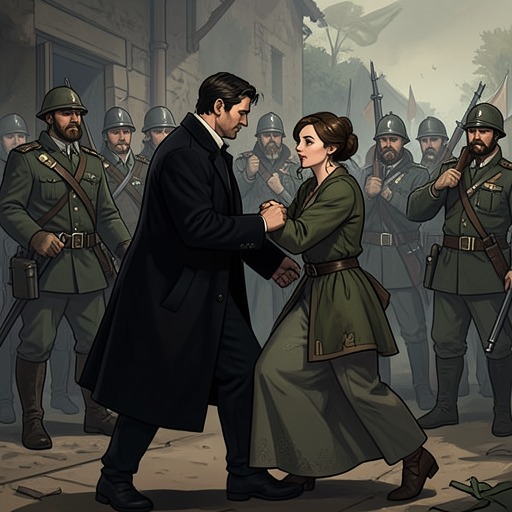
[Sven](entity:character-recall-character-sven-9b225feee4ee) conquers the [Kingdom of Berigord](entity:location-recall-location-kingdom-of-berigord-d9d78494b5e7) as part of a broader campaign to extend his rule across the surrounding lands. The conquest is not merely a change of royal authority. It creates a regime of expansion whose military ambitions threaten neighboring kingdoms and whose hostility toward the [Highlanders](entity:organization-recall-organization-a939b3bec2cb) transforms territorial war into an attempted campaign of eradication. The event therefore supplies the central pressure behind the Kigom king’s alliance with [Carden](entity:character-recall-character-carden-e413adf6f995)’s mercenary werewolf clan and sets the political conditions for [Zuzulla](entity:character-recall-character-zuzulla-cd65d20d6158)’s kidnapping.
## Causes and Political Background
Sven’s seizure of Berigord places the [Kingdom of Kigom](entity:location-recall-location-kingdom-of-kigom-2bb41aa98797) next in the path of his ambitions. Kigom’s king recognizes that his own army cannot defeat Sven’s forces, yet he refuses to accept conquest and searches for an indirect means of stopping the advance. The decisive vulnerability is Sven’s daughter, Zuzulla, whom he values deeply; removing her, the Kigom king reasons, could redirect Sven’s attention from conquest toward a search for his missing child.
The conflict is sharpened by Sven’s treatment of the Highlanders. He regards them as filthy animals and wants them eliminated from his lands, cities, and future population. He is especially determined to prevent them from breeding with his people, making the conquest inseparable from a politics of species, lineage, and exclusion. The Highlanders, meanwhile, have no desire to become part of Sven’s kingdom because they understand that his rule threatens their continued existence rather than merely their independence.
## Military Escalation
Sven’s army attacks a small village known to be frequented by the Highlanders, burning its shacks and taking whatever remains. The assault is both territorial violence and deliberate signaling: Sven wants the Highlanders to know that he has located places connected with them and intends to pursue them. His best warriors are already planning how to kill every Highlander, and he treats their destruction as necessary to completing his conquest of the countryside.
The village matters strategically and socially. The Highlanders sell the fur and meat from their kills there, using the proceeds to equip the clan with the best weapons. More than a supply point, it is one of the few settlements where the clan feels accepted by ordinary people. Burning it therefore attacks the Highlanders’ livelihood, military capacity, and fragile relationship with the local population at the same time.
Carden returns to the edge of the woods after meeting with the Kigom king and crawls toward the bushes to determine whether any soldiers remain. He sees smoke rising from cottages that have been burned to the ground and realizes that he should have been present to defend the town. His absence becomes a personal failure within the larger military crisis, intensifying his desire to strike back at Sven.
## Resistance and Retaliation
The Kigom king commissions Carden and his clan to take Zuzulla, and the Highlanders accept because they are experienced mercenaries willing to do whatever is required to complete the mission. Their assignment is calculated as asymmetric resistance: Kigom cannot win a direct battle, but the Highlanders can exploit the emotional importance of Sven’s daughter and force the conqueror to divide his attention.
The kidnapping also exposes the limits of Sven’s power. He can burn villages and deploy superior armies, but his campaign produces new enemies and gives the threatened Highlanders a reason to cooperate with neighboring rulers. The possibility that the Highlanders could lead the people in revolt alarms Sven because their combined forces might defeat his army. His conquest thus generates the resistance that could ultimately prevent the larger empire he seeks.
## Consequences and Narrative Significance
Sven’s conquest functions as the initiating political catastrophe of the Highlander storyline. It explains why Carden is moving through the smoke of a destroyed village, why the Kigom king resorts to covert action, and why Zuzulla becomes the pressure point in a war between kingdoms and supernatural clans. The later conflict is not an isolated romance or abduction detached from history; it grows out of an imperial campaign that treats land, communities, and bloodlines as resources to be controlled.
The event also establishes a recurring contrast between systems of domination and relationships that cross their boundaries. Across the wider narrative, pure lineage, royal succession, human and supernatural identities, and reproductive control repeatedly determine who is considered valuable or expendable. Sven’s conquest gives that pattern its clearest military form: he seeks a unified realm by destroying the people who stand outside his preferred order, while the threatened Highlanders answer through alliance, mobility, and retaliation. His territorial victory therefore opens the story’s central question of whether conquest can ever secure lasting control when it continually creates the enemies capable of undoing it.
Event 2
Highland werewolves' village-burning raid
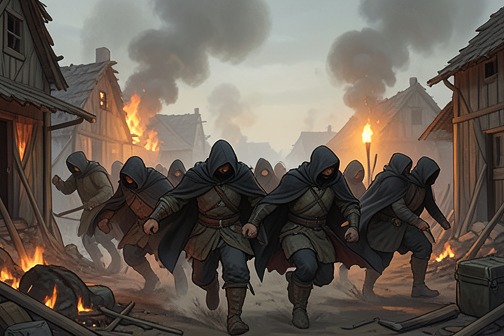
[Highland werewolves' village-burning raid](entity:event-recall-event-9736a89214bf) is a deliberate act of conquest and intimidation in which [Sven](entity:character-recall-character-sven-9b225feee4ee)'s army burns a village associated with the [Highlanders](entity:organization-recall-organization-a939b3bec2cb), destroys its homes and livelihood, and terrorizes its people. The attack transforms an already violent struggle over territory into a personal and strategic confrontation between Sven and [Carden](entity:character-recall-character-carden-e413adf6f995)'s clan: Sven uses devastation to announce that he knows where the Highlanders operate, while Carden returns to smoke, loss, and the knowledge that his absence left the village exposed.
## Causes and Strategic Background
Sven had sent his army into the village not merely to seize another piece of land but to send a message to the Highlanders. The settlement was one of the places the clan regularly visited, and Sven wanted them to understand that his forces had identified their network and intended to pursue them. His larger objective was rule over the surrounding lands; the Highlanders were the remaining obstacle because Sven believed they could provoke a revolt among the people and lead a force capable of defeating his own army.
The raid also belongs to the wider contest between Sven's expanding power and the [Kingdom of Kigom](entity:location-recall-location-kingdom-of-kigom-2bb41aa98797). After Sven the Conqueror took over the [Kingdom of Berigord](entity:location-recall-location-kingdom-of-berigord-d9d78494b5e7) and continued pressing into Kigom, Kigom's king recognized that his own army could not defeat Sven's. He therefore relied on Carden's werewolf clan as mercenaries, expecting them to kidnap Sven's daughter, [Zuzulla](entity:character-recall-character-zuzulla-cd65d20d6158), and thereby divert Sven from conquest toward rescuing her. The village-burning raid is consequently both a military reprisal and part of Sven's effort to eliminate the Highlanders before they can become the instrument of organized resistance.
## The Village and the Attack
The village is poor, but it has unusual importance for the Highlanders. Its inhabitants buy the fur from the clan's kills and the meat that enables the clan to equip itself with the best weapons. The settlement is therefore an economic base as well as a place of refuge and exchange. The Highlanders have grown fond of its people because it is one of the few communities where the clan feels accepted, giving the raid a human and social significance beyond the destruction of buildings.
When Carden approaches the settlement, he crawls through the woods and studies the edge of the village before revealing himself. Smoke from the previous night still hangs in the air, and most of the small cottages have been burned to the ground. He peers through the bushes to make certain that Sven's soldiers have gone, treating the ruins as a potentially continuing battlefield rather than as a scene of completed violence.
Carden and several members of the clan had been returning to camp when they saw the smoke. They reached the village within minutes in werewolf form, whose speed is described as far beyond that of any human runner, and shifted back into human form only after confirming that no soldiers remained. The rapid return cannot undo the delay that made the attack possible: Carden had gone to meet with the king and had not been present to protect the settlement.
## Human Cost and Opposing Codes
The raid places the village's women and children in particular danger. Several Highlanders have women they care about among the villagers, and Carden understands that their chances of survival are slight. Sven's soldiers kill the men or absorb those strong enough into their army, while women who refuse the soldiers' demands may be killed. The elderly are also killed because the army sees no value in keeping them alive. Survival is thus made conditional on allegiance to Sven, turning military occupation into a system of coercion that reaches every household.
The violence establishes a sharp contrast between Sven's army and Carden's clan. Carden regards Sven's soldiers as brutal men blinded by power who take pleasure in killing those who resist. Carden's own clan also needs human hearts to survive, but its members do not take pleasure in killing and attempt to feed only on the worst criminals. The distinction does not erase the clan's predatory nature, yet it gives Carden a moral boundary: he would rather die than kill another human, and he takes some comfort in not killing the innocent. The burned village makes that boundary politically meaningful, because Sven's forces treat innocence as irrelevant while Carden's clan understands the difference between necessity and cruelty.
## Carden's Response and Consequences
Carden's first response is marked by guilt as much as anger. Looking over the ruined ground, he knows that he should have been there the previous night and should not have left the town without protection. He had not imagined that Sven understood how important the village was to the Highlanders. That realization changes the raid from a general act of war into evidence that Sven can strike at the clan's social and material foundations.
The destruction intensifies Carden's desire to pursue Sven. Sven's message is meant to frighten and isolate the Highlanders, but it also clarifies the stakes: the clan must defend the people who sustain and accept it, while Sven must destroy that relationship if he is to conquer the countryside. The village becomes a pressure point linking commerce, loyalty, civilian survival, and military power.
## Narrative Significance
The raid functions as a decisive value shift from uneasy resistance to open personal vendetta. Before the attack, the Highlanders remain a strategic obstacle in Sven's campaign; afterward, the smoke, the ruined cottages, and the endangered women and children make the conflict immediate for Carden and the clan. The event also complicates the supernatural war by refusing to make the werewolves the sole source of danger. Carden's clan possesses frightening physical power and can move through the woods at extraordinary speed, but the human army's organized violence is presented as more indiscriminate and more deliberately cruel.
The village-burning raid therefore establishes the moral and political grammar of the Highlander conflict. Sven seeks obedience through terror, conquest, and the destruction of communities that might shelter resistance. Carden's clan, despite its own need to kill in order to live, defines itself against the deliberate slaughter of innocents. In the aftermath, the burned village stands as both a wound and a summons: proof of what Sven's rule does to the vulnerable, and the immediate reason Carden can no longer treat the struggle as a distant contract.
Event 3
Zuzulla is kidnapped by Carden
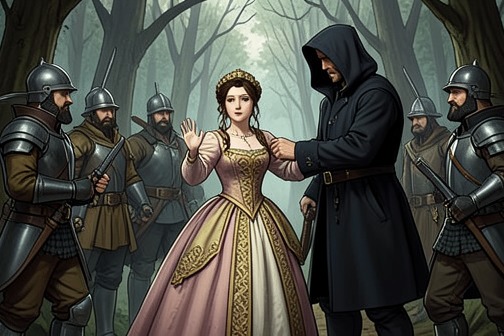
[Zuzulla is kidnapped by Carden](entity:event-recall-event-zuzulla-carden-3252d3282a06) in a forest outside her father [Sven](entity:character-recall-character-sven-9b225feee4ee)’s immediate control, an event that converts the princess’s familiar wandering ground into a site of abduction, pursuit, and political leverage. [Carden](entity:character-recall-character-carden-e413adf6f995) does not seize her because of a personal grievance against her; he uses her captivity to pressure Sven, whose violence and hostility toward the [Highlanders](entity:organization-recall-organization-a939b3bec2cb) have made the kingdom dangerous for both ruler and subject.
## Causes and Background
[Zuzulla](entity:character-recall-character-zuzulla-cd65d20d6158) enters the woods under guard but has long treated the forest as a place where she can escape the restrictions imposed by court and by her father. She knows Sven has a temper, has heard servants speak of his destruction of an entire village, and has witnessed him sentence people to death. Although she refuses to believe every accusation against him, she imagines that becoming queen will allow her to bring peace to the land. Her compassion extends even to the guards who frustrate her, since she does not want them condemned to death for failing to control her.
The guards’ supervision is less vigilant in the forest than it appears. Two remain near the edge while two follow Zuzulla farther in, and all know that Sven would kill them if his daughter failed to return. At the same time, they have watched her wander these woods for years and do not expect this particular excursion to end differently. Their familiarity with her routine creates the opening Carden has been waiting for: he has observed Zuzulla on previous days and understands that he has only about an hour before her absence is likely to be noticed.
## The Abduction
As Zuzulla goes deeper into the forest, she hears branches breaking behind her and is surprised that the guards have followed so far. When she turns, Carden places a hand over her mouth and an arm around her waist. His strength overwhelms her; unable to scream or fight him off, she becomes weak and loses consciousness. The scene reverses the apparent meaning of her excursion. What began as a young princess’s act of defiance becomes a carefully timed operation in which her knowledge of the woods is turned against her.
Carden has prepared a horse on the far side of the forest and immediately carries Zuzulla toward it. Her dress impedes his movement, so he tears away the excess fabric, leaving the ruined material in the dirt. The discarded dress is not merely a practical inconvenience: Carden deliberately leaves it behind because he knows Sven will panic when he finds evidence that his daughter has been taken. The torn garment therefore serves as both trace and message, extending the kidnapping into psychological warfare against the king.
## Flight Across the River
After roughly thirty minutes, Carden reaches the horse and places the unconscious Zuzulla facing him, her legs around his waist and her head against his chest. He recognizes that she is not responsible for Sven’s evil, yet he believes there is no other way to force her father to stop. His stated bargain with the king of Kigom requires him to deliver Zuzulla alive, so even when the river crossing becomes dangerous, he refuses to let her die.
The escape is also complicated by Carden’s awareness of Zuzulla as a woman and as an enemy. While riding, he notices her body moving against him and briefly considers taking advantage of her vulnerability, but he restrains himself because she is the captive central to his mission and he must keep his attention on the operation. The moment exposes the unstable boundary between political violence, sexual threat, and calculated self-control that surrounds her captivity.
At the river, Carden abandons the horse and carries Zuzulla into the rushing water. He places her on his stomach and swims backward, considering whether to let the current carry her away because the guards would never find her. He does not do so. The crossing takes longer than expected, and Zuzulla begins to stir while he is still in midstream, but Carden gathers his strength and reaches the opposite bank before she fully awakens.
## Consequences and Aftermath
The river marks a decisive territorial threshold. Carden believes that once Zuzulla is across it, Sven’s army can search but will fail to recover her. The escape therefore separates the princess from her father’s kingdom not only physically but strategically: pursuit is transformed from an immediate rescue into a problem of crossing borders and locating a fugitive captive.
Carden is too exhausted to rest for long. He knows Sven will soon learn that his daughter is missing, if he has not already, and hurries toward the caves where he and Zuzulla will spend the night before continuing farther the next morning. He has traveled only about half a mile when she becomes fully awake and begins pounding on his back, demanding to be released. Looking around, Zuzulla realizes that there are no guards, that she does not know the surrounding country, and that she is outside her father’s kingdom. Her fear comes not only from the assault itself but from the sudden collapse of every familiar means of return.
The kidnapping consequently begins a larger conflict rather than resolving one. Zuzulla’s position as Sven’s daughter makes her a political instrument, while her own belief that she could someday rule peacefully places her moral hopes in direct contrast with the violent methods used by the men around her. Carden’s decision to spare her life and deliver her to the caves preserves the possibility of future negotiation, but the event has already made her captivity the price of confronting Sven’s rule and the bridge between rival territories.
Event 4
Mary is detained by Thomas
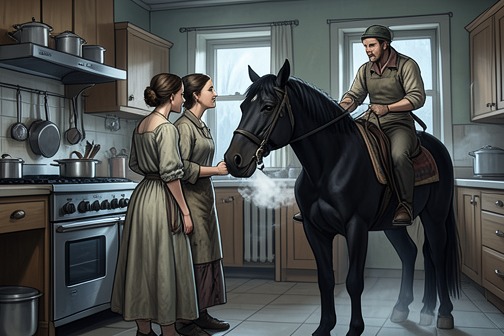
[Mary is detained by Thomas](entity:event-recall-event-mary-thomas-5ef639aaa928) after an encounter in an apple grove changes her position from a married woman moving freely on familiar land to a captive whose future is being decided by men. What begins as an accusation of trespassing and theft becomes a decisive rupture in [Mary](entity:character-recall-character-mary-ea333e3cde9f)’s marriage and freedom: [Thomas](entity:character-recall-character-thomas-96b965fcdef2) removes her from the household, while [George](entity:character-recall-character-george-4ccc9776b2d0)’s rejection leaves her without the protection or belonging she expected to return to.
## The Apple Grove Confrontation
Mary spends time in the countryside with the cook, the household member she likes best and sees most often. Their quiet rest beside the grass is interrupted by hoof beats that gradually become impossible to ignore. When the sound stops, Mary opens her eyes to the underside of a black horse’s jaw. The horse and its unseen rider transform the familiar landscape into a sudden threat, and both women scramble away in fear.
Mary assumes that no soldier belonging to her husband would approach her in such a manner, so her fear is mixed with indignation. She demands to know who the rider thinks he is, but the stranger identifies himself as Thomas and says that he works for [Robert](entity:character-recall-character-robert-dcc9e88f1178). He claims that Mary and the cook are trespassing, immediately placing the encounter within a dispute over boundaries and ownership rather than treating the women’s presence as harmless.
Mary tries to explain that she and the cook were only tasting apples. She believes the trees belong to George, and she offers to leave, but Thomas distinguishes between Mary’s assumption and Robert’s claim. He releases the cook while ordering Mary to come with him, insisting that trespassing—and especially theft—will not be taken lightly. The apple in Mary’s hand becomes the concrete object through which the conflict is enforced: an ordinary piece of fruit is recast as evidence that she has crossed a legal and social boundary.
## Removal from Her Household
Mary protests that she cannot accompany Thomas because she must be home when George returns. Thomas answers that the cook will explain what has happened, removing Mary’s last immediate reason for believing that she can simply walk away. The cook is allowed to leave, but Mary is separated from the only companion present who might have shared her account of the encounter.
Thomas then physically takes control of the situation. His large hands and conspicuous strength allow him to lift Mary by the waist and place her on the horse. She does not struggle because she fears startling the animal and being thrown to the ground. Thomas mounts in front of her, and the arrangement leaves Mary riding behind him, dependent on his body, his horse, and his direction for movement.
The journey is not presented as a voluntary escort. Thomas tells Mary that she will stay with him while the matter is sorted out and says that it would not be seemly for her to remain at the main house. His language gives the detention a veneer of propriety, but the practical result is confinement away from her home. Mary’s freedom is therefore displaced by a mixture of physical force, property authority, and social judgment.
The ride also introduces an uneasy bodily tension into the abduction. Mary is repeatedly thrown against Thomas as the horse moves, while he notices the contact and struggles to concentrate on controlling the animal. The scene thus combines danger, enforced proximity, and sexual awareness without changing the central fact that Mary has not chosen to leave with him.
## George’s Rejection
The detention acquires its deepest emotional force when Thomas reveals what George has decided. In an intimate exchange, Thomas tells Mary that George does not want her back and has said that they may do as they please with her because he will not surrender his land for a “useless barren woman.” The statement converts Mary’s detention from a temporary property dispute into the consequence of her husband’s abandonment.
George’s words reduce Mary to her fertility and make land more valuable than the marriage she expected to preserve. The revelation explains why Thomas can tell her that she will remain with him: Mary has been denied the marital home, while the men around her treat her fate as something that can be transferred or settled. Her hot tear registers the delayed recognition that returning to George is no longer a real possibility.
Thomas’s question, “Mary, can I keep you?”, follows the revelation with disturbing precision. It sounds like a request for affection, but within the circumstances of the detention it also exposes the possessive structure governing her life. Mary is not merely being asked to begin a new relationship; she is being treated as a person whose residence, protection, and sexual future can be claimed after another man has discarded her.
## Consequences and Narrative Significance
The event marks a sharp value reversal. Before Thomas arrives, Mary possesses domestic belonging, physical mobility, and the confidence to assert that the apple trees are hers and George’s. After Thomas intervenes, she has been removed from the household, separated from the cook, physically carried onto a horse, and told that her husband has renounced her. Property language supplies the official reason for the detention, but the later disclosure reveals that marriage, inheritance, fertility, and female autonomy are all entangled in the same act.
Thomas’s detention also establishes the emotional and structural basis for Mary’s later separation from George and her new household with Thomas. The immediate encounter is coercive and frightening, yet the later revelation gives it the shape of a forced transition: George’s contempt closes one home to Mary while Thomas offers to retain her in another. The scene therefore carries both the threat of captivity and the possibility of an attachment formed under radically unequal conditions.
As a narrative turning point, Mary’s detention joins an external conflict over Robert’s apple trees to an internal crisis of identity. The accusation of theft is literal within the scene, but the larger irony is that Mary herself becomes the object everyone else claims to own or dispose of. Her removal from the main house makes the consequences of George’s decision visible, while Thomas’s final question leaves the reader facing the unresolved tension between shelter and possession, desire and consent, and romantic rescue and continued captivity.
Event 5
Mary leaves George and starts a family with Thomas

[Mary leaves George and starts a family with Thomas](entity:event-recall-event-mary-george-thomas-961b766ab0b8) after [George](entity:character-recall-character-george-4ccc9776b2d0)’s rejection reduces her marriage to a question of property and usefulness. The decisive turn comes when George declares that he will not surrender his land for a “useless barren woman” and says that [Mary](entity:character-recall-character-mary-ea333e3cde9f) may be treated as others see fit. [Thomas](entity:character-recall-character-thomas-96b965fcdef2) responds not by debating her value but by asking whether he may keep her; Mary, with nowhere else to go, accepts the refuge he offers. Their union transforms her from an unwanted wife into a protected partner and, soon, an expectant mother.
## Causes and Background
Mary’s departure is caused by George’s contempt and his refusal to take responsibility for her future. His language defines her through infertility and land ownership, making marriage an economic arrangement in which her place depends on producing an heir. Once he rejects her, she is left vulnerable and effectively dispossessed. The emotional violence of that dismissal is captured by the tear sliding down her cheek, while the bluntness of Thomas’s question exposes the immediate practical stakes: Mary needs somewhere to belong.
## The Decision to Stay with Thomas
Thomas’s appeal is direct and concrete. He asks Mary whether he can keep her, and she answers that she has nowhere else to go. The exchange is therefore both a rescue and a negotiation shaped by desperation. Their first night together, with their limbs still tangled as they fall asleep, marks the bodily and emotional crossing from temporary shelter into partnership. The scene’s value shift is stark: Mary moves from rejection and insecurity toward intimacy, even though the decision begins under conditions created by George’s abandonment.
## Building a New Domestic Life
Mary adjusts easily to Thomas’s simpler household. Housekeeping no longer feels burdensome when life is less elaborate, and she discovers genuine pleasure in cooking. Her new routine includes occasional meetings with her friend the cook in the apple grove for a snack, and Thomas does not restrict her movements. That permission contrasts with the possessive and humiliating structure she has escaped. The cook notices Mary’s changed appearance, calling her radiant and remarking on how insufferable George has become in her absence; domestic life is presented not merely as labor but as a setting in which Mary’s vitality becomes visible.
The new household also becomes a family before George is prepared to acknowledge it. After several months of happiness, Mary becomes pregnant. Her pregnancy answers the accusation that had been used to discard her, but the narrative frames it less as a vindication of George’s standards than as evidence that Mary’s life with Thomas has given her security, affection, and room to flourish. Thomas’s care is not limited to shelter: he offers her the conditions in which she can feel wanted.
## Confrontation with George
Mary and Thomas encounter George in town while buying supplies, several months after leaving him. George emerges from the pub staggering, startled to find Mary alive, partnered, and visibly pregnant. His reaction changes from casual dismissal to shocked recognition when he sees her rounded belly, carrying the child of her new relationship. He also tells Thomas to give his regards to [Robert](entity:character-recall-character-robert-dcc9e88f1178) and to keep his pond, while attempting to dismiss Mary once more as “this blasted woman.” His drunken confusion cannot restore the authority he previously exercised.
Thomas answers the encounter by wrapping an arm around Mary’s shoulders and assuring George that she is taken care of. The gesture establishes a new public order around her: she is no longer standing alone before the man who rejected her. Mary leans into Thomas’s chest and gently caresses her swollen belly, answering George without pleading or retaliation. Her smile and physical closeness make the consequence of her departure unmistakable. George withheld affection, respect, and a future; Thomas has given her all three.
## Consequences and Significance
The event resolves Mary’s movement from marital abandonment to chosen domestic belonging. Her pregnancy makes the change irreversible and gives the ending a generational dimension: the relationship with Thomas is not a brief refuge but the foundation of a family. The contrast between George’s property-based judgment and Thomas’s protective care organizes the episode’s moral logic, while Mary’s comfortable new routine supplies its quieter proof of recovery.
The ending also reverses the power of George’s accusation. He called Mary barren and useless, but when he sees her again she is radiant, pregnant, and openly cherished. The narrative does not return her to the household that rejected her; instead, it lets her answer through the life she has built. Mary’s departure is consequently both a separation from George and a redefinition of what marriage and family can mean when care, freedom of movement, and mutual attachment replace ownership and contempt.
Event 6
Marie is rescued by Slate
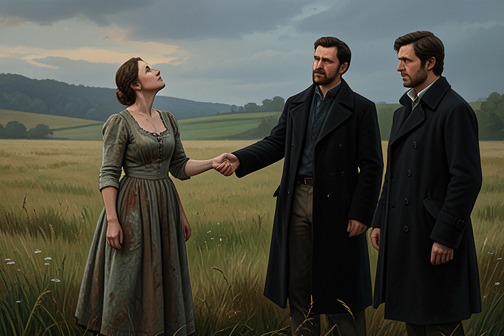
[Marie is rescued by Slate](entity:event-recall-event-marie-slate-7dee77e2f841) at the moment when her abusive domestic life becomes impossible to ignore. Returning home early, she finds [Chris](entity:character-recall-character-chris-6b96eaa1894c) being beaten by an enormous man over money, yet the scene offers no real safety: Chris has already struck Marie, and she expects her own pain to follow. [Slate](entity:character-recall-character-slate-10e989565222)’s intervention changes the direction of her life by giving her an immediate route out, then helping ensure that Chris understands the relationship is over. Months later, Marie is living with Slate, preparing a new apartment, and looking back on Chris as a distant nightmare rather than an active threat.
## Causes and Background
Marie’s escape begins with the accumulated violence of her life with Chris. Before leaving for work, she receives another blow across the cheek for what Chris considers tardiness, insolence, or some other offense. She worries that the reddened skin will become a bruise, then works through the morning and misses her usual lunch break in the park. Because she has a dentist appointment, she leaves work early, buys beer on the way home, and reaches the house roughly two hours before Chris expects her.
The early arrival creates the opening for the rescue. Marie pauses outside to study the motorcycle parked there and considers leaving until her normal return time. Irritation over the lost lunch break finally overcomes her caution, and she enters her own home carefully. Inside, she sees an enormous, leather-clad man looming over Chris in the easy chair while demanding payment. The stranger strikes Chris across the jaw, leaving him slumped and moaning with a swollen eye. Chris still directs his anger toward Marie, asking, “What are you doing home, you lazy bitch? Are you skipping out on work again?” The scene makes clear that Chris’s humiliation and violence remain directed at her even after he has been physically overpowered.
## What Happens
Slate notices injuries that Marie tries to conceal. When he asks whether she is all right, she insists that she is fine, but he rejects the answer after seeing the bruise around her eye and the cut on her lip. He points toward the house and asks, “He do that?” Marie avoids his eyes and refuses to answer, but her silence confirms what she cannot or will not say aloud. Slate understands the situation without requiring her to provide a complete account of it, telling her, “I’ll take that as a yes, Marie.”
The decisive offer is practical rather than ceremonial. Slate asks, “You want to get out of here for a little while?” When Marie stammers and asks where he would take her, he explains that she does not seem eager to return inside and offers to invent a story that will get her away from the house temporarily. He does not pretend that she already knows him or that following him is risk-free. Marie studies the contrast between her conservative black suit and sensible heels, the house containing Chris and a case of beer, and Slate’s scruffy, sun-hardened face. His ice-blue eyes are not harsh, however, and his slight smile gives the offer a measure of gentleness.
Marie recognizes the danger of trusting a motorcycle rider she does not know, but the sounds from inside—the beer opening and Chris shouting at the television—make remaining with Chris more threatening than leaving with Slate. She answers with a deliberately brave “Let’s go,” and puts on a helmet before climbing onto the motorcycle. The helmet and the ride mark a physical departure from the house, while her uncertainty shows that rescue does not erase fear in a single instant.
## Consequences and Aftermath
The rescue becomes more than a brief ride away from an unpleasant home. Slate’s friends ensure that Chris understands the relationship has ended, and Chris’s hospital stay lasts long enough for him to grasp that Marie is no longer available to him. The aftermath therefore combines Slate’s personal protection with a wider deterrent: Chris is not merely left behind; he is made to recognize that his access to Marie has been cut off.
Several months later, Marie wakes beside Slate and smiles at his sleeping face. She is preparing to leave for a storage unit so that she can meet the moving van and make her new apartment habitable, a concrete sign that escape has become independence rather than temporary flight. The marks on her skin recall intimacy with Slate rather than punishment by Chris, and the bodily memory of pain has been placed within a relationship she experiences as pleasurable and chosen. Chris survives as a “distant nightmare,” while Marie’s daily life is organized around a home of her own and a future with Slate.
## Relationship and Transformation
Slate’s role in the rescue is complicated by the fact that he first appears as a stranger whose appearance could invite distrust. He is associated with a motorcycle, leather clothing, a shaved scalp, and multiple tattoos, all of which contrast with Marie’s earlier assumptions about respectability. Yet the narrative later reveals that beneath this intimidating exterior he is the same sweet soul she had known as Howard. Marie’s relationship with him therefore involves both rescue and recognition: she is not simply carried from danger by an unknown hero, but comes to understand that the rough exterior conceals a continuity of character.
The new relationship also changes Marie’s judgment of appearances and of her own possibilities. Her first decision to follow Slate is marked by fear, caution, and feigned bravery; her later life contains sexual intimacy, a new apartment, and emotional trust. The movement from a bruised cheek and a cut lip to chosen closeness does not make the original abuse insignificant. Instead, the contrast gives the rescue its central value shift: Marie moves from a household in which her body is controlled through fear to a relationship in which the body becomes part of mutual desire and renewed agency.
## Narrative Significance
Marie’s rescue follows the classic rescue-and-escape pattern, but its force comes from the small physical details surrounding the decision. The motorcycle outside the house, the rear-view mirror in which she checks the damage to her face, the unopened possibility of leaving, and the beer and television noise inside all turn an ordinary early return from work into a threshold scene. Marie’s silence when Slate identifies Chris as the source of her injuries functions as testimony without exposition; her refusal to name the violence is answered by Slate’s willingness to act on what he can see.
The event also establishes a recurring tension in the book between trauma and rapid romantic restoration. Marie’s danger is immediate and bodily, while her recovery unfolds through protection, separation, housing, and intimacy. The later image of her moving into a new apartment gives the rescue a durable consequence, but the narrative does not present freedom as existing only in Slate’s presence. Slate opens the way out, his friends reinforce the boundary against Chris, and Marie takes the practical steps that make a separate life possible. Her departure is therefore both an act of rescue and the beginning of self-directed change.
Event 7
Abigail becomes the Wright ranch bride
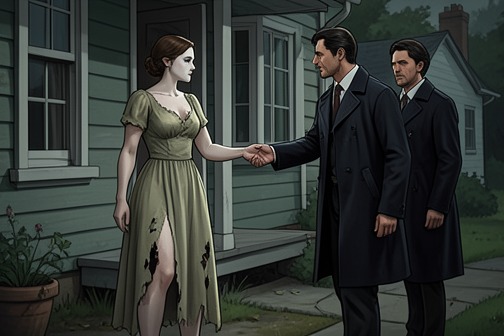
[Abigail becomes the Wright ranch bride](entity:event-recall-event-abigail-wright-c5fafc531f59) in an event that begins as a calculated escape from grief and social ruin but ends as a freely embraced commitment to [Clayton Wright](entity:character-recall-character-clayton-wright-ecfa62dda51d) and the life represented by his ranch. What first appears to be a marriage of convenience is transformed when [Abigail](entity:character-recall-character-abigail-d72687631c24) discovers that the place she intended to leave behind has become the setting of her recovery, and that the man connected to it has become the partner she genuinely wants.
## Causes and Background
Abigail’s decision grows out of catastrophic loss. Two years before the marriage, a storm capsized her family’s yacht. She survived, but her older brother and mother were found dead, while her father and younger sister were taken by the sea. The accident left her with grief that her friend [Sally](entity:character-recall-character-sally-995cd04e2cf1) understood but could not simply solve. Abigail therefore sought what she called a clean break: she had sold her house, placed a few of her grandfather’s antiques in storage, and arranged for Sally to keep her clothes, handbags, and photo albums.
The original plan treated marriage as a financial instrument. Sally summarized it as Abigail marrying a rich American so that he could inherit his family fortune, then divorcing him and returning to [London](entity:location-recall-location-1bfd335cdd1b) with money to establish her own business. Abigail’s departure was scheduled for the next morning, while the wedding was set for two weeks later. Even then, she resisted calling the farewell permanent, insisting that the meal was an “until I get back” occasion rather than a final goodbye. Her language reveals the event’s initial value structure: marriage promises transportation, money, and distance from painful memories, while London represents the life she needs to escape.
## The Turning Point at the Ranch
The decisive change occurs after Abigail has spent enough time at the Wright ranch for the setting to become more than a temporary refuge. She tells Clayton that she thinks she has changed her mind, a remark that immediately alarms him because he assumes she may be withdrawing from the wedding. She quickly reassures him that they are still getting married, but clarifies that her uncertainty concerns returning to London. She has fallen in love with the ranch and no longer knows whether she wants to leave it.
Abigail then joins the place and the man in a single emotional image. She tells Clayton that he is the ranch to her: she feels him in every tree, bush, and grain of sand. The statement changes the proposed marriage from an external bargain into an attachment rooted in daily surroundings and shared belonging. The ranch is no longer merely the destination of a transaction; it has become the landscape in which Abigail can imagine a life after bereavement.
## Clayton’s Proposal and Abigail’s Choice
Clayton responds by turning the uncertain arrangement into an explicit personal commitment. He retrieves a simple, beautiful diamond ring from the nightstand, kneels before Abigail, and asks her to marry him “For real and forever?” The proposal is significant because it asks her to choose the marriage beyond whatever financial or logistical purpose brought her to the ranch. His gesture supplies the event’s romantic reversal: the prospective bride who once expected to return to London is invited to remain, not as a temporary participant in an inheritance plan but as Clayton’s permanent wife.
Abigail accepts by slipping the ring onto her finger. It is too large, but its imperfect fit does not matter to her. She calls herself “Mrs. Clayton Wright” and links the name to finally finding “Mr. Right.” The oversized ring preserves a trace of haste and incompleteness, yet her indifference to its practical flaw emphasizes the emotional certainty of the decision. She is not accepting a perfectly prepared contract; she is accepting the person and home she has come to value.
## Consequences and Narrative Significance
The event completes Abigail’s movement from flight to belonging. Her family’s deaths had made London inseparable from painful reminders, and her initial strategy was to convert marriage into an exit route funded by another man’s wealth. At the ranch, however, the expected sequence is reversed: instead of marrying, divorcing, and returning to build an independent business, she begins to imagine permanence with Clayton. The promised clean break remains, but its destination changes from London and financial self-reliance to the Wright ranch and a chosen marriage.
Within the wider book, Abigail’s story belongs to a recurring pattern in which marriage is introduced through economic pressure, immigration, inheritance, work, or survival and then tested by emotional attachment. Other narratives treat mail-order or contractual marriage as a response to an expired work visa, a family inheritance stipulation, an open-marriage negotiation, a surrogacy payment, or the need to leave a damaged home. Abigail’s case is distinctive because the initial bargain is not simply accepted or rejected: it is overtaken by a new understanding of home. The event therefore dramatizes a shift from marriage as an exchange of resources to marriage as an enduring bond, while retaining the social and economic conditions that made the arrangement possible in the first place.
The final image is deliberately modest rather than ceremonially grand. Abigail wears a ring that is too big, smiles at the name she has chosen, and accepts the possibility of remaining where she once expected only to stay briefly. Her transformation does not erase the storm, the bodies, or the years of grief. Instead, it gives those losses a new aftermath: survival becomes the ability to choose a future, and the Wright ranch becomes the place where that choice can take lasting form.
Event 8
Sky acquires an MMA gym

[Sky acquires an MMA gym](entity:event-recall-event-sky-mma-8f6badb2ad05) at the decisive turning point in her attempt to rebuild her life and claim authority in a field that initially treats women as intruders. The purchase is not merely a business transaction: it converts unemployment, limited capital, and outsider status into a public enterprise whose success will depend on Sky’s willingness to train, compete, renovate, and prove that her vision can survive beyond the room in which it is announced.
## Causes and Background
Sky’s decision begins after she loses her job selling cars and finds herself drifting without a clear future. Watching Rhonda Rousey fight convinces her that mixed martial arts may offer room for a new female contender, but her ambition extends beyond personal competition. She wants women and men to train together and enter the arena as competitors, challenging the assumption that MMA belongs primarily to men.
Her friend [Owen](entity:character-recall-character-owen-63fed795a993) warns that the sport is dangerous, that gym members may refuse to respect a female owner, and that investing her life savings could leave her without a viable future. Sky nevertheless secures a small bank loan and accepts that it will not cover everything. Her response to uncertainty is characteristic: she treats risk as the price of beginning rather than as a reason to retreat. The proposed acquisition therefore carries a double stake. It could establish her as a promoter and owner, or it could deepen the failure she already feels after losing her job and struggling to make a mark on the East Coast.
## The Acquisition and Its Conditions
Sky approaches the aging gym’s owner after identifying a facility that appears to be falling apart but is, on inspection, in need mostly of cosmetic repairs and minor renovations. She refuses to buy it blindly, arranging a complete inspection from top to bottom before finalizing the deal. This practical scrutiny distinguishes the acquisition from a reckless impulse: her dream is accompanied by a concrete assessment of the property and an effort to understand what her limited finances can actually sustain.
The old owner is reluctant to leave, but the money gives him a path toward retirement. He also knows that the existing membership may resist the change. He has already told the members that the new owner will be a woman, and they scoff at the idea. His personal endorsement of Sky helps soften that resistance, though it does not remove the burden of proof. The gym’s former culture had allowed male members to work out privately without worrying that women were watching them or expecting them to perform, so Sky’s arrival threatens not only ownership but the social arrangement that made the space feel exclusively theirs.
Sky enters the premises in blue jeans and a denim shirt tied at the waist, visibly taking possession of the place and of the identity attached to it. The purchase makes her the owner of her own MMA enterprise, even though the building still requires work and the membership remains uncertain. Her physical presentation and business declaration operate together: she is not waiting for permission to belong, but she also understands that symbolic confidence must eventually be supported by training and results.
## Vision for the Gym and the Fight World
Sky promises the former owner that, in six months, he will not recognize what the gym has become. She imagines it as [Boston](entity:location-recall-location-boston-aded649f4602)’s MMA hotspot, a venue that will be televised and become a destination for everyone interested in the sport. The scale of this promise exceeds the modest condition of the building and the smallness of her initial loan, creating the event’s central tension between material limits and expansive ambition.
Her plan places women at the center of the enterprise. Sky intends to make the female fighter the gym’s defining figure, but she does not pretend that she is already ready to embody that role in the ring. She has entered an amateur fight scheduled for a later pay-per-view event, hoping first to make a strong showing before advancing toward larger opportunities. The acquisition thus joins two careers that must develop together: Sky must become a credible fighter while making the gym credible as a commercial and cultural institution.
Sky knows that her height and appearance may lead others to underestimate her. At five feet three inches, she does not possess what she regards as the conventional stature of a fighter, yet she describes an inner fire powerful enough to face almost anyone. She has experience fighting defensively and aggressively, but wants formal training that will allow her to defeat opponents without causing unnecessary injury. In her understanding, MMA is more primal than boxing, demanding the development of instinct as well as technique; owning the gym gives her a place in which those instincts can be disciplined rather than merely displayed.
## Obstacles, Allies, and Economic Pressure
Owen functions as both skeptic and facilitator. He questions whether Sky should gamble her savings and whether anyone will take her seriously, but he also supplies access to the city’s informal network. By arranging a face-to-face opportunity with Brandon at a particular restaurant and time, Owen offers Sky a possible source of additional financial support without removing her responsibility to make the proposition herself. His influence operates through favors exchanged for favors, a precarious form of social capital that contrasts with Sky’s more direct investment of labor, money, and bodily risk.
The acquisition also belongs to a wider pattern in which intimate and economic arrangements become explicit bargains. Elsewhere, [Abigail](entity:character-recall-character-abigail-d72687631c24) describes a plan to marry a wealthy American, divorce him, and use the money to start a business; William considers a mail-order bride as a way to satisfy an inheritance stipulation; [Jenna](entity:character-recall-character-jenna-65f88e27192a) weighs opening her marriage against divorce; Dennis offers Kember payment, medical expenses, employment, and continued contact in exchange for surrogacy; and Tomas seeks a wife through a personally controlled selection process rather than a dating service. Against that background, Sky’s gym purchase is comparatively self-directed. She seeks capital and institutional legitimacy, but the enterprise is designed to increase her independence rather than make her body or marital status the commodity securing another person’s fortune.
## Consequences and Narrative Significance
The immediate consequence is a transfer of power: Sky moves from unemployed uncertainty to ownership of a physical site in Boston. The gym becomes the material platform from which she can train, promote MMA, recruit women, and attempt to alter the membership’s expectations. Yet ownership does not guarantee acceptance. The old members’ contempt, the building’s cosmetic decay, the insufficiency of the first loan, and the danger of competition all remain active threats.
The former owner’s warning about Icarus frames Sky’s ambition as both admirable and hazardous. She is reaching toward a larger public future while still standing inside a modest, damaged facility and preparing for an amateur debut. That contrast gives the acquisition its narrative force. Sky does not receive recognition before acting; she purchases the place in which recognition might be earned, then commits herself to becoming the centerpiece she has promised the gym will produce. In that sense, the event is a value shift from drift to agency: financial security is endangered, but purpose, visibility, and the possibility of professional transformation are gained.
Event 9
Sky wins her first MMA fight

[Sky wins her first MMA fight](entity:event-recall-event-sky-mma-75421f23e90b) in a scene where apparent inexperience is overturned by disciplined technique, private commitment, and public astonishment. Facing the feared Crusher as a novice with no record to speak of, Sky converts a seemingly impossible debut into a decisive victory that changes her reputation, her business, and the direction of her life.
## Identity and Stakes
Sky enters the bout as an unlikely challenger. Her opponent regards her as a joke, and the Crusher’s reputation makes the mismatch visible before the contest begins. Sky’s lack of an established record leaves her with little conventional authority in the ring, so the fight tests more than physical ability: it tests whether the knowledge she has acquired can survive contact with an experienced and unforgiving opponent.
The circumstances are also shaped by Sky’s private relationship with Brandon. He is in her corner, taping her wrist, and his presence links the public contest to an intimate turning point. Before the fight, he tells her, “I know that this is sudden, but I can’t help the way that you affect me. I want you to know that you’re very special and that I don’t want to lose you.” He then presents a diamond engagement ring discreetly, keeping the declaration away from the crowd while Sky asks that their happiness remain private until the publicity surrounding the gym settles.
## Course of the Fight
Brandon has shown Sky one move and hopes she will have an opportunity to use it quickly. The opportunity comes almost at once, but not in an orderly demonstration of training. The Crusher attacks and catches Sky in a rear chokehold, placing one hand over Sky’s forehead and a forearm beneath her throat to cut off her oxygen. Sky must respond while under immediate physical pressure rather than wait for an ideal opening.
She first slams the Crusher repeatedly against the chain enclosure to break the hold. Then she reaches up with both hands, bends sharply at the waist, and flips the Crusher over her body. The maneuver breaks their contact and puts Sky on the ground, where she moves into a triangle hold. The sequence turns Brandon’s brief instruction into practical knowledge, but its effect depends on Sky’s speed, composure, and ability to improvise under attack.
The Crusher does not expect that level of expertise from a fighter with no meaningful record. She struggles against the hold, but Sky increases the pressure until the Crusher taps out and the referee is forced to stop the match. The fight ends within five minutes. Sky’s victory is therefore not a narrow survival or a disputed decision; it is a rapid submission that overturns the assumptions attached to her novice status.
## Immediate Consequences
Brandon is astonished by how quickly Sky applies what he taught her. While Sky is in his arms after the match, the Crusher approaches in a gesture of sportsmanship, shakes Sky’s hand, and tells her that she has a future. Recognition comes from both sides of the contest: Brandon acknowledges the technical achievement, while the defeated opponent confirms that Sky’s performance signifies more than a lucky result.
The win brings Sky notoriety, and that notoriety attracts people who want to associate themselves with the growing force around the gym. The victory consequently expands beyond the ring. It gives Sky public credibility and helps turn the gym into a rising enterprise whose visibility can draw new interest and investment.
## Partnership and Reversal
The fight also completes a change in the balance between Sky and Brandon. He had been callous and accustomed to pursuing new conquests, but Sky interprets his engagement proposal as evidence that he now wants her and is willing to demonstrate love and affection. Their relationship becomes a partnership in both emotional and practical terms, even though Brandon formally retains only five percent after the business develops. Sky nevertheless regards them as true partners.
The victory’s celebration is complicated by a consequence already anticipated in the surrounding scenes. Sky knows that she is going to have a child, and she later confirms that she is pregnant. Brandon then forbids her from returning to the ring until after the birth of their son. The fight thus functions as both culmination and interruption: it proves Sky can compete at a high level, while pregnancy imposes a new boundary on the career the victory has just launched.
## Narrative Significance
Sky’s first MMA fight is a value reversal built from expectation and result. The expected outcome is humiliation for an untested novice facing the Crusher; the actual outcome is technical mastery, public recognition, and a future in the sport. The scene makes knowledge meaningful only when it is enacted under pressure, and it makes reputation unstable by showing that a fighter’s status can change in less than five minutes.
The event also joins three kinds of transformation. Sky changes from an apparently unqualified challenger into a recognized prospect; Brandon changes from a detached conqueror into a committed partner; and the gym changes from a private or developing venture into a force capable of attracting public attention. The pregnancy prevents the victory from becoming a simple beginning-of-career triumph, giving the scene a double consequence: Sky gains authority in the ring and immediately enters a period in which motherhood limits her access to it.
In that tension, the fight becomes the defining proof of Sky’s emerging identity. She does not receive legitimacy because Brandon supports her, although his instruction and encouragement matter; she earns it by escaping the choke, reversing the Crusher, and forcing the submission herself. The ring supplies the public evidence of her ability, while the engagement and pregnancy place that ability inside a rapidly changing personal and domestic future.
Event 10
Georgina's affair with Kerrigan

[Georgina's affair with Kerrigan](entity:event-recall-event-georgina-kerrigan-a10f45e44d24) is a turning-point event in which immediate refuge becomes forbidden intimacy, and forbidden intimacy becomes a possible family. After [Georgina](entity:character-recall-character-georgina-5239be700684) describes how Nicholas frightened and physically controlled her without striking her, [Kerrigan](entity:character-recall-character-kerrigan-177211e1682c) offers safety rather than sexual pressure. Her decision to kiss him nevertheless makes the relationship an act of desire as well as an escape from danger, and the pregnancy that follows transforms a single transgression into a permanent challenge to her marriage and future.
## Causes and Background
Georgina arrives at Kerrigan's door carrying the effects of Nicholas's abuse. She recounts that Nicholas twisted her wrist and demanded that she repeat “Honey please,” leaving her frightened despite the absence of a conventional beating. Her account establishes the affair's emotional circumstances: Kerrigan is not simply an alternative lover, but the first man in the immediate crisis to treat her vulnerability as something requiring patience and protection.
Kerrigan explicitly tells Georgina that nothing has to happen and that he wants to help a woman in need rather than pursue sex. The distinction matters because Georgina, not Kerrigan, initiates the first kiss. She places her hands on his head and kisses him, responding to the gentleness she encounters in him: his patience, his attention to the kiss itself, and his refusal to reach immediately for her body. The scene therefore presents desire as emerging through contrast. Nicholas has made intimacy frightening and coercive, while Kerrigan's restraint makes Georgina feel able to choose.
## What Happens
The kiss does not remain tentative. Georgina and Kerrigan acknowledge that both want more, and they move backward together toward the bed while continuing to kiss and look at one another. Georgina touches his bare chest and muscular body, and the narrative emphasizes the physical intensity of their attraction. Their affair is thus not portrayed solely as a rescue or consolation; Georgina experiences an active sexual desire that she and Kerrigan decide to pursue at a crossroads in her marriage.
The encounter ends with Kerrigan withdrawing before ejaculation but still ejaculating over Georgina's abdomen and pubic hair. The concrete aftermath of the act soon becomes its larger consequence: Georgina realizes that she is pregnant. When she wonders what should be done, Kerrigan does not evade responsibility. He tells her not to be afraid, promises to help her do whatever she believes is right, and admits that he helped create the situation.
## Consequences and Aftermath
The pregnancy makes Georgina's marriage impossible to treat as a private emotional problem. Kerrigan asks whether she is leaving Nicholas, and Georgina answers that she thinks it is time. Kerrigan acknowledges the pain of saying so as Nicholas's friend, but he also recognizes that the relationship has become destructive. Georgina's departure is therefore both a personal decision and the direct consequence of the affair exposing what her marriage had already become.
Kerrigan initially frames his position in terms of Georgina's freedom. He recognizes that they barely know one another and that they have accidentally brought a child into the world, so he does not claim an automatic right to control her future. Yet when Georgina's separation from Nicholas becomes explicit, Kerrigan offers to have the baby with her and says that he would be honored to do so. His response changes the affair from an isolated betrayal into a proposal of shared parenthood.
Kerrigan's offer also marks an unexpected change in his own identity. He says that he had never imagined himself raising a child or becoming a family man, but the pregnancy thrusts him into the “survival mode” through which he wins fights. He connects his new desire for family with an earlier lesson from his sensei about finding passion wherever it waits. In Georgina, he claims to have found that passion; the affair gives direction to a life he describes as previously aimless.
## Narrative Significance
The event belongs to the story's recurring pattern of relationships formed under pressure from violence, obligation, pregnancy, or social arrangements. Elsewhere, marriage and reproduction are imposed by inheritance clauses, alien systems, or unequal power: [Amy](entity:character-recall-character-amy-b0c9984bdc2f) learns that Sloan's will requires pregnancy within six months of marriage; William discovers that he must marry and produce an heir to control his family estate; [Maggie](entity:character-recall-character-maggie-39724c72a859) learns that the [Watchers](entity:character-recall-character-watchers-156c2f4cc152) use selected humans as slaves or breeding subjects; and Dawn confronts the possibility that a child's custody would belong to a powerful nonhuman father. Georgina's situation differs because Kerrigan offers support rather than a formal reproductive command, but her pregnancy still reveals how quickly a woman's body can become the ground on which competing futures are negotiated.
The affair also stands in sharp contrast to the book's scenes of overt and systemic violence. Aleah's first strike from Jerome turns domestic contempt into repeated abuse; [Valerie](entity:character-recall-character-valerie-879cd9992233) explains that a vampire transformed her before their wedding to save her from a fatal brain tumor, leaving gratitude and indebtedness entangled with mate obligations; and [Opal](entity:character-recall-character-opal-b515ca0df54f)'s flight from enslavement begins with a night hiding in a tree while pursuers and dogs search the woods. Against these circumstances, Kerrigan's promise to help Georgina retain a choice offers a language of care. At the same time, the speed with which fear, sex, pregnancy, and romantic redemption follow one another leaves the trauma only partly processed: the affair provides an exit and a future, but not a sustained reckoning with the injury that made escape urgent.
The event's emotional logic is therefore double. Georgina's kiss is an assertion of desire after coercion, yet it also binds her to consequences she did not plan. Kerrigan's tenderness becomes meaningful because it is enacted in the space Nicholas's violence has opened, but his declaration of love and family arrives before the damage of the previous marriage has fully settled. The affair's decisive significance lies in that tension: it is simultaneously a breach of marriage, an act of self-recovery, an accidental conception, and the beginning of a new claim to belonging.
Event 11
Avery's red-dragon transformation
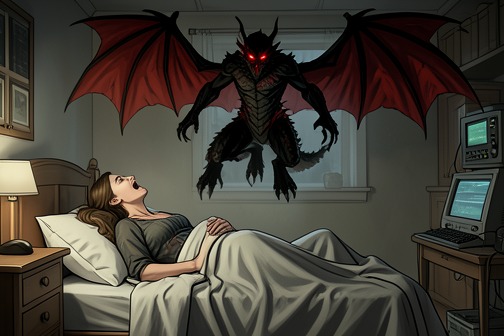
[Avery's red-dragon transformation](entity:event-recall-event-avery-f43b1934e56f) turns a frightening rescue into an encounter with an unknown supernatural identity. First perceived as a creature descending through the trees, [Avery](entity:character-recall-character-avery-3f30ea9cdcd5) later erupts into a red dragon during an intimate scene, forcing the narrator to recognize that the nightmare's red wings, screech, and red eyes were not products of imagination. The transformation also exposes the bite-shaped curse associated with the death of Avery's wife and changes the story's central question from what attacked the narrator to what Avery has become.
## Causes and Forewarnings
The transformation is preceded by an image that the narrator initially understands as a nightmare. While climbing, the narrator sees strange red wings approaching through the sunlight, hears their flapping, and is overwhelmed by panic. The creature's face remains obscured, but its red eyes appear to look through her, while its screeching, animalistic howl overtakes her own scream. She wakes sweating beneath sheets that cling to her, with the memory still vivid enough to make the supernatural threat feel physically present.
The apparent dream gains a material explanation when Avery rescues her after a fall. He explains that she had fallen no more than five feet, but that the impact against jagged rocks knocked her unconscious; he then carried her on his shoulders up the mountain. His open shirt reveals a red dragon tattoo on the upper side of his left shoulder, together with scars apparently connected to his past in the armed forces. The narrator realizes that the tattoo resembles the creature from the nightmare and that her mind may have turned an actual sign into a monstrous vision, although the later transformation proves that the image was more than symbolic.
## The Transformation Scene
The decisive change occurs after the narrator and Avery become intimate. A sudden burst of force lifts the table and throws it against the far wall. When the narrator looks up, Avery has been replaced by a red dragon with outstretched wings and scaly hide. The sight produces a split recognition: she knows the creature is Avery, but cannot reconcile the human man before her with the dragon occupying his place. The transformation therefore functions as both physical metamorphosis and an identity crisis witnessed at close range.
The dragon's behavior confirms the danger of the change. It strikes the narrator with one imposing wing and sends her flying onto the sofa, reproducing the screech heard in the earlier dream. The chair beneath its bulky frame breaks into kindling, and the narrator considers escape but cannot flee because of her injured ankle. Her helplessness turns the room into a confinement space: the supernatural revelation is not observed safely from a distance but endured by someone who is physically unable to leave.
The creature eventually calms, folding back upon itself like a cocoon. Its wings retract, and the narrator watches the reverse transformation until Avery is sitting before her again. The return to human form does not restore normality. Avery appears unaware of what he has been, even asking why the intimate activity stopped and claiming that he can continue all night. His confusion creates a disturbing gap between the dragon's violence and the man's apparent ignorance, making the transformation involuntary or at least inaccessible to his conscious memory.
## Recognition of the Curse
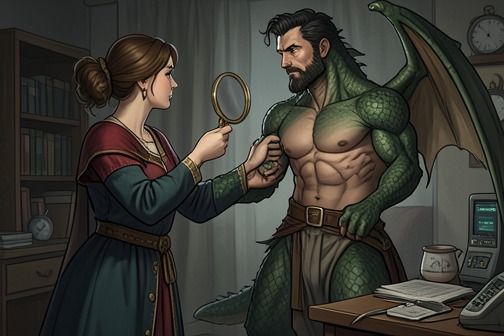
The narrator responds to the uncertainty as an investigator rather than simply fleeing. She retrieves a magnifying glass from a dresser and examines Avery's shoulder, finding two puncture wounds within the dragon tattoo. The marks provide the first concrete mechanism for the metamorphosis: the dragon form is connected to a bite, not merely to a permanent emblem or hallucination.
She then asks whether Avery has experienced blackouts, awakened in places he does not remember reaching, or found blood or tissue on his fingernails or the taste of copper in his mouth after disturbing dreams. His startled reaction suggests that these symptoms match experiences he has already endured. The narrator tells him that the bite is responsible and identifies the condition as that of a dragon shifter. What began as terror at an unseen creature becomes a revelation about a hidden bodily state, while the magnifying glass converts a mysterious tattoo into evidence.
The curse is further associated with Avery's murdered wife. The narrator concludes that whoever killed his wife left him with a curse as well as the memory of discovering her dead. This links the transformation to grief, violence, and unresolved injury: Avery is not merely a monster appearing without history, but a man whose past has been inscribed on his body and expressed through a form he does not understand.
## Consequences and Significance
The event collapses the boundary between dream and waking life. The red-winged figure from the narrator's nightmare is retrospectively identified with Avery's dragon form, and the screech heard in sleep is repeated in the room. The earlier sequence of obscured face, red eyes, descent, and panic thus operates as forewarning rather than false perception. The story moves from hesitation between psychological explanation and supernatural explanation to a definite supernatural account: Avery has been transformed by a bite into a dragon shifter.
The transformation also reverses the meaning of rescue. Avery's medical knowledge and physical strength initially present him as the injured narrator's protector; he describes himself as someone who had served as a medic and knew how to treat wounds under fire. Yet the same man becomes the immediate source of danger, demolishing furniture and throwing her across the room. Protection and threat occupy the same body, and the narrator must hold a fire poker against her chest while waiting for the dragon to settle.
For Avery, the event begins a forced recognition of a self divided between human consciousness and monstrous embodiment. He sees the bite only after the narrator directs his attention to it and appears not to know what he has done in dragon form. For the narrator, witnessing the change supplies the knowledge needed to confront the curse and its symptoms, but it does not eliminate fear. The red-dragon transformation is therefore both a revelation and a new confinement: it explains the nightmare while making the nightmare part of ordinary reality.
Event 12
April controls Avery's dragon form
[April controls Avery's dragon form](entity:event-recall-event-april-avery-2f9d8c0d79d7) in a desperate experiment that converts intimacy into both a source of danger and a means of restraint. The event reveals that [Avery](entity:character-recall-character-avery-3f30ea9cdcd5)'s transformation is bodily, stimulus-dependent, and potentially violent, but not wholly beyond control: by observing its triggers and keeping him mentally focused, [April](entity:character-recall-character-april-dcf0562a76c2) helps him retract the dragon's wings and return to human form. The success also binds their romance to flight, secrecy, pregnancy, and the continuing threat of people who regard Avery as either a danger to humanity or a subject for government experimentation.
## Causes and Experimental Background
Two days before the decisive test, April documented everything she and Avery were doing. Their observations suggested that pain and REM sleep could bring on the change, while oral gratification might also act as a trigger. Electrical shock had already produced the most alarming result: Avery transformed, flew into a rage, expanded his wings, and burst through the boarded-up living-room window as though it were paper. He stayed away for several hours and returned naked, covered in blood, and carrying what appeared to be the head of a baby rabbit. The aftermath forced April to wash him with soap and water while they discussed the incident for hours, and Avery agreed that identifying the causes of the transformation was their best defense.
The investigation is also tied to Avery's unexplained survival. April believes that the men searching for him may have been hunting the thing inside him, while the evidence suggests that something in his DNA prevented the killer from killing him. His chronic back pain may have spared him because it had already made him accustomed to pain, or because the condition was connected to whatever protected him. In either case, the dragon is not merely a hidden identity; it is a biological mystery pursued by outside forces.
## The Control Test
April administers two sedatives and a morphine injection before beginning the most dangerous test. She tells Avery that the process will be very painful and instructs him not to react with his mind, asking his body to reveal what it will do. Her aim is explicitly experimental: they need to learn what causes the change and whether it can be prevented. The medication is meant to blunt the physical and mental reaction, while April provides a competing focus by directing Avery to remain in the moment and concentrate on her rather than on the dragon.
The test takes place in the bedroom and uses sexual stimulation as the unconfirmed trigger. April deliberately relies on surprise, believing that an involuntary bodily response will disclose more than a prepared performance. As Avery responds, his eyes lose and then regain focus, his movements become remarkably forceful, and the danger begins to surface. Red, scaly hide appears across his shoulders, his voice changes by an octave, and he reaches the threshold between remaining human and becoming the beast. April watches his eyes and keeps her hands on his chest, monitoring the point at which erotic intensity might become an uncontrolled transformation.
The scene's central value shift is from imminent bodily catastrophe to provisional mastery. Avery's pleasure threatens to become the mechanism of his transformation, yet April uses the same intensity to keep him connected to his human self. Her instructions make the encounter a coordinated act rather than an accidental loss of control: Avery must draw on the dragon's strength without surrendering his mind to it, and April must remain close enough to recognize the signs of change before violence can take over.
## The Moment of Reversal
At the climax of the experiment, April sees a semblance of Avery's wings appear. The red hide begins to emerge, confirming that the stimulus has reached the dragon, but the wings retract and the hide disappears. Avery does not escape through the window, attack April, or remain transformed. Instead, the physical signs reverse, and the couple concludes that they have achieved their goal.
That reversal does not erase the danger. It establishes a technique rather than a cure. Avery can apparently be brought to the edge of transformation and pulled back when April keeps him focused on the immediate human relationship, while medication and prior observation help reduce the risk. The event therefore changes their understanding of the dragon from an entirely autonomous killer into a force with recognizable thresholds and possible restraints.
## Flight and Continuing Consequences
The successful test cannot make their current home safe. April and Avery agree that they cannot remain there for long because people are hunting him. They still do not know whether those pursuers believe Avery threatens humanity or intend to capture him for government experiments, but either possibility makes public life dangerous. April leaves with him and sends [Eric](entity:character-recall-character-eric-7ec3f96e28e6) an email explaining that she has found the man of her dreams and will be in touch. Eric responds warmly and offers to attend a future wedding as her best man, giving the couple a distant sign of ordinary social acceptance even as they must remain out of the public eye.
Their survival now depends on repeating the techniques learned together. The dragon may be contained, but it remains a recurring domestic and emotional risk, and April imagines that a future marriage could arrive quickly despite the unconventional circumstances. She also knows she is carrying their child and anticipates that raising a young dragon shifter will bring a new version of the same problem into family life. The experiment thus resolves the immediate transformation while projecting its consequences into parenthood: control has been achieved once, but the dragon is now part of the couple's future rather than a danger that can simply be left behind.
## Narrative Significance
The event combines a metamorphosis plot with a flight plot. Avery's body carries the secret that explains the pursuit, and April's response is neither abandonment nor passive rescue; she records evidence, tests competing triggers, administers drugs, watches for physical signs, and places herself directly inside the danger. Her care is practical as well as romantic, but the experiment also makes clear how precarious that care is, since the same intimacy that expresses trust can activate the beast.
The narration is presented through April's first-person account, which gives the event the form of a retrospective case record shaped by immediate bodily observation. Her documentation, recollection of the electrical-shock episode, and description of the final reversal move between summary and scene, making the experiment feel like both a scientific inquiry and a private rite of passage. The outcome is not a final cure or public vindication. It is a fragile method of living together under pursuit, with love functioning as the focus through which Avery can return from the dragon form.
Event 13
Penelope is expelled from the estate
[Penelope is expelled from the estate](entity:event-recall-event-penelope-174d8d2433d6) after revealing that she is pregnant and refusing her employers’ demand that she surrender the child. The episode exposes how domestic employment, sexual exploitation, and reproductive control converge: once Penelope asserts that the baby is hers to keep, the household withdraws wages, shelter, and protection, forcing her into the snow with little money and no secure place to go.
## Causes and Background
Penelope has worked in the household for more than two years, serving Marvin and his wife while Marvin secretly maintained a sexual relationship with her. Marvin is a large, bearded man whose outward familiarity and established household authority initially conceal the extent of his entitlement. His wife has never had children, and the couple had assumed that Marvin’s childhood measles might have caused the infertility; Penelope now understands that the problem lies with his wife instead.
When Penelope becomes certain that she is pregnant, she enters Marvin’s office intending to explain the situation and ask for enough additional money to return to her mother. Her stated plan is to leave, find another job, and avoid bringing shame or inconvenience to the household. She does not approach him as someone seeking to profit from the pregnancy. She is trying to preserve her dignity and secure a way out of an arrangement that has become dangerous.
## The Reproductive Demand
Marvin tells Penelope that he cannot simply let her go because his visits had another purpose beyond sex. His wife wants a baby, and the pregnancy has apparently solved the question of who was responsible for the couple’s infertility. Marvin proposes that Penelope remain at the estate until delivery and then give the baby to his wife in exchange for payment and discretion.
Penelope rejects the proposal immediately. She has already decided to keep her child and is offended that Marvin and his wife assume that a baby can be taken from her in return for a few gold coins. Her refusal is not merely a rejection of money; it is a claim to parental connection and to authority over the consequences of her own pregnancy. The household’s plan treats her body as a means of producing an heir while excluding her from the decision about the child’s future.
## The Expulsion
Marvin responds to Penelope’s refusal by invoking poverty as a weapon. He argues that she cannot afford to care for a baby and insists that he and his wife could provide the child with a better life. He then threatens to throw her into the streets and withhold her final paycheck, warning that she will starve if she does not comply. His language changes the meaning of their previous relationship: the employer who had seemed familiar now regards Penelope not as a worker or person but as an incubator whose labor and pregnancy belong to the household.
Penelope asks him to be reasonable and reminds him that she has worked there for over two years. When anger crosses his face, she begins backing out of the room. Marvin then orders her to leave, fires her, denies her wages, and demands that she pack immediately. The dismissal is therefore both physical and economic. He removes her from the estate while attempting to strip her of the money she earned, making obedience the condition of continued shelter and survival.
## Flight into the Snow
Penelope runs to her small room and packs the few belongings and clothes she possesses. Her savings are insufficient to get her home, and fear replaces the limited security the estate once provided. She knows that the immediate priority is to leave before the situation becomes worse, even though she has no reliable plan beyond reaching the town inn.
Outside, snow is beginning to fall. Penelope’s jacket is threadbare, and she shivers as she walks toward town, hoping the local inn will rent her a room for the night. The cold makes the household’s threat material rather than abstract: losing the job means losing warmth, food, and a place to sleep. Her hand over her belly becomes the scene’s defining gesture, joining physical vulnerability to a firm decision. She recognizes that surrendering the baby might purchase temporary safety, but she refuses because Marvin and his wife have already shown that they are willing to harm her in order to obtain a child.
## Consequences and Significance
Penelope leaves the estate as a fugitive from an arrangement that has denied her meaningful consent, but she does not leave as a defeated character. Her expulsion establishes a decisive value shift from employment and shelter to autonomy and uncertain survival. The household’s wealth and authority give Marvin the power to threaten her, yet the threat clarifies what Penelope is defending: not only the pregnancy but also her status as the child’s mother and her right not to be reduced to a reproductive instrument.
The event also places Penelope within the book’s recurring pattern of reproductive bargains. Other plots attach marriage, inheritance, surrogacy, medical intervention, or species hierarchy to pregnancy, but Penelope’s case is especially direct because her employer attempts to convert an unplanned pregnancy into a private transaction. Her refusal reveals the difference between consenting to a reproductive arrangement and being pressured by the threat of homelessness, withheld wages, and starvation.
By choosing to take her chances alone, Penelope rejects the estate’s definition of security. The immediate consequence is exposure to poverty and winter, while the longer narrative consequence is the opening of her path away from Marvin’s control. The expulsion is thus both an act of retaliation and the beginning of her escape: the household casts her out to force compliance, but the punishment gives her the first clear opportunity to seek a life in which the child will not be treated as property.
Event 14
Carl and Tonya's first meeting
[Carl and Tonya's first meeting](entity:event-recall-event-carl-tonya-89ac1dd44a15) is framed as a seemingly accidental encounter that quickly becomes a reversal of status. Their introduction moves from mutual irritation and social imbalance to reluctant recognition when Tonya's practical skill leaves Carl dependent on her help.
## A Fateful Encounter
The meeting begins at the [Grandfork](entity:location-recall-location-grandfork-779b76d2f5f4) Men's House department store, where [Tonya Abrams](entity:character-recall-character-tonya-abrams-9f54a793290d) arrives looking for boots. The narration presents Carl's presence there at nearly the same time as more than coincidence, describing the timing as something close to fate. The setting places them together before either has reason to expect a meaningful connection, making chance itself the first force that brings them into one another's orbit.
Tonya is depicted as a young-looking cowgirl in her late twenties, identifiable by her hat and manner as she searches through the store. Carl, by contrast, is associated with the well-dressed white man whose position in the queue irritates her. Even before their later roadside encounter, the scene establishes a social contest in which Tonya refuses to yield her place and resists being made subordinate to someone who appears more privileged.
## The Store Conflict
The first meeting carries an immediate tension between Tonya's financial hardship and Carl's condescension. When [Nancy](entity:character-recall-character-nancy-371993dde326) runs up Tonya's boots, the payment card is declined. Tonya reacts angrily because money has been removed from her bank account even though the purchase cannot be completed. Carl responds by explaining the situation as the consequence of unpaid bills, turning an embarrassing financial problem into a judgment about her responsibility.
The exchange fixes their early dynamic: Tonya is exposed by circumstances she cannot control, while Carl assumes the authority to interpret those circumstances. Her anger and refusal to surrender her place preserve her dignity, but the failed payment leaves her vulnerable. The encounter therefore begins not as an uncomplicated attraction but as a clash shaped by class, pride, and the unequal power of being able to pay.
## The Reversal on the Road
The relationship's first decisive turn comes when Carl sees a black Ford pull up beside him and recognizes Tonya inside, visibly pleased with the situation. His initial smile disappears when he realizes that the person arriving to assist him is the same woman he had judged in the store. Tonya openly marks the reversal by telling him that the boot is now on the other foot, making his earlier criticism return to him as an uncomfortable irony.
Carl's problem is concrete: his vehicle has suffered a tire puncture, and he is forced to wait for assistance. Tonya treats the breakdown as evidence that his earlier certainty was misplaced. The roadside scene changes the value structure of their first encounter. In the store, Carl possessed the advantage of money and social confidence; beside the disabled car, Tonya possesses the needed knowledge and physical capability.
## Skill, Dependence, and Recognition
Tonya changes the tire herself, working with strength and precision. The result is not merely adequate: the tire is fitted perfectly, better than the work done at the dealership. This practical achievement gives the reversal substance. She does not defeat Carl through an argument alone; she demonstrates competence in the exact situation in which he needs help.
Carl smiles back but is unsure what to say or feel, a hesitation that suggests the collapse of his earlier certainty. He promises to check his bank account the next day and thanks her for intervening. Tonya answers with teasing familiarity, calling men like him the ones who need the most help, then leans against the car window before returning to her own vehicle and driving away. Her departure leaves Carl with gratitude, embarrassment, and a new basis for seeing her.
## Narrative Significance
The event functions as the foundation for the later Carl-and-Tonya relationship because it gives their connection a pattern of challenge and reversal rather than passive admiration. Their first contact is built from a declined card, a cutting remark about unpaid bills, a black Ford arriving at exactly the right moment, and a tire changed with unusual competence. Each detail converts an abstract judgment into a material consequence.
The phrase about the boot being on the other foot also becomes the governing image of the meeting. Carl first appears able to evaluate Tonya from a position of advantage, but the roadside emergency exposes how quickly that position can disappear. Tonya's assistance does not erase the hostility between them; instead, it transforms it into a charged recognition in which she has shown that independence and expertise can matter more than appearance or purchasing power.
Event 15
Carl's marriage proposal to Tonya

[Carl's marriage proposal to Tonya](entity:event-recall-event-carl-tonya-e5ac1a43bb47) is a decisive shift from transactional encounter to attempted romantic partnership. What begins with Tonya helping Carl in a vulnerable roadside situation develops into a contest over money, dignity, and control, then culminates in Carl offering to buy her profile and make her his wife. The proposal is inseparable from the book's recurring portrayal of intimacy as something negotiated through labor, wealth, contracts, and unequal bargaining power.
## From roadside help to financial dispute
Tonya first enters Carl's orbit through practical assistance rather than courtship. She changes his tire, an efficient performance she values at roughly five hundred dollars of her time, and Carl later places $5,000 in her bank account. Tonya had asked only for the amount he had taken, so the larger payment feels less like ordinary reimbursement than an attempt to establish a new kind of obligation. When Carl tells her that men like him need the most help, the exchange remains framed as assistance, but the money gives it an uneasy emotional charge.
## The office confrontation
Tonya does not simply accept the payment or approach Carl through an approved social channel. Because she knows that her poverty prevents her from storming into his workplace openly, she adopts the identity of a hired contractor sent to repair computers. Using the false name Kate Johnson, she passes through the building before a secretary and project manager realize that no such employee exists. By the time they reach Carl's office, she has already reached him.
Carl's reaction prevents the encounter from becoming an ordinary security incident. He orders the women to let Tonya stay, accepts responsibility for the failure that allowed her inside, and chooses to hear what she has to say. Tonya confronts him angrily about the $5,000 deposit, insisting that she requested only what he had taken. Her protest preserves her claim to fairness: she does not want the appearance of being purchased without explanation, even though Carl's wealth has already altered the terms of their interaction.
## Courtship disguised as repayment
Carl answers Tonya's objection by converting the excess money into the cost of a date. He tells her that changing his tire was worth five hundred dollars, that dinner at the Ritz Diner in [Bellevue](entity:location-recall-location-bellevue-b4edffe45ad2) could cost a thousand dollars if she orders the best wine, and that the limousine ride and a beachside dinner in [Galveston](entity:location-recall-location-galveston-c2bec6ed6d80) are also part of the bill. His declaration that she is paying her own way makes the date sound like an invoice, but the accounting conceals an unmistakable romantic intention: he is convinced she will agree to go out with him.
Tonya's demand to know what she is supposed to say yes to gives Carl the opening to state the proposal directly. He is not merely asking for another dinner. He is asking her to enter a relationship with him, and the extravagant itinerary becomes a test of whether a financial arrangement can be made to resemble mutual courtship. The scene therefore shifts the value at stake from reimbursement to romantic possibility while leaving the original power imbalance intact.
## The marriage offer
The proposal becomes explicit when Carl describes the domestic role he wants Tonya to occupy. When she asks whether helping around the house means becoming a maid or a slave, he answers that he means a wife and says he would buy her profile. The language is deliberately startling: marriage is presented through the vocabulary of acquisition, as though a person could be obtained through a paid listing or contract. Tonya's shock, stuttering, and movement backward show that the offer exceeds the confident control she displayed when entering his office.
The proposal consequently carries two meanings at once. It offers Tonya access to Carl's wealth and a potentially secure domestic position, but it also threatens to reduce her identity to a purchased role. Unlike a conventional declaration of love, Carl's offer is built from compensation, expensive hospitality, and ownership language. Its emotional force comes from that contradiction: the same gesture that may promise protection also makes Tonya question whether she is being invited into a marriage or bought into service.
## Pattern within the wider narrative
Carl's proposal belongs to a larger pattern in which marriage is organized as an economic solution. [Abigail](entity:character-recall-character-abigail-d72687631c24)'s proposed marriage to a rich American is described as a means of escaping [London](entity:location-recall-location-1bfd335cdd1b), securing money, and eventually starting a business after divorce. William treats a spouse as a business partner selected to satisfy an inheritance condition, with transportation, citizenship, care, ten years of marriage, and a child exchanged for protection of the estate. Dennis similarly offers Kember $100,000 for surrogacy, medical expenses, and a possible personal-assistant position while negotiating future contact with the child.
Other relationships complicate the same market logic. [Jenna](entity:character-recall-character-jenna-65f88e27192a) considers opening her marriage because her husband's work absences have left divorce as the alternative, while [Amy](entity:character-recall-character-amy-b0c9984bdc2f) responds to an unusually candid email from a man seeking a wife because of his parents' will, financial stability, children, friendship, and eventual love. [Emma](entity:character-recall-character-emma-0b5c09f9ac66) leaves [England](entity:location-recall-location-england-b153c1f368ea) for a mail-order marriage to Lucas after fire, bereavement, and mounting bills make departure appear to be a new beginning. Against this background, Carl and Tonya's encounter is not an isolated proposal but a concentrated version of the book's recurring question: when money, labor, security, and desire are exchanged together, where does negotiation end and coercion begin?
Event 16
Highlanders raid the village and abduct Freya
[Highlanders raid the village and abduct Freya](entity:event-recall-event-freya-3fb0b8dd66b3) in a sequence that transforms remembered danger into immediate captivity. The attack begins with screams outside Freya’s cottage, sword clashes, and the sudden disappearance of [Angus](entity:character-recall-character-angus-d4a05454cf09) and the woman he has brought into the house. Freya’s attempt to survive by hiding ends with her being discovered, dragged from a cupboard, and carried away; by morning, she is told that she will be sold to the highest bidder.
## Causes and Background
The raid reopens a wound Freya has carried since childhood. When she was seven, [Highlanders](entity:organization-recall-organization-a939b3bec2cb) attacked the village, and she and her sisters spent two days concealed in a dirt cellar while their parents supplied food and water. The memory has never faded: the screams overhead remain tied to hunger, confinement, and the fear that the attackers might return. Her father could offer no real explanation for the family’s survival, suggesting only that God had pitied their poverty. In the present attack, that earlier refuge is replaced by a much more exposed domestic space, where Freya must hide alone.
Freya’s vulnerability is intensified by her marriage to Angus. Before the raid, she hears him loudly repeating the possessive, humiliating behavior he has inflicted on her, now directing it at another woman in the kitchen. Freya closes her eyes and tries to imagine the days when she and her sisters dreamed of ideal husbands and she herself might be free. The Highlander assault therefore does not interrupt a secure life; it breaks into an already abusive household and replaces one form of domination with another. The prospect of freedom exists only as an imagined alternative when the attack begins.
The event also belongs to a larger political and military crisis. In the account of Elizabeth Kensington’s life, Highland warriors are described as moving closer to English settlements and destroying towns, leaving soldiers stationed at the edges of communities and residents on alert. Patrick McDowell identifies himself as a highland warrior charged with taking land and pillaging whatever he can find, and his threat to destroy Elizabeth’s town if she refuses him reveals the coercive logic behind the raids. Freya’s abduction is consequently not an isolated crime but one instance of a wider campaign in which conquest, plunder, and the seizure of women are treated as connected acts of power.
## What Happens
Freya first misreads the screams as another episode of Angus’s sexual display, but their repetition changes their meaning from sordid familiarity to terror. She opens the bedroom door and finds the front door standing wide open, with Angus and his companion gone. Knowing from the earlier attack what such screams may signify, she searches for anything that could serve as a weapon before retreating to the bedroom. The cottage becomes a trap: the familiar rooms offer concealment but no protection.
A Highlander ransacks the house, overturning the kitchen table and moving toward the cupboard where Freya is hidden. She prays with her eyes closed, hoping that God will again see her poverty and spare her. The narrative emphasizes the narrow margin between concealment and discovery: her prayer prevents her from seeing or hearing the man approach, and the cupboard doors suddenly fly open. Light forces her eyes open, but fear leaves her unable to produce a scream. The tall man, with long brown hair, a close-cut beard, and a sword at his side, seizes her arm and pulls her from the cupboard.
The encounter quickly makes the material stakes explicit. He demands her money and coins; Freya explains that she has none because Angus possesses everything the household owns. Her lack of property does not protect her. When she begs for her life and refuses to go, the Highlander grabs her by the calves, throws her over his shoulder, and marches out. She faints almost immediately, so the abduction is marked by a bodily loss of control before it becomes a conscious journey into an unknown fate.
When Freya regains consciousness, she is being carried across damp grass and sees the back of the man’s kilt. She cannot tell where she is going or whether she is the only captive taken in the raid. After he lowers her to the ground, he offers water from a flask, but she turns away in defiance. His command that she drink or die of thirst combines practical care with coercion, preserving the unequal structure of the encounter even when he supplies something necessary for survival.
The Highlander brings Freya to a small thatched house and tells her that she will remain with him until morning. She follows because she wants to know what will happen, but the answer makes the abduction’s commercial purpose unmistakable: she will be sold to the highest bidder. The closed door at the end of the exchange converts the cottage, the road, and the temporary shelter into stages of confinement, with Freya’s future placed in the hands of an unknown purchaser.
## Consequences and Aftermath
The raid produces a decisive value shift. Freya begins in a condition of domestic oppression, imagining freedom while enduring Angus’s abuse; once the Highlanders arrive, the threat of sexual and physical violence becomes immediate, armed, and mobile. Her home no longer offers even the limited familiarity of her previous misery, and her movement from cupboard to grassland to the thatched house takes place entirely under another person’s control. The event turns the abstract stories of Highlander rape, looting, and pillage into the concrete conditions of Freya’s life.
The abduction also reverses the meaning of Freya’s poverty. She repeatedly insists that she has nothing of worth and that Angus holds the household’s money, but the Highlander’s response demonstrates that her lack of coins does not make her valueless within the raiding economy. Her body becomes the commodity that can be transferred to a bidder. The promise of a sale makes captivity an organized social practice rather than a momentary act of violence, linking the village raid to the broader patterns of forced marriage, sexual exploitation, and Highlander conquest that recur elsewhere in the book.
For Freya, the present attack is inseparable from the childhood raid. The dirt cellar once provided a temporary collective refuge with her sisters, parents, a neighbor, and even a small dog helping draw the girls out. The new hiding place provides none of that protection. Her sisters and parents are absent, prayer fails to prevent discovery, and the door that closes behind her leads not back to the village but toward an unknown market. The remembered attack thus functions as both warning and prelude: it teaches Freya what the screams mean, but it cannot teach her how to escape them.
## Narrative Significance
The event concentrates the book’s recurring conflict between claimed protection and actual possession. Highlanders present themselves as warriors who control land and enforce their will, while the surrounding communities answer with guards, fear, and stories of destroyed towns. Within that structure, women are not merely witnesses to political violence; they are among its most vulnerable spoils. Freya’s removal from her cottage makes conquest intimate, showing how a military raid enters the smallest domestic space and reorganizes a person’s future in a single morning.
The scene also uses enclosure and exposure to intensify its horror. Freya moves from the bedroom, where she hides behind cupboard doors, into the open grassland where she is carried helplessly, and finally into a thatched house whose door is slammed shut. Each spatial change appears to offer a different kind of safety, yet each reveals a deeper loss of agency. The most frightening discovery is not simply the Highlander’s presence but the realization that every available space belongs to the power pursuing her.
The raid’s final image is therefore not resolution but suspended commodification. Freya survives the initial violence, yet survival has not restored her freedom: she is alive, transported, and awaiting sale. The village attack ends its immediate sequence with her fate deliberately unresolved, leaving the announced auction as the next instrument through which conquest may become marriage, ownership, or further abuse.
Event 17
Freya and Lorne's first intimate encounter
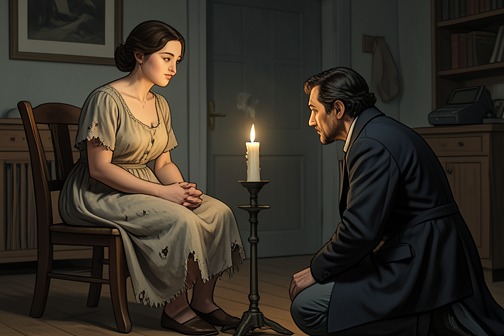
[Freya and Lorne's first intimate encounter](entity:event-recall-event-freya-lorne-0b9fe6bc3504) marks a decisive reversal in Freya’s life: after years of being mocked, controlled, and treated as a servant by her husband [Angus](entity:character-recall-character-angus-d4a05454cf09), she speaks her suffering aloud and enters a relationship defined, at least in this scene, by gentleness, consent, and the promise of freedom. The encounter is therefore not presented merely as a sexual initiation, but as the bodily and emotional climax of Freya’s recognition that remaining Angus’s wife has become a living form of destruction.
## Causes and Emotional Background
Freya’s movement toward [Lorne](entity:character-recall-character-lorne-3c57ab203d18) begins with a conversation about divine punishment and human suffering. Lorne argues that violence need not occur on a battlefield to destroy a person; it can also take the form of being slowly deprived of dignity and life within a marriage. His observation gives language to what Freya has feared but never before heard spoken aloud. She recognizes that Angus has been “killing” her since the day they married—not through a single attack, but through a continuing process of humiliation, deprivation, and emotional cruelty.
Freya describes herself as having been a good wife but a weak woman. She has allowed Angus to mock her and treat her as a slave while continuing to love him and hoping that he would eventually learn to treat her with affection. That hope has failed repeatedly, and she reaches the bleak conclusion that an eternity of damnation would be preferable to another lifetime as Angus’s wife. Speaking this confession makes her feel lighter, because Lorne becomes the first person to hear and acknowledge the reality of her domestic life without asking her to conceal or excuse it.
## The Encounter and Its Consent
The scene develops through a sequence of hesitation, reassurance, and reciprocal touch. Freya asks whether a weak person can become strong, and Lorne answers that anyone can become strong. When she admits that she is afraid, he touches her face and kisses her gently. The contrast with Angus is central: Lorne’s touch is careful rather than coercive, and his response to her vulnerability is encouragement rather than contempt.
Lorne explicitly frames the possible sexual relationship as a matter of Freya’s freedom. Before proceeding, he tells her that no punishment or divine wrath awaits her and that the act can mean liberation. Freya answers that she wants freedom intensely. She then participates actively, removing the distance between them and telling him that she wants him. The scene’s emphasis on his pauses, questions, and attention to her reactions distinguishes this encounter from the marital experience she has described as oppressive.
Freya’s body records the difference before she fully explains it. Because Angus has not touched her lovingly for so long, Lorne’s kiss produces disorientation and intense physical response. She notices the warmth of his breath, the texture of his unshaven face, and the gentleness of his supposedly barbaric touch. When he asks whether the experience feels good and whether it feels like freedom, she responds affirmatively. Her plea that he give her freedom turns the sexual climax into the scene’s defining symbolic gesture: pleasure and agency, previously separated from her married life, become joined.
## Consequences for Freya and Lorne
The encounter changes the value of intimacy for Freya. Marriage with Angus has made the body a site of punishment, servitude, and gradual erasure; intimacy with Lorne makes it a site where choice and dignity can be felt again. The change is not achieved through an abstract declaration alone. It is conveyed through Freya’s movement from fear and tears to active participation, bodily release, and a smile when Lorne asks whether she feels free.
Lorne’s conduct also establishes the immediate shape of their relationship. He does not treat Freya’s confession as an invitation to possess her without question. Instead, he interprets her desire as evidence of her need to be treated gently, asks whether he may do so, and remains attentive to her condition afterward. When he asks whether she is all right, Freya nods, and his final question about what she has experienced leaves the moment suspended between innocence and discovery. The scene closes not with a resolution of her marriage but with the first unmistakable experience of an alternative to it.
## Narrative Significance
Freya and Lorne's first intimate encounter embodies the book’s recurring pattern of love as rescue from conditions of captivity and abuse. Its language makes freedom physical: freedom is not only escape from a household or a husband, but also the recovery of breath, movement, desire, and the ability to say what one wants. The event therefore functions as both a relationship milestone and a redefinition of Freya’s self-understanding.
At the same time, the scene’s emotional force depends on the wound that precedes it. Freya does not approach Lorne from an undamaged life; she carries years of fear, obedience, and disappointed hope into the encounter. Her immediate transformation into pleasure and relief gives the episode the shape of romantic redemption, while the starkness of the contrast reveals how thoroughly Angus has denied her ordinary tenderness. Lorne’s promise of freedom becomes the scene’s governing image, but Freya’s confession remains its foundation: before she can imagine a different future, she must first name the marriage that has been destroying her.
Event 18
Freya conceives Lorne's child
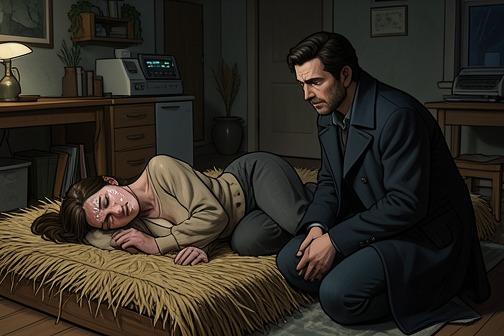
[Freya conceives Lorne's child](entity:event-recall-event-freya-lorne-24638203c2de) during the couple’s return to [Lorne](entity:character-recall-character-lorne-3c57ab203d18)’s village, an event that converts a dangerous and exhausting journey into the beginning of a family life. Her pregnancy is first presented through bodily distress rather than celebration: after fourteen days and nights of daytime travel, Freya arrives tired, nauseated, and unable to join the villagers’ welcome. Her collapse forces Lorne to confront the possibility that something is seriously wrong, making the pregnancy revelation the decisive reversal of the sequence.
## Causes and Circumstances
Freya and Lorne reach his village after a prolonged journey lasting fourteen days and nights. The villagers greet Lorne with cheers and smiles, and he relishes the attention, but Freya is too exhausted and sick to share in the welcome. She tugs at Lorne’s sleeve before suddenly crumpling to the ground, and he carries her into his home, laying her on a straw mattress while sending for a doctor. The physical cost of travel therefore supplies the immediate cause of alarm, while the village’s celebratory arrival creates a sharp contrast between public triumph and private vulnerability.
Freya initially minimizes the danger by saying that she is merely tired after the long journey. Lorne cannot accept that reassurance. He waits anxiously outside his home until the doctor finishes examining her, and in his haste to return to her bedside he forgets to thank the doctor. His reaction establishes how completely the event is filtered through fear before its meaning becomes clear: the pregnancy is not announced as a planned domestic milestone, but discovered through a crisis that leaves Lorne frightened for Freya’s safety.
## The Pregnancy Revelation
When Lorne reaches Freya’s bedside, she tells him to sit and takes his hand. She then reveals that they are going to have a baby, resting her free hand on her belly. Lorne asks whether he is going to be a father and whether she is certain; Freya confirms the news twice and attributes it to the doctor’s conclusion. The repeated confirmation emphasizes the distance between his expectation of illness and the reality of pregnancy.
The revelation changes Lorne’s physical and emotional posture. His eyes widen, then his face breaks into a smile, and tears well in his eyes as he kisses Freya’s forehead. He admits that he had been afraid she was sick and had even wondered whether God was punishing him for taking her. Freya rejects that interpretation, telling him that their God does not punish them but rewards them, and she draws his hand toward her belly. The pregnancy thus becomes, in her account, a reward rather than a sentence: an embodied sign that their relationship has produced a future neither of them can treat as temporary.
## Lorne’s Response and the Family Future
Lorne’s response moves from panic to tenderness. He rubs Freya’s belly gently and names the unborn child “our own little highlander,” linking the pregnancy to his people and to the village that has just welcomed him home. The phrase makes the child a symbol of belonging as well as a biological consequence of the couple’s union. Freya is no longer simply someone being brought into Lorne’s world; through the pregnancy, she becomes part of the continuity of that world.
Freya’s role in the scene is equally important. Although her collapse has made her appear helpless, she becomes the person who steadies Lorne, invites him to sit, confirms the doctor’s finding, and reframes his guilt. Her reassurance does not erase the troubling fact that Lorne believes he took her, but it redirects the immediate emotional meaning of that history toward care, mutual recognition, and a shared child. The scene’s resolution is therefore built through reciprocal gestures: Lorne carries and watches over Freya, while Freya gives him the knowledge and reassurance that release him from fear.
## Consequences and Narrative Significance
The pregnancy is the final turn of the Freya and Lorne sequence. Their arrival begins in communal celebration but is interrupted by Freya’s collapse; the doctor’s report then reverses the apparent disaster and produces an intimate family revelation. The event closes the story with Lorne imagining fatherhood rather than conquest, and with Freya presenting the child as a reward. It is consequently both a plot consequence and a moral reorientation of the relationship.
The scene also treats pregnancy as a form of narrative integration. The couple’s movement from the journey into Lorne’s home, from the crowd into the sickroom, and from suspected illness to confirmed pregnancy brings public and private worlds together. The unborn “little highlander” gives the relationship a future inside Lorne’s community, while Lorne’s tears and gentle touch show that the future is emotionally significant to him rather than merely socially useful. The story ends at the moment of recognition, before the child’s birth, leaving the pregnancy itself as the promise that carries the couple beyond the closing scene.
Event 19
Nairobi and Mitch's wedding
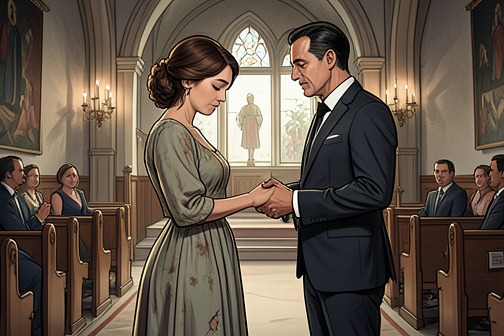
[Nairobi and Mitch's wedding](entity:event-recall-event-nairobi-mitch-f81003fd02c0) is the pivotal moment at which a vulnerable migration arrangement becomes an emotionally meaningful marriage. [Nairobi](entity:character-recall-character-nairobi-12f7eaa1ec31) reaches the [United States](entity:location-recall-location-united-states-2f533bc8d0b9) through a system that treats marriage as a means of transportation, protection, and relocation, while Mitch initially approaches her as a possible partner in a new life after a failed marriage. Their ceremony in [Las Vegas](entity:location-recall-location-las-vegas-96bec1c037c8), followed by Mitch's realization that Nairobi is more than a mail-order bride, shifts the relationship from negotiated necessity toward mutual trust and love.
## Causes and Background
Nairobi's marriage prospects are shaped by danger and limited choice rather than romantic freedom. She grows up in [South Africa](entity:location-recall-location-south-africa-49123e8bd978) without a father, who was killed when she was young, while her mother hides her in a mud shack to protect her from guerrillas who abduct girls. At eighteen, Nairobi's mother takes her to a mail-order-bride company because she sees the arrangement as the only available way to get her daughter out of South Africa and into the United States. The company promises to find a husband, and within a month Nairobi is collected from her mother's home after the men give her mother more money than Nairobi has ever seen. The payment makes the economic structure of the arrangement unmistakable: Nairobi wonders how much her future husband actually paid for her, even as the transaction offers escape from a violent environment.
The journey itself reinforces Nairobi's lack of control. She is placed in a truck, taken to a small airport, transferred to a larger airport, and put aboard a jet accompanied by one man. During the flight she shakes with fear because she does not know how to behave when she meets the stranger who is supposed to become her husband. She worries that he may be cruel or even kill her. Her anxiety is therefore not merely shyness; it is the emotional consequence of being transported across continents toward an unknown man under an arrangement in which her safety and future depend on his decisions.
Mitch is waiting for her at the airport while imagining that the two of them might build a new life together. His previous marriage to Alice has left him wishing for a wife who would listen to him, and he wonders whether he can recover the person he was before that relationship. He is not presented as free of the marriage market's calculations: he wants companionship and a different domestic future, while Nairobi needs protection and a new country. Their wedding begins within that unequal exchange, but the narrative allows the emotional relationship to alter the meaning of the bargain.
## What Happens in Las Vegas
When Nairobi enters the terminal, she sees Mitch leaning against a post beneath a sign bearing her name. He is an attractive, clean-cut white man with blond hair, blue eyes, and a cowboy hat, but she remains self-conscious rather than reassured. Dust from Africa still clings to her feet, and she believes her old, worn dress is not what he expected. She approaches him by pointing to the sign and identifying herself, then looks down at the floor as Mitch recognizes how shy and intimidated she is.
The first meeting rapidly establishes the tension between attraction and consent within the arrangement. After Mitch takes Nairobi to his home, she realizes that returning to Africa is unacceptable to her. When he touches and kisses her, she asks when they will marry because she knows that if she gives him what he wants before marriage, he could send her back. Mitch replies that they can marry the next day, and Nairobi immediately accepts. Her decision is both a safeguard and an act of choice: marriage is the condition she uses to secure her new life, and she refuses to risk that life by entering the relationship without the legal commitment she has been promised.
Mitch then drives Nairobi for several hours to Las Vegas. She sleeps during part of the journey with his hand resting on her leg, exhausted by the new country, unfamiliar food, and unfamiliar culture. He wakes her when they reach the illuminated city at night so that she will not miss it. Nairobi looks around with the wonder of someone encountering an entirely new world, and her happiness reassures Mitch that the upheaval has not overwhelmed her.
They find a small chapel and marry before visiting casinos and a show. Mitch has booked a presidential suite rather than a honeymoon suite because he considers the latter tacky, yet his purpose is not simply display. He wants to introduce Nairobi to the finer things in life, although he understands that even the smallest hotel room would have amazed her. In the suite, Nairobi runs her hands over the furniture and says that she feels like a princess. Her tears and wonder become the emotional center of the wedding sequence: the ceremony has not erased the conditions that brought her there, but it gives her an immediate experience of dignity, abundance, and welcome.
## The Marriage Becomes Personal
The decisive change occurs when Mitch recognizes that Nairobi is more to him than a mail-order bride. Her response to the hotel and the life he is showing her awakens a connection he has not felt with anyone else. He wants to spend the rest of his life with her not merely because he fears loneliness, but because he loves the person she is. The value at stake shifts from security as a purchased arrangement to belonging as an emotional commitment.
Mitch embraces Nairobi and tells her, “You are a princess,” adding, “You are my princess and you will always be treated like a princess.” The statement is important because it answers the humiliation and uncertainty of her arrival. She entered the airport worrying that she was too poor, dusty, and plainly dressed for the man who had selected her; in the suite, Mitch explicitly gives her a valued place in his life. Her large smile and trusting, loving gaze mark the reciprocal side of the transformation, even though the relationship began under economic pressure.
The wedding also contrasts with other marriage arrangements in the wider narrative. [Abigail](entity:character-recall-character-abigail-d72687631c24) describes a plan to marry a rich American so that he can inherit his family fortune, divorce him, and use the money to start a business. William and his lawyer discuss a mail-order bride as a business solution to an inheritance stipulation, proposing a contract that would require a minimum period of marriage and a child while preventing the wife from claiming the estate. [Amy](entity:character-recall-character-amy-b0c9984bdc2f) receives an unusually explicit proposal offering financial stability, children, and friendship under an expectation of monogamy. Against these arrangements, Nairobi and Mitch's ceremony begins as a practical match but moves toward feeling that cannot be fully reduced to contract terms.
## Consequences and Narrative Significance
The immediate consequence of the wedding is that Nairobi gains the marital security she believes she needs in order to remain in the United States. The ceremony also gives Mitch the domestic possibility he has been missing: he has been married before, but that relationship left him lonely and dissatisfied, whereas Nairobi's openness to the new world makes him imagine a shared future. Las Vegas functions as a threshold, carrying Nairobi from the frightening transit of the airports into a public ceremony and then into a private home that she experiences as royal.
The event's emotional force comes from its double character. Nairobi's vulnerability never disappears from the background: she has been selected through a commercial system, transported away from her mother, and made dependent on a stranger's treatment of her. Yet the wedding does not remain only a transaction in the narrative's immediate emotional logic. Mitch's promise to treat her as his princess and his recognition that he loves her convert the arrangement into an early form of mutual attachment. The ceremony therefore represents both the unequal economics of mail-order marriage and the possibility that genuine care may emerge within, and partially resist, that structure.
As a romance beat, the wedding combines first meeting, apprehension, commitment, and the first major relational reversal. Nairobi begins as a frightened traveler who must protect herself by insisting on marriage before intimacy. She ends the sequence as a newly married woman looking at a lavish suite with trust and love in her eyes. Mitch begins as a lonely man hoping a new wife will help him build a different life; he ends the sequence understanding that Nairobi is not an interchangeable solution but the particular person with whom he wants to spend his life. The wedding's significance lies in that movement from selection to recognition, from negotiated survival to the promise of a shared future.
Event 20
Sloan and Amy's contractual marriage
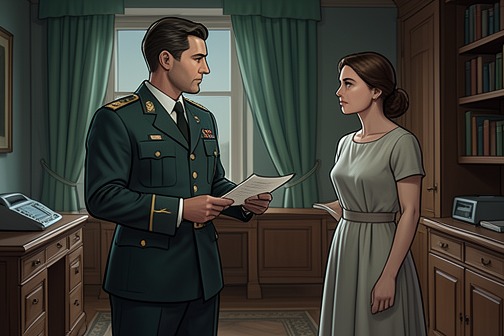
[Sloan and Amy's contractual marriage](entity:event-recall-event-sloan-amy-03106ddfce6c) is a romance structured by inheritance law, reproductive expectations, and the gradual conversion of an economic bargain into mutual commitment. Sloan enters the arrangement because his parents' death leaves him as the sole heir to their company, but their unchanged will requires him to marry and have a child within six months of taking control. [Amy](entity:character-recall-character-amy-b0c9984bdc2f) initially considers his proposal with clear awareness of its practical terms; only after experiencing tenderness, domestic belonging, and sexual intimacy does she decide that the marriage can become emotionally real.\n\n## Inheritance, Time Limit, and the Proposed Bargain\nSloan's position is established through loss and obligation rather than romantic pursuit. After twenty years of military service, he receives his final discharge papers and reluctantly faces retirement. His parents have died in a car crash, and because he is their only heir, he cannot simply walk away from the company without allowing it to be sold. The will makes inheritance conditional on a private family expectation: he must be married and must produce a pregnancy within six months of taking over the business. The legal condition turns marriage into a deadline-driven succession problem, forcing Sloan to seek a spouse as part of an estate strategy rather than through ordinary courtship.\n\nHis first practical route is an online search. Amy reads an email in which Sloan explains the situation bluntly: he wants a wife because of his parents' will, can offer financial stability and children, and hopes that friendship might develop into something more. He does not present the arrangement as a promise of immediate love or a temporary fling. He also specifies monogamy, offering the same exclusivity he expects from her. The candor makes the proposal sound almost absurdly exposed, but it also gives Amy information with which to judge the arrangement rather than disguising its coercive economic context as romance.\n\nThe six-month pregnancy requirement is not left vague when Amy asks Sloan to explain it. He confirms that they are expected to be pregnant within six months of the marriage and mentions medical intervention if infertility becomes an obstacle, provided that they are actively trying to resolve the problem. Amy responds from her own circumstances: she loves children, teaches partly because of that love, has regular cycles, and is not using birth control because she has not had a boyfriend for some time. Her question is therefore both practical and ethical—whether Sloan genuinely wants children or is merely obeying the will. The contract places reproduction at the center of the proposed union, but Amy still insists on distinguishing a legal requirement from a shared desire.\n\n## Negotiating Marriage as a Transaction\nThe event belongs to a broader pattern in which marriage is treated as an exchange involving property, security, citizenship, or inheritance. [Abigail](entity:character-recall-character-abigail-d72687631c24) describes her own plan to [Sally](entity:character-recall-character-sally-995cd04e2cf1) as marrying a rich American so that he can inherit his family fortune, then divorcing him and using the money to start a business in [London](entity:location-recall-location-1bfd335cdd1b). William develops a related strategy with his lawyer, proposing that a spouse be found through a mail-order arrangement so that the family benefits while the woman receives transportation and citizenship. His lawyer imagines a contract requiring her to remain married for at least ten years and bear a child while preventing her from claiming the estate. These parallel arrangements make Sloan and Amy's marriage part of a recurring social mechanism: intimacy is used to solve succession and migration problems, while the woman negotiates the security and restrictions attached to the deal.\n\nOther relationships in the surrounding narrative expose different versions of the same tension. [Jenna](entity:character-recall-character-jenna-65f88e27192a)'s husband, [Kyle](entity:character-recall-character-kyle-7dd591f8eb9a), permits her to have a boyfriend because his work keeps him away and he sees an open marriage as preferable to divorce. Dennis offers Kember one hundred thousand dollars, medical expenses, and a possible personal-assistant position in exchange for surrogacy, while also proposing an open-adoption arrangement that would allow her to know the child. [Emma](entity:character-recall-character-emma-0b5c09f9ac66) chooses a mail-order marriage to Lucas after a house fire destroys her former life, treating the move to Texas as both escape and a chance to help him care for his niece. Tomas, meanwhile, openly says that he wants a wife, lover, and friend who will want children and share his rural life, but he also threatens [Lydia](entity:character-recall-character-lydia-3e7a560b729c) into finding suitable women for him. Against these examples, Sloan's relative transparency matters, though the inheritance deadline still gives the arrangement an unmistakable imbalance: his family fortune and legal future depend on Amy's marital and reproductive participation.\n\n## From Terms to Domestic Intimacy\nThe proposed marriage changes value when Amy begins to experience Sloan not merely as the author of a contract but as a man capable of ordinary care. He invites her to ride horses and watches her eat pancakes with a hearty appetite, a small domestic moment that makes their association feel less like a formal transaction. The dogs also become part of the emotional setting. When Stella is found in the barn, panting and apparently close to giving birth, Amy approaches slowly, speaks gently, and reassures the distressed dog. She asks Sloan to remain outside the stall while she establishes trust, and Stella eventually rests her head on Amy's leg. Amy's care for the animal gives the prospective household a practical emotional texture, while Sloan's willingness to let her take charge allows her to occupy the space as something more than a temporary contractual entrant.\n\nTheir sexual encounter supplies the immediate physical turning point, but the decisive shift follows afterward. Sloan pulls Amy onto his lap, wraps a blanket around them, and holds her while she rests against his shoulder. In that quiet aftercare, she recognizes that her decision is not based only on sex or on the dogs' acceptance of her. She feels content in his arms and experiences the house as home. Her declaration that she will marry him therefore functions as more than consent to the original bargain: it is a spoken choice to remain because she likes him and feels secure with him. The contract remains the plot's initiating condition, but the relationship begins to acquire an attachment that the will itself cannot compel.\n\n## The Wedding and the Pregnancy Reveal\nThe wedding makes the private negotiation public. Amy experiences a moment of fear before the ceremony, acknowledging that marriage sounds wonderful in theory but is difficult in reality. [Madison](entity:character-recall-character-madison-53d0d83590ae) encourages her forward, and Sloan meets her at the front, telling her,
Event 21
Amy becomes pregnant and marries Sloan
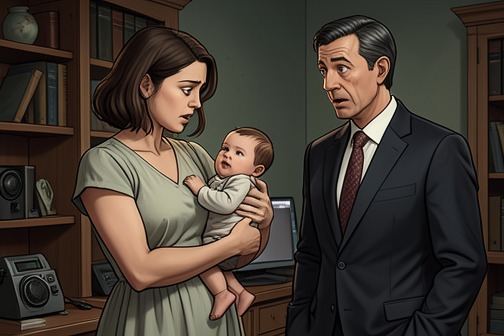
[Amy becomes pregnant and marries Sloan](entity:event-recall-event-amy-sloan-01c36e986106) in the same decisive sequence, turning an arrangement initially shaped by inheritance requirements into a chosen family commitment. The event joins two kinds of promise: the biological fact of an unexpected pregnancy and the public vows through which [Amy](entity:character-recall-character-amy-b0c9984bdc2f) and Sloan accept marriage, parenthood, uncertainty, and a shared future.
## Causes and Background
Amy’s relationship with Sloan began under unusual contractual circumstances. She understood that having a child was part of what Sloan needed to fulfill the inheritance requirements, and she had accepted the possibility of pregnancy in theory. She had been taking birth control until she agreed to marry him, then stopped a month before the wedding. When her period became late and she developed tender breasts and a general sense that she was not feeling normal, she initially wondered whether the symptoms were simply the result of coming off the pills. The pregnancy therefore emerges from a decision connected to the marriage bargain, but it also exposes how quickly a practical arrangement has acquired emotional stakes.
The evidence of that emotional shift is Amy’s admission that she loves Sloan. She tells [Madison](entity:character-recall-character-madison-53d0d83590ae) that she had not intended to fall in love, yet considers him amazing and says that she loves him deeply. This confession changes the meaning of the forthcoming ceremony: Amy is no longer merely preparing to satisfy an inheritance condition. She is frightened by the speed of the pregnancy and by the reality of making the marriage official, but she also wants the relationship to endure.
## Discovery and Disclosure
On the day of the wedding, Amy waits privately for the result of a pregnancy test while her family has flown in for the ceremony. When she checks the test, two bright pink lines confirm that she is pregnant. The discovery shocks her because conception has happened so quickly. The abstract possibility written into the arrangement becomes a physical and immediate reality, leaving Amy unsure whether she is ready. Her fear is not presented as rejection of the child or of Sloan, but as the startled recognition that both marriage and motherhood have arrived at once.
Amy hides the test in her purse and first tells Madison, the only person who knows the full story of how Amy and Sloan met and why the inheritance requirements matter. Madison responds with an embrace and encourages Amy to proceed, assuring her that the pregnancy is good news if Sloan wanted it. Amy then walks toward the ceremony carrying two secrets that are about to become public: her pregnancy and the extent of her love for Sloan.
At the altar, Sloan tells Amy that she is beautiful and that he is glad they are doing this. Before she can stop herself, Amy whispers that she is pregnant. Sloan’s immediate response is to hug her tightly, interrupting the pastor in the middle of the ceremony and surprising everyone present. His embrace converts the moment from a test of contractual compliance into a visible act of acceptance. The scene’s central value shifts from anxious uncertainty to shared joy, even though the future remains difficult and unguaranteed.
## Marriage and Vows
After Sloan apologizes and the pastor resumes the ceremony, the couple makes its commitment in explicit terms. Sloan promises to marry Amy in sickness and health, for richer or poorer, until death parts them. He acknowledges that they did not meet in an orthodox way and expects trials ahead, but promises to support her, hold her hand, grow old with her, laugh with her, and make countless memories together. His vows place continuity and mutual care above the unusual origin of their relationship.
Amy answers with an equally deliberate promise. She pledges to support Sloan and remain at his side even when she disagrees with his choices. She promises to love him regardless, to fight for the relationship when it becomes difficult, and not to look back with regret or fear. Her vow looks directly toward the life revealed by the pregnancy: she says that she looks forward to raising children with him and identifies love as the most important truth she can offer.
The wedding concludes with the pastor’s permission for the couple to kiss, followed by applause as Amy and Sloan share their first kiss as bride and groom. The public ceremony does not erase the marriage’s contractual beginning, but it layers a personal and emotional covenant over that economic foundation.
## Consequences and Significance
The pregnancy fulfills the practical possibility that Sloan needed for the inheritance arrangement, yet the narrative gives the event greater weight by making Amy’s emotional choice equally important. She does not simply reveal evidence that could secure Sloan’s position; she declares love, accepts the risks of marriage, and commits herself to raising children with him. The event thus marks the point at which a negotiated relationship becomes a family project openly embraced by both partners.
The sequence also establishes a pattern in which care is expressed through concrete action. Amy’s private anxiety is met by Madison’s reassurance, while Sloan answers the pregnancy disclosure not with calculation but with physical affection and an immediate public embrace. Their vows then translate that emotional response into durable obligations: support, patience, shared memories, and persistence through hardship. The marriage’s happy direction is therefore built not on the disappearance of fear, but on the couple’s decision to acknowledge fear and move forward together.
In the broader emotional landscape surrounding the book, Amy and Sloan’s wedding stands in sharp contrast to relationships defined by grief, coercion, violence, or captivity. Other narratives contain bereavement after Jake’s death, repeated domestic abuse against Aleah, [Emma](entity:character-recall-character-emma-0b5c09f9ac66)’s traumatic house fire, and [Opal](entity:character-recall-character-opal-b515ca0df54f)’s flight from enslavement. Against those darker forms of vulnerability, Amy’s ceremony presents pregnancy and marriage as events that can become consensual and sustaining when the people involved recognize one another as partners. Its ending is a romance-oriented promise of a shared future: the couple is married, the pregnancy is accepted, and the vows commit them to building a family despite the unconventional path that brought them to the altar.
Event 22
William and Natasha's contractual wedding
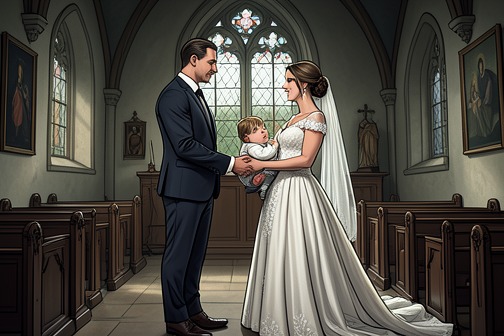
[William and Natasha's contractual wedding](entity:event-recall-event-william-natasha-15c28ba5ac86) is the decisive enactment of a marriage designed around inheritance, immigration, and reproduction rather than courtship. William Larsen can inherit his family's estate, home, property, and business only by marrying and producing an heir, while Natasha receives transportation, citizenship, and material security under a contract that requires her to remain married for at least ten years and bear a child. The wedding therefore converts intimacy into a legal and economic instrument, yet William's immediate attraction to Natasha makes the arrangement unstable from the moment it becomes real.
## Causes and Contractual Background
William's situation begins with a family succession rule revealed by the family's lawyer, Theodore Jenkins. Although William is the only heir, the estate cannot simply be handed over to him because a stipulation established generations earlier requires the heir to be married and to have an heir apparent. The rule applies regardless of the child's sex. William is the first member of his generation forced to confront it because his parents and sibling have died while he has devoted himself almost entirely to his career and neglected romantic relationships.
The requirement turns succession into a deadline-driven personal crisis. William regards marriage and children as possibilities he had never prioritized, not as things he opposed, but the deaths in his family and the inherited condition remove his freedom to postpone them. Jenkins explains that there is no practical loophole: previous generations already had spouses and children when their parents died, whereas William's career-centered life has left him uniquely exposed. The estate's continuity is treated as a form of family insurance, ensuring that the property and business remain within the family.
William and Jenkins consequently recast marriage as a business deal. William proposes a mail-order bride because a formal contract could specify what Natasha would receive and protect the Larsen estate from claims against it. Jenkins accepts the idea after initial disbelief and shapes it into an enforceable arrangement: Natasha is to receive transportation and citizenship and be taken care of, while remaining married to William for a minimum of ten years and bearing a child. The agreement is also designed to prevent her from claiming any portion of the estate. Its language presents marriage as an exchange of benefits, obligations, and safeguards, with William's family retaining the strongest control over the terms.
## Arrangements and Ceremony
Jenkins completes the preparations in three weeks. He drafts an ironclad contract, researches a leading mail-order bride company, contacts it, and arranges a meeting at its headquarters so William can specify his needs. Natasha is not introduced to William until the day of the wedding. She arrives at the airport on a Tuesday evening, is collected by William's personal driver, and spends the night in the city's most luxurious hotel. Jenkins and William decide that the couple should meet at the ceremony itself, making the legal act of marriage also their first face-to-face encounter.
On the drive to City Hall, Jenkins finally tells William his future wife's name: Natasha. William knows her appearance only through photographs and recognizes that images and written answers cannot reveal what she is actually like. His nervousness exposes the limits of the contract's attempt at control. He checks that his jacket is unwrinkled, notices Natasha's car outside City Hall, and finds his breathing becoming increasingly rapid as he approaches the room where she is waiting.
The ceremony is brief and formal. Natasha stands in a simple white dress, turns toward William, and smiles widely when he enters. Jenkins introduces them; Natasha speaks with a soft accent and a raspy voice that William finds intensely attractive. He notices her deep red hair, honey-colored eyes, and very fair skin. The judge begins the ceremony after clearing his throat for the group to pay attention, and less than an hour later William and Natasha are legally married and walking down the steps of City Hall. The speed of the ceremony emphasizes how little personal history precedes the legal bond, while the immediate physical response between them complicates its commercial logic.
## The First Shift from Deal to Desire
The crucial change occurs before the couple has even returned to the Larsen estate. William has been telling himself that he must treat the marriage as a business transaction, but seeing Natasha in person produces an unfamiliar sensation and the realization that this mental discipline may be difficult to maintain. The contract has successfully solved the succession problem, yet the encounter creates a new problem: the woman selected as a contractual means has become an object of genuine fascination.
During the ride home, they remain silent for much of the journey, then begin to speak. William tells Natasha she is beautiful, moves closer, and holds eye contact. Natasha responds by appraising him openly and remarks that she would not have expected someone like him to order a bride. William gives only the restrained explanation that he has his reasons, although he wants to learn about her childhood, former life, preferences, and motives for becoming a mail-order bride. His immediate priority, however, is physical closeness. The scene moves the relationship from a signed arrangement toward mutual erotic tension without establishing that the contractual obligations have disappeared.
This transition is not a conventional meeting between two people free to negotiate from equal positions. William possesses the estate, the lawyer, the contract, and the power to protect or restrict Natasha's economic future; Natasha's promised benefits include transportation and citizenship, advantages that imply dependence on the marriage. The ceremony thus contains two simultaneous stories. On the surface, it completes a carefully managed exchange meant to secure inheritance. Beneath it, William's nervousness and attraction begin to produce the romantic uncertainty that the contract was designed to exclude.
## Pattern within the Novel's Marriage Economy
The wedding belongs to a broader pattern in which marriage, fertility, and economic survival are repeatedly organized through agreements. [Abigail](entity:character-recall-character-abigail-d72687631c24) describes a plan to marry a rich American so that he can inherit his family fortune, then divorce and use money he gives her to start a business. [Amy](entity:character-recall-character-amy-b0c9984bdc2f) learns that Sloan's inheritance will requires the couple to be pregnant within six months of marriage. In another arrangement, a man asks Penelope to carry a baby for his wife and offers payment while threatening her with homelessness and starvation if she refuses to surrender the child. These examples show that the book repeatedly places reproduction inside negotiations over property, money, security, or social position.
Other relationships make the same structure more explicit. [Jenna](entity:character-recall-character-jenna-65f88e27192a)'s husband gives her permission to have a boyfriend because their alternative is divorce, turning an intimate decision into an open-marriage agreement. Dennis offers Kember one hundred thousand dollars for surrogacy, payment of all medical expenses, and an opportunity to retain a personal-assistant position, while also proposing an open-adoption arrangement that would let her remain connected to the child. [Emma](entity:character-recall-character-emma-0b5c09f9ac66) leaves [England](entity:location-recall-location-england-b153c1f368ea) to become a mail-order bride to Lucas, seeking a new home in Texas after fire, bereavement, accumulating bills, and painful reminders of loss. In each case, marriage or reproduction offers an exit from another form of precarity, but the terms also reveal unequal bargaining power.
William and Natasha's ceremony crystallizes that legal-economic pattern while adding a romantic complication. Unlike a purely strategic marriage, it contains the beginnings of desire at the exact point when the contract is completed. Unlike a freely developing romance, it begins with a requirement imposed by an inheritance system and a document designed to limit Natasha's future claim. Its significance lies in that contradiction: the law treats the wedding as a mechanism for transferring property, while the scene's emotional and physical details suggest that the people inside the mechanism may not remain governed by its original purpose.
## Narrative Consequences and Open Direction
The wedding resolves William's immediate succession obstacle by satisfying the first visible condition of the Larsen stipulation: he is now married. It does not, however, complete the requirement that will determine whether he truly controls the estate, because the contract also demands an heir. The legal ceremony is therefore both an ending and a beginning. It closes the search for a spouse and opens the more difficult question of whether a marriage created for inheritance can become a functioning personal relationship while still carrying a ten-year minimum term and a reproductive obligation.
Natasha's arrival, the rapid City Hall ceremony, and William's sudden inability to regard her as merely contractual leave the future deliberately unsettled. The evidence establishes the contract, the wedding, and the attraction, but not the later fulfillment of every promise made within the agreement. The event's lasting force comes from that gap between intention and consequence: William believes he has purchased a controlled solution to a family problem, yet the first meeting already shows that the supposed transaction has acquired the unpredictability of human attachment.
Event 23
Aubrey发现Mikaela与Antoine的联系
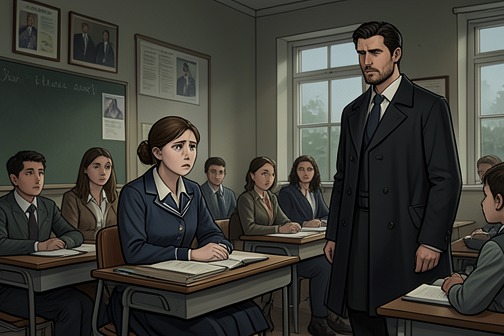
Aubrey’s discovery that Mikaela is connected to Antoine is the turning point at which a classroom concern becomes a personal and potentially dangerous relationship. What begins with a teacher noticing a frightened student’s silence leads Aubrey into Antoine’s neighborhood, forces her to confront the gap between reputation and conduct, and ultimately brings the three of them into direct contact. The event matters because Aubrey does not merely learn who Mikaela’s mysterious correspondent is; she discovers that the feared man is also the uncle who has assumed responsibility for a traumatized girl’s welfare.
## Suspicion Begins in the Classroom
It was [Wednesday](entity:time-recall-time-wednesday-c0d2d52cbe23) afternoon, after two smooth days working in the field, when Aubrey realized that Mikaela’s withdrawal could not be explained simply by shyness or a need for more time. The other children appeared to like and respect Aubrey, while Mikaela remained almost entirely silent. Aubrey read her roughness as a protective surface over an inner softness, but she also sensed fear beneath it. The student’s silence therefore became an active warning rather than a personality trait.
The immediate clue came while the children were completing an activity Aubrey had prepared. Mikaela looked at her phone, and Aubrey quietly glanced over her shoulder, catching only the message “watch out when you come” from Antoine. The fragment was enough to make Aubrey’s heart sink. She connected the name with the major drug lord she had heard about during a brief conversation with Dave at brunch on Sunday, and she feared that a very young girl had become entangled with someone capable of frightening the entire neighborhood. Aubrey did not confront Mikaela in front of the group. Instead, she withdrew without revealing that she had seen the phone and waited until the session ended before examining Mikaela’s file.
## Entering Antoine’s Neighborhood
Aubrey copied the home address and telephone numbers from the file and decided to drive past the address. She understood that the choice was risky, yet her desire to help Mikaela overcame her caution. The address was close to the community center, but a sharp turn led into one of the neighborhood’s darkest and dingiest areas, a space that seemed cut off from the surrounding streets and even from sunlight. Aubrey immediately recognized that her car would attract attention and began turning around rather than continuing into danger.
At that moment she saw Antoine leaning against a vandalized street sign. He was tall and very dark, with a buzz cut, blue jeans, a white T-shirt, and exceptionally clean white sneakers. His clothes fit his body more closely than those of most men she had seen in the neighborhood, and his appearance produced an immediate physical reaction: a chill moved up Aubrey’s spine and she broke into a cold sweat. When she turned the car around, Antoine approached from behind and appeared in the rearview mirror. He did not reach for a weapon or walk in an openly threatening way, but Aubrey remained rooted in place, calculating whether driving away would make the situation worse.
Antoine came to the passenger side, bent toward the window, and knocked. Aubrey lowered it only a crack. He offered to help if she explained why she was there, while making clear that she could simply drive away. He observed that she did not look as though she had arrived accidentally: she seemed like someone who did not belong in the neighborhood but was searching for a person or something else. He then warned her quietly that the place was unsafe. The warning unsettled Aubrey because his manner was both intimidating and restrained. She refused to explain, determined not to expose Mikaela, and drove away when Antoine backed from the car and raised his hands in surrender.
## The Family Connection Revealed
The following afternoon, Mikaela approached Aubrey’s desk with an unusual hesitancy and asked whether Aubrey had gone home after class the day before. Mikaela had never spoken so much to her, and the girl’s voice was soft and small. Aubrey quickly suspected that Antoine had mentioned the encounter or questioned Mikaela about it. Mikaela then explained that her uncle had noticed a strange woman in the area and had described both Aubrey and her car. She sounded uncertain, as though she feared she had done something wrong.
Aubrey responded by taking a physical and emotional risk: she placed a hand on Mikaela’s shoulder and asked whether Antoine was her uncle. Mikaela nodded. Aubrey admitted that she had gone to the area, while reassuring her that nothing bad had happened. Mikaela nodded again, then used her phone to ask Antoine to meet with Aubrey. The revelation changed the meaning of the previous scene. Antoine was not an unknown drug lord merely linked to a threatening message; he was Mikaela’s guardian figure and the person monitoring what happened around her.
Antoine arrived a few minutes later and walked into the gym, politely extending his hand and offering a formal greeting. His conduct once again contradicted the reputation Aubrey had heard. He sat down to discuss why she had visited the neighborhood, and Aubrey found enough courage to ask why Mikaela was so shut down. Antoine explained that Mikaela had endured an exceptionally difficult and traumatizing life and therefore had trouble trusting people. He said that he always tried to protect her and that his fearsome reputation gave him the power to do so, although he remained worried about her overall well-being. His explanation does not erase the danger surrounding him, but it supplies a motive and a form of responsibility that Aubrey had not expected.
## From Investigation to Intimacy
Antoine invited Aubrey to dinner at the gym so they could discuss practical ways to help Mikaela. Aubrey was astonished by the invitation, yet accepted because she believed Antoine could help her reach the girl more effectively. They ordered pizza and began with the problem that had brought them together, but the conversation soon widened to other matters in their lives. The shift is important: the meeting moves from an investigation into a collaboration, and from collaboration toward personal attachment.
Aubrey found the speed of the change surreal. Antoine was unlike the man people had described to her, at least in his dealings with her. He appeared to love and care deeply for Mikaela, and he shared Aubrey’s seriousness about giving the girl a better future. Their common concern creates the first basis for trust. Aubrey’s fear is not simply dismissed; it is revised through repeated evidence of Antoine’s restraint, politeness, and investment in Mikaela.
The evening lasted nearly until midnight before Aubrey noticed the time and apologized for keeping him so late. Antoine smiled softly, and Aubrey felt an unfamiliar sensation stir in her stomach. It was the first moment that night when she perceived him looking at her in a distinctly personal way. Thus the discovery does not end with a clarified family relationship. It becomes the opening beat of a new bond, one whose initial language is protection but whose emotional charge has already begun to change.
## Narrative Significance
The event is structured around recognition and reversal. Aubrey first sees Antoine through a frightening public reputation, then through the immediate physical threat suggested by his setting and appearance, and finally through his private role as Mikaela’s protective uncle. Each stage revises the last without making the earlier danger irrelevant. The neighborhood remains unsafe, Antoine remains intimidating, and Aubrey’s caution remains justified; nevertheless, his behavior toward her and his concern for Mikaela expose a more complicated identity than the one supplied by rumor.
Mikaela functions as the connection between two adults who would otherwise have had no reason to trust one another. Her guardedness initially appears to be an obstacle to Aubrey’s work, but it becomes the evidence that something deeper is wrong. The phone message, the address in the file, the vandalized street sign, and the description of Aubrey’s car form a chain of material clues that draws her from the classroom into Antoine’s world. Once the family connection is spoken aloud, the same clues become part of a protective network rather than merely signs of criminal danger.
The encounter also establishes the central tension of Aubrey and Antoine’s developing relationship: she is drawn toward him precisely as she continues to measure the risks around him. Their first movement toward intimacy is therefore not detached from conflict. It grows out of a shared attempt to protect Mikaela, while Antoine’s unexpected gentleness challenges Aubrey to distinguish between a feared reputation and the conduct she witnesses herself.
Event 24
Aubrey与Antoine开始交往

Aubrey and Antoine’s relationship begins as an improbable connection formed through concern for Mikaela. Aubrey first encounters Antoine while trying to understand why Mikaela is so withdrawn, and what appears to be a potentially intimidating meeting instead reveals a man who is protective, serious about Mikaela’s welfare, and unexpectedly considerate toward Aubrey. Their attraction crosses a boundary that both recognize as inappropriate, yet the relationship ultimately becomes a source of mutual commitment rather than a passing lapse.
## A Meeting Built Around Mikaela
Aubrey’s initial purpose is practical and compassionate: she wants to help Mikaela, whose difficult and traumatizing life has left her wary of other people. After learning that Antoine is Mikaela’s uncle, Aubrey meets him at the gym and asks why Mikaela has become so shut down. Antoine explains that he has tried to protect her and worries about her overall well-being, even though his feared and respected reputation makes him seem more dangerous than the behavior he shows Aubrey. His invitation to have dinner and discuss ways she might help Mikaela changes the meeting from an uncertain inquiry into a shared undertaking.
The dinner begins with pizza and an attempt to solve Mikaela’s problems, but the conversation gradually widens into personal subjects. Aubrey is struck by the contrast between Antoine’s public reputation and his conduct with her: he is well spoken, caring, and genuinely invested in Mikaela’s chance to reach a better place in life. The contrast does not erase the troubling history attached to him, but it makes him more complex to Aubrey. She is drawn not to an idealized version of him, but to the combination of his rough past and the tenderness he displays toward Mikaela.
## The Boundary They Both Cross
The shift from cooperation to romance occurs late at night, after Aubrey realizes how long they have been talking. Antoine tells her that he enjoyed being with her, and his low, gruff voice intensifies the attraction she has been resisting. He then kisses her. The kiss becomes more passionate as their physical responses overtake their attempts to classify the situation as wrong or inappropriate. Aubrey’s racing heart, caught breath, and growing heat convey the relationship first as bodily intensity before either character can make it emotionally orderly.
Aubrey and Antoine both acknowledge that the encounter is inappropriate, but neither is willing to end it for that reason alone. When Antoine pulls her onto him and begins touching her, he abruptly stops because he does not have a condom. His withdrawal also reflects a moment of self-correction: he apologizes for assuming that sex would happen and tells Aubrey that she should simply help Mikaela. Aubrey answers that she would have had sex with him and assures him that nothing will stop her from doing everything she can for Mikaela. The exchange establishes that the attraction is mutual while preserving Aubrey’s stated purpose and agency.
## From Impropriety to an Official Couple
The relationship does not remain confined to the first charged encounter. Aubrey’s friend Mila disapproves of the circumstances and remains concerned about Aubrey’s safety, but she also recognizes that Aubrey does not enter relationships easily, break rules readily, or pursue people casually. Aubrey’s willingness to date Antoine therefore signals to Mila that the connection matters deeply to her. On their first official date, Aubrey learns more about the events that produced Antoine’s harsh reputation. Some of what she hears unsettles her, particularly because it belongs to a history involving serious wrongdoing or danger, yet she also understands the circumstances behind those events and continues to see the caring man who exists alongside the feared one.
After dinner, Aubrey invites Antoine to her home, where their physical relationship becomes more direct. The scene continues the tension between danger and desire that defined their first kiss: Antoine’s intensity is forceful, while Aubrey responds actively and openly to the attraction. The encounter confirms that their connection is not merely an accidental breach of professional or familial boundaries surrounding Mikaela. It has become a relationship in which both are choosing intimacy, even while the social circumstances make that choice difficult to defend publicly.
Four months later, Aubrey’s graduation provides the clearest evidence that the relationship has stabilized. She has completed all her coursework, passed her final examination, and secured a job because of her strong performance in the practical portion of her training. Antoine waits beside Mila’s car in a suit, surprising Aubrey before the ceremony; she runs to him and kisses him. Their public affection marks a change from the earlier period when being together would have been more openly frowned upon. After the first official date, they continued dating and soon became an official couple, but they waited until Aubrey was preparing for her final examination before feeling free to appear publicly together.
## Mikaela’s Recovery and the Relationship’s Consequences
Aubrey and Antoine’s relationship is intertwined with Mikaela’s improvement rather than existing separately from it. Antoine’s original concern is to protect his niece, while Aubrey supplies a persistent, hopeful presence that helps Mikaela become more open and optimistic. By the time Aubrey graduates, Mikaela is described as happier, more trusting, and more hopeful than before. The relationship therefore produces a consequence beyond the couple’s own happiness: the collaboration that brought them together also contributes to a better life for Mikaela.
The event’s decisive value shift is from guarded responsibility to mutual attachment. Aubrey enters the meeting as someone attempting to help another person, and Antoine enters as a feared protector whose reputation makes him difficult to read. Their conversation reveals care; the kiss reveals attraction; the later dates establish commitment; and the graduation scene confirms a shared future that can finally be acknowledged. The relationship’s progression follows a recognizable romantic structure of meeting, resistance, physical and emotional approach, public confirmation, and a hopeful continuation rather than a breakup or permanent concealment.
## Narrative Significance
Aubrey and Antoine’s romance is built on contrast. Antoine is both intimidating and gentle, associated with a threatening reputation yet attentive to Mikaela’s vulnerability. Aubrey is cautious and rule-conscious, yet she accepts a connection that she immediately understands may be judged as improper. Their bond gains force from this contradiction: neither character is reduced to the public role attached to them, and the relationship depends on seeing the whole person rather than selecting only the respectable or frightening part.
The event also illustrates how the book turns emotional change into physical sensation and visible action. Aubrey’s racing heart and altered breathing register attraction before she can comfortably name it; Antoine’s apology and withdrawal introduce consent and uncertainty into the encounter; Mila’s concern tests whether Aubrey’s choice is serious; and Antoine’s appearance at the graduation transforms a private attachment into a publicly recognized partnership. By the ending, love, Mikaela’s recovery, Aubrey’s academic success, and Antoine’s commitment converge in the same forward-looking moment. The relationship begins in a morally uneasy situation, but it ends as an official and apparently enduring couplehood with Aubrey excited about what lies ahead.
Event 25
Renee Meets Randy and Helps Him Leave the Drug Trade
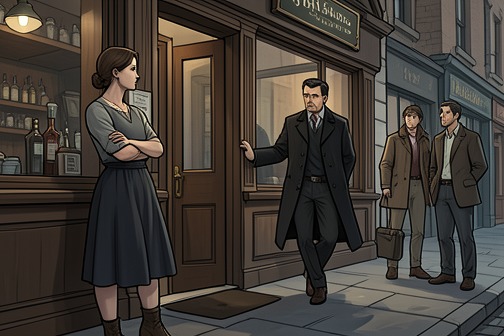
[Renee](entity:character-recall-character-renee-3bacf4904875) and Randy’s meeting is the decisive turning point in a romance built across the boundary between ordinary ambition and criminal power. What first appears to be an encounter with a dangerous drug kingpin becomes, through Renee’s influence and Randy’s own willingness to change, the beginning of his withdrawal from the drug trade, his new charitable career, and a shared future with Renee.
## Causes and Initial Circumstances
Renee meets Randy while celebrating with her college friends Sam and [Thea](entity:character-recall-character-thea-1f97d6230d52) after spending several weeks job-hunting. Dressed for a night out and determined to support a local bar, she finds Sam and Thea being refused entry by the bouncer. Renee approaches the entrance and argues that she lives nearby, will bring the bar good business, and that the three women only want a few drinks before leaving. Her directness draws Randy’s attention as he steps out of the bar.
Randy’s reputation gives the encounter its immediate danger. Thea identifies him as [Randy Paulson](entity:character-recall-character-randy-paulson-8db66f451b14) and describes him as probably the most influential drug dealer in that part of town, warning Renee that he is bad news. Renee has never even taken marijuana, yet the forbidden nature of Randy’s career intensifies her curiosity rather than extinguishing it. She recognizes the mismatch between them: she is a financially struggling sorority graduate with a marketing degree and considerable ambition, while he is surrounded by people who may be friends, clients, or both.
## The Meeting and Its Reversal
Renee’s attraction becomes physical before the relationship becomes intelligible. Randy is exceptionally tall, heavily muscular, sharply dressed, and marked by expensive grooming; his hazel eyes and self-assured manner make his attention difficult for her to resist. After she spends the evening trying to formulate a way to approach him, Randy unexpectedly sits across from her. Her startled greeting and job-interview-style handshake lead to their formal introduction: she gives her name as Renee, and he answers, “Randy.”
The apparent criminal romance changes direction when Randy tells Renee that he is bored and feels he is doing nothing useful with his business degree. He explains that watching college students graduate and move toward constructive lives has made him reconsider his own path. The drug trade is dangerous, he says, and there are many people to whom he could hand it over; he wants to leave it behind. Renee is surprised that the man she has imagined as a dangerous alpha drug lord may instead be someone seeking a legitimate life. Randy admits that part of his attraction to her is precisely that she is not involved with drugs, making the possibility of leaving the business feel more tangible.
This revelation shifts the event’s central value from danger to possibility. Renee first approaches Randy because the taboo surrounding him excites her, but his confession gives the attraction a future-oriented dimension. Their connection is no longer merely an encounter with a criminal outsider; it becomes a test of whether a person shaped by illicit work can choose a different identity.
## From Attraction to Deliberate Change
The relationship does not immediately erase Renee’s doubts. After Randy leaves, she worries that he may have been offering her a line and wonders what he could possibly gain from abandoning the business for unemployment and a relationship with a broke graduate who has not yet secured a job. Her suspicion is a genuine dark moment in the event’s development: Randy’s promise remains uncertain because his past gives him every reason to be distrusted.
Randy answers that doubt through action rather than another declaration. When he invites Renee out again, he brings a collection of curricula vitae and job applications for her to review and help complete. The gesture is unexpected for a second date, but it proves to Renee that he is genuinely attempting to start over. His change is therefore presented as practical and laborious. He must apply, accept the risks of leaving his established position, and construct a new public role rather than simply announce that he has become different.
Randy eventually finds work running a small charity for drug-addicted teenagers outside the city. The new position gives him a way to redirect knowledge of addiction toward helping people rather than profiting from the drug trade. Each day at the charity leaves him happier with his place in the world, while Renee obtains a copywriting job and begins advancing in her own career. Their parallel professional movement makes the romance reciprocal: Renee does not simply rescue Randy, and Randy does not merely provide her with excitement. Both are rebuilding their lives at a pivotal moment.
## Consequences and Ending
The immediate consequence of the meeting is a transformation in Randy’s occupation and social identity. He moves from suspected drug kingpin to charity worker serving drug-addicted teenagers, while Renee moves from an uncertain graduate searching for work into a copywriting career. The relationship thus links emotional intimacy with reinvention, but the text grounds that reinvention in concrete decisions, applications, and sustained employment rather than in desire alone.
Their attraction develops into love quickly. Renee and Randy fall hard and fast for one another, and the narrative treats their meeting as especially consequential because each encounters the other at a decisive point in life. They become evidence of one another’s capacity to adapt to changing circumstances. The criminal past remains the source of the initial tension, but the ending places greater weight on the fact that Randy follows through on his intention to leave it.
The event concludes with domestic commitment rather than a formal marriage. Renee has moved into an apartment months earlier, and Randy is preparing to move his belongings into that same home. Their willingness to adapt to one another is presented as the final proof that the encounter has become a durable partnership. The man Renee first sees as dangerous does not remain fixed in that role; he becomes someone building a legitimate vocation and a shared life, while Renee’s initial fascination with danger is converted into confidence in his capacity for change.
## Narrative Significance
Renee and Randy’s meeting uses the romance pattern of attraction, suspicion, disclosure, and demonstrable reform. The criminal identity creates the forbidden edge of the encounter, but the story reverses the expected trajectory: Renee does not descend into Randy’s world, and Randy does not use romance to preserve it. Instead, their contact helps make a different future imaginable, then measurable through his job search and charitable work.
The event also reflects the book’s recurring interest in relationships shaped by economic and social pressures. Elsewhere, marriage and partnership can function as contracts, solutions to inheritance conditions, visa insecurity, or financial distress. Renee and Randy’s connection is less formalized as a transaction, yet it still joins intimacy to work, status, and self-reconstruction. Their future becomes credible because both find a place in the world beyond the roles that first define them: Renee is more than a broke graduate, and Randy is more than his criminal reputation. The meeting matters because it turns those identities from apparent destinies into conditions that can be challenged.
Event 26
Demon Hunt and the Demon’s Death
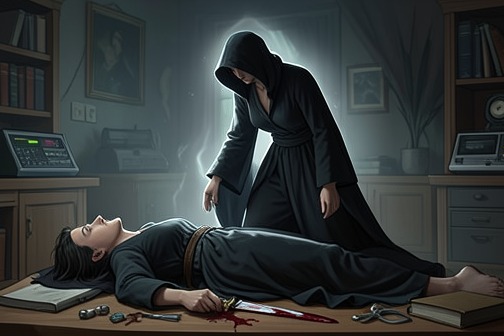
[Demon Hunt and the Demon’s Death](entity:event-recall-event-demon-hunt-and-the-demo-c1b7d45fe8a0) marks the moment when Alissa attempts to end the supernatural threat that has controlled her life and return to a future with [Niq](entity:character-recall-character-niq-604d64508f78). The demon’s death is not presented merely as a victory over a monster; it is Alissa’s effort to sever the chain between hunting, fear, and the loss of any ordinary human existence.
## Causes and Background
Alissa’s decision grows out of her recognition that demon hunting has consumed her. In conversation with Niq, she questions whether a normal life is still possible, since danger seems to surround everything she sees and everyone she cares about. She admits that she never chose this life and would not have chosen it if the choice had been hers. Her crisis is therefore both practical and existential: the demon is an immediate threat, but the life organized around pursuing it has become a second form of captivity.
The presence of Niq sharpens that conflict. He understands that Alissa’s circumstances are unlike ordinary human life, while she understands that his nature would place both of them in danger if the other hunters discovered it. Their relationship gives Alissa a concrete reason to imagine a different future, but it also raises the stakes of ending the hunt. She begins to wonder whether the demon’s death could release her from the past rather than simply provide another successful mission.
## Alissa’s Decision and the Hunt
Alissa acts on that realization by calling one of her hunter friends. She knows the hunter wants to pursue the demon, and she tells him that she knows where it is. During the call, she passes on all the information she possesses, effectively transferring the pursuit to someone prepared to carry it out. Her action is not described as a direct confrontation between Alissa and the demon; instead, the event turns on disclosure, delegation, and the deliberate use of knowledge gathered through her former life.
Once she has given the information, Alissa asks Niq to take her home. Niq stops the car, surprised by the request, and Alissa explains that he was right: she has allowed the demon to control her life. She wishes she had never learned what existed beyond ordinary human experience and wishes she could return to the time before she began hunting. The decision to send the hunter after the demon thus carries an unmistakable double movement. Alissa wants the creature destroyed, but she also wants to withdraw from the identity and obligations that made its existence the center of her world.
## The Demon’s Death and Immediate Consequences
The result arrives in the most compressed possible form. After Alissa wakes and begins dressing, her phone receives a message from the hunter she contacted earlier. The entire message says, “It’s dead.” That brief confirmation resolves the external threat while leaving the emotional consequences in Alissa’s hands. The demon is gone, but the life it shaped cannot simply be erased by a single text.
Alissa nevertheless treats the message as the answer she needed. She finishes dressing, takes Niq’s hand, and returns with him to her car. Their movement away from the site of the hunt and toward a hotel gives the aftermath a domestic and intimate direction rather than another supernatural escalation. At the hotel, Niq obtains the best room available, and the two move together through the elevator and toward a private space. Their physical closeness presents the possibility of a new life built around mutual desire and companionship, even as the danger of discovery by the hunters remains in the background.
## Meaning and Narrative Function
The event changes the value at stake from survival through continued vigilance to freedom through relinquishment. Alissa does not defeat the demon by proving that she can endure another battle; she acts by deciding that its influence must end, sharing the necessary information, and stepping away from the hunt. The hunter’s terse message supplies the plot’s factual closure, while Alissa’s hand in Niq’s establishes its emotional direction.
The demon’s death also exposes the cost of Alissa’s earlier existence. She has seen too much to recover an uncomplicated normality, and she knows that Niq’s identity could endanger them both if revealed. Even so, she chooses to focus on the happy life she hopes to build with him. The event therefore functions as both a supernatural resolution and a personal threshold: the monster dies, and Alissa begins trying to become someone who is no longer defined by monsters.
Event 27
Valerie’s Kidnapping
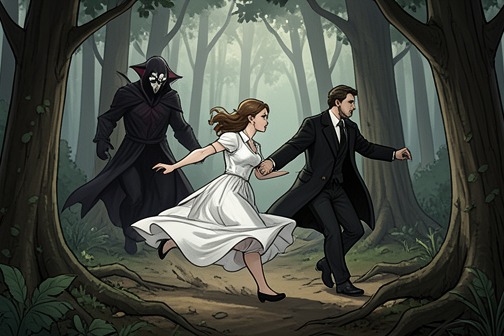
[Valerie’s Kidnapping](entity:event-recall-event-valerie-s-kidnapping-f82951a4a119) is a strategic abduction in which [Melonius](entity:character-recall-character-melonius-0eb2463dedfd), acting for his vampire father, removes [Valerie](entity:character-recall-character-valerie-879cd9992233) from college before the werewolves can turn her into a wolf or formalize her position as [the pack](entity:organization-recall-organization-tomas-30b0bd005fd3) leader’s bride. The event matters because it converts Valerie’s supposed marriage into a battlefield objective: the vampire [King](entity:character-recall-character-king-817ed90ecad5) wants to injure werewolf leadership by stealing the woman they carefully selected, while Valerie herself had imagined the arrangement as a limited, paper-based agreement that would allow her to finish college and retain her own life.
## Causes and Political Background
The kidnapping begins with the continuing war between [Vampires](entity:creature-recall-creature-vampires-1d7f37af175a) and [Werewolves](entity:creature-recall-creature-werewolves-8de514e497c0). The vampire King orders his son, Melonius, to find Valerie because he wants her taken before the werewolves can change her into a wolf. He describes the capture as a benefit to his side: taking a human mate would allow the vampires to get under the werewolves’ skin and damage their authority. His motive is therefore not Valerie’s safety or consent, but the symbolic and political value of depriving the opposing faction of its chosen bride.
The King makes the immediate reason explicit when he explains that the werewolves have selected a human as the princess bride of their pack leader. In his view, the selection is a carefully constructed act of leadership, and stealing Valerie from beneath the werewolves’ noses would create a visible wound in that leadership. The abduction consequently operates as both a rescue-prevention mission and an act of rivalry: Valerie’s body and future become instruments in a contest over prestige, succession, and supernatural power.
Melonius questions the policy before carrying it out. He argues that a human would offer little practical benefit beyond provoking the werewolves and suggests that his father should consider ending the war rather than escalating it by stealing mates. The King rejects that appeal, invoking the death of his own mate as the emotional source of his rage toward the wolves. His grief is not resolved; instead, it is converted into a justification for another coercive act, making the kidnapping part of a cycle in which earlier losses perpetuate new violence.
## Planning and Execution
The vampire side first searches for a point of vulnerability in Valerie’s routine. [Jesse](entity:character-recall-character-jesse-9add889b79bb) discovers that she attends a college class every Tuesday at 8:30 a.m. Two guards escort her as far as the parking lot but do not follow her into the school, apparently believing that an attack in a classroom would be unlikely. This information gives Melonius a predictable schedule, a partially protected route, and a precise place where Valerie can be separated from her werewolf security.
Jesse proposes that Melonius create a distraction and remove Valerie away from public view. He recommends drugging her rather than attempting to drag her away while she struggles, reasoning that witnesses might recognize an abduction. The plan includes a getaway vehicle positioned at the back of the college, with Jesse ready to drive once Melonius has acquired the target. The language of the preparation is deliberately operational: Valerie is treated as a target to be acquired rather than as a person whose decision could determine whether the plan is legitimate.
Melonius watches Valerie enter the college from the parking lot and communicates with Jesse through an earpiece and a small microphone pinned to his shirt pocket. Although he initially intends to coax her out of the building, he decides that she is unlikely to cooperate willingly. He therefore uses chloroform. When Valerie stops alone in an empty hallway to tie her shoes, Melonius approaches from behind, apologizes as he places the cloth over her face, waits for her to lose consciousness, and carries her out through the back of the hall.
He puts Valerie into the van Jesse has waiting. Jesse is surprised by how quickly the abduction has occurred, but the danger has not ended: he fears the werewolves’ response and recognizes that being a human participant in the war places him at risk. Jesse drives away and checks that they are not being followed. When Valerie begins to wake during the journey, Melonius sedates her again and keeps her unconscious until they reach their destination, preferring continued incapacitation to the possibility of a struggle inside the van.
## Valerie’s Position and the Conflict Over Consent
The abduction exposes a sharp contrast between the political story told about Valerie and the life she says she intended to lead. Valerie explains that the werewolf leader first noticed her beauty and then learned her personal history, after which he wanted to give her a chance at a real life. His father was pressuring him to select a mate, but neither Valerie nor the leader initially intended to treat the union as a conventional marriage. She wanted to complete college; he wanted to pursue his own activities. In her understanding, the arrangement could have remained largely symbolic and workable for both of them.
That account complicates the vampire King’s claim that taking Valerie is simply an attack on the werewolves. Valerie is not presented as an eager participant in a supernatural breeding project, nor as someone who has freely surrendered her future to the pack. She understands that the werewolves may eventually expect her to produce pups, but she believes there is no immediate need to consummate the relationship. Her expectations are limited, conditional, and centered on preserving time for her education and personal plans.
The later confrontation turns the issue from military possession into a question of legal and personal agency. [Kale](entity:character-recall-character-kale-6dafcc097f5f) insists that Valerie was chosen as his son’s mate and therefore has an obligation to the werewolves. [John](entity:character-recall-character-john-6bc68dc682c3) answers that, under the werewolves’ own laws, an unwilling mate cannot be married. He further argues that the werewolves cannot claim a woman who needs an opportunity to live her own life, warning that marriage to them could take away the freedom Valerie has not agreed to surrender.
John’s argument does not make the kidnapping harmless. Valerie has been removed from her college and from the choice she might have made for herself; she has merely been transferred between competing powers. Yet the exchange identifies the decisive value shift in the event. Valerie begins as a woman with a constrained but negotiable future, while the competing factions treat her as a strategic possession. The kidnapping turns freedom into captivity, and the subsequent debate restores the language of consent as a direct challenge to the werewolves’ customary claims.
## Consequences and Narrative Significance
The immediate consequence is that the werewolves lose physical control of the woman they intended to use as their leader’s mate, while the vampires gain a hostage whose significance extends beyond her individual identity. Jesse expects the wolves to be furious when they discover Valerie is gone, and Melonius leaves the political consequences to his father. The operation therefore threatens to intensify the war rather than resolve the grievance that produced it.
The event also reveals the instability of supernatural systems that connect bloodline, mating, and political authority. Elsewhere in the story, Tate recognizes the pressure to preserve pure werewolf royal blood while rejecting the contempt directed at humans and mixed-blood werewolves. Valerie’s kidnapping gives that broader conflict a physical form: both factions speak of mates, transformation, and leadership as if those institutions authorize possession, while Valerie’s own account insists that a political arrangement cannot erase her independent intentions.
As a plot structure, the event combines pursuit, abduction, rivalry, and rescue. Its suspense comes from the gap between the werewolves’ guarded expectation and the vampires’ successful exploitation of a routine weakness at college. Its deeper reversal is that the vampires’ attempt to undermine werewolf control does not establish Valerie’s freedom; it demonstrates how easily one coercive order can replace another. The kidnapping is therefore not a completed return to safety or integration. It is a forced crossing into a new sphere of danger, leaving Valerie’s autonomy as the unresolved stake around which the larger vampire–werewolf conflict continues.
Event 28
The Vampire-Werewolf Bride Conflict

[The Vampire-Werewolf Bride Conflict](entity:event-recall-event-the-vampire-werewolf-br-82d4e8084b06) turns [Valerie](entity:character-recall-character-valerie-879cd9992233)’s arranged mating into a direct test of whether a supernatural community can treat a woman as a consenting person rather than as a political or reproductive asset. Valerie had been selected for [Kale](entity:character-recall-character-kale-6dafcc097f5f)’s son under pressure from the werewolf leadership, but her attachment to [John](entity:character-recall-character-john-6bc68dc682c3) leads her to reject that future. John’s protection prevents the dispute from becoming an immediate armed clash, while Kale’s demands expose the violent assumptions beneath the language of obligation, marriage, and family continuity.
## Causes and Background
Valerie explains that Kale’s son chose her partly because he found her attractive and partly because, after hearing her story, he wanted to give her the possibility of a real life. The proposed marriage was initially meant to exist largely on paper: Valerie wanted to finish college, while the young werewolf wanted to pursue his own plans. She understood that the arrangement carried an expectation that she would bear pups, but she believed there was no immediate pressure to consummate it. Her account presents the match as a compromise that might have allowed both parties some independence, even though the werewolf community treated it as a binding reproductive obligation.
The arrangement is also shaped by werewolf bloodline politics. Tate’s reflections elsewhere in the narrative distinguish ancient pure-blood werewolves from those born of human-werewolf unions or changed by another werewolf, and he recognizes that his own ancestry extends back thousands of years. Accalia treats non-pure werewolves and humans as inferior, whereas Tate rejects that hierarchy. Valerie’s conflict therefore belongs to a wider pattern in which ancestry, marriage, and reproduction are used to preserve supernatural status. Her proposed union is not merely romantic; it is tied to [the pack](entity:organization-recall-organization-tomas-30b0bd005fd3)’s authority over bodies and succession.
## The Confrontation at John’s House
The immediate crisis begins when [Melonius](entity:character-recall-character-melonius-0eb2463dedfd) warns his father, John, that the wolves are at the door demanding Valerie’s return and have brought enforcers with them. He fears that the household lacks enough guards to prevent the meeting from becoming bloody. John agrees to meet Kale without either side’s guards present, but he orders Melonius to protect Valerie. His response makes the stakes clear: he is willing to negotiate, but not to surrender her to a force that intends to treat her choice as irrelevant.
Kale enters John’s office as the wolf leader and declares that John has his son’s bride-to-be. John acknowledges the claim but insists that Valerie is not being held against her will and offers to let Kale ask her directly. Kale argues that Valerie was chosen as his son’s mate and therefore has an obligation to return. John counters with the werewolves’ own law, reminding him that an unwilling mate cannot be married. The dispute thus turns on competing interpretations of the same social order: Kale emphasizes selection and duty, while John invokes consent as a limit on those claims.
When Valerie enters the room, she is visibly nervous. Kale moves toward her, and John instinctively steps between them, warning Kale away as his eyes flash red and his fangs emerge. The physical gesture makes the moral conflict visible: John’s protection is not abstract sympathy but a bodily refusal to let the werewolf leader intimidate Valerie. Kale accuses her of abandoning the people who saved her and joining the vampires, but Valerie answers that his son deserves a woman who loves him. Kale replies that his son needs pups and a wife, not love, reducing marriage to breeding and social function.
## Valerie’s Choice and the Threat of War
Valerie’s decision becomes explicit when she tells Kale that she will not return to a relationship without love. She places her hand on John’s cheek and tells him that he has never frightened her, a gesture that confirms both her trust in him and the difference between his protective force and Kale’s coercive demand. When Kale mocks the possibility that they are in love, John states that Kale cannot have her and draws Valerie protectively against his side.
Kale then reverses his language, claiming that he does not want Valerie and calling her damaged goods while insisting that his son deserves better. The insult reveals the possessive logic beneath his earlier demand: Valerie is valuable when she serves the pack’s reproductive purpose, but disposable when she refuses it. He threatens revenge before leaving, making clear that the immediate negotiation has not ended the hostility between the groups.
The meeting nevertheless avoids open violence. Valerie stands stunned because she had expected bloodshed, while John explains that the last physical war between vampires and werewolves caused heavy losses on both sides and that the groups generally try to avoid repeating it. Their disputes are often petty, but the bride dispute carries the potential to reactivate that older conflict. Valerie’s choice therefore functions as both a romantic decision and a narrow peacekeeping moment: her refusal prevents her forced return, while John’s intervention keeps the confrontation from becoming a battle.
## Law, Consent, and Reproductive Power
The event’s central contradiction is that several characters describe reproduction as a communal necessity while Valerie experiences the same expectation as a threat to her autonomy. Kale believes that being selected makes her responsible for producing pups, and his claim treats the young werewolf’s need for a wife as more important than Valerie’s feelings. John, by contrast, argues that a woman who needs the chance to live her own life cannot be claimed simply because a pack has designated her as a mate.
This tension echoes other inheritance and breeding arrangements in the narrative. William learns that he must marry and produce an heir to control his family estate, while Sloan and [Amy](entity:character-recall-character-amy-b0c9984bdc2f) discuss a will requiring pregnancy within six months of marriage. Urieal defends the breeding of a human for a royal hybrid program but argues that humans should be treated as equals rather than animals. In another conflict, a husband proposes that Penelope remain until she gives birth and then surrender the baby to his wife, threatening to leave her destitute when she refuses. Valerie’s case belongs to this recurring structure: institutions convert intimacy and fertility into contractual resources, and the plot tests whether individuals can resist that conversion.
The contrast is sharpened by relationships that move beyond reproductive purpose. Dennis tells Kember that he wants not merely a baby but a genuine relationship with her, explicitly joining his desire for the child to his desire for Kember herself. [Borg](entity:character-recall-character-borg-7ed238786ac5), by comparison, speaks of claiming Dawn and timing the pregnancy so paternity can be established. Valerie’s rejection of Kale’s arrangement aligns her with the narrative’s recurring insistence that partnership cannot be reduced to lineage, biological proof, or institutional duty.
## Consequences and Narrative Significance
The immediate outcome is that Valerie remains with John rather than returning to Kale’s son. John’s defense gives her a protected space in which her own answer determines the result, and Kale leaves without taking her. Yet the ending is deliberately unstable: Kale promises revenge, refuses to accept John’s moral authority, and declares that he will raise his pack according to his own principles. The conflict is contained, not resolved.
As an event, the confrontation combines the dramatic situations of threatened abduction, forbidden love, rivalry between groups, and resistance to imposed marriage. Its decisive value shift is from Valerie’s presumed status as an already assigned bride to her recognition as an agent whose refusal can redirect the future of two communities. The wolves arrive expecting possession and perhaps violence; they leave without Valerie because her choice, supported by John’s authority and force, cannot be silently overridden.
The conflict also exposes the difference between a rule that exists on paper and a society willing to honor it. John can invoke the principle that an unwilling mate cannot be married, but Kale’s behavior shows that the principle is contested whenever bloodline and reproduction are at stake. Valerie’s selection of John therefore has significance beyond the love triangle. It challenges the pack’s claim to define her belonging, interrupts a hereditary mating system, and briefly replaces the logic of compulsory alliance with the possibility of chosen attachment.
Event 29
Valerie’s First Painless Shift

[Valerie’s First Painless Shift](entity:event-recall-event-valerie-s-first-painles-0bc168db54f0) marks the moment when [Valerie](entity:character-recall-character-valerie-879cd9992233)’s werewolf transformation ceases to be only a source of fear and becomes evidence of emotional change. Guided by [John](entity:character-recall-character-john-6bc68dc682c3) after an intimate encounter, she shifts without pain for the first time, discovering that her feelings for him can steady her body as powerfully as they affect her heart. The scene turns a supernatural ordeal into a test of trust, acceptance, and belonging.
## Causes and Immediate Circumstances
The shift follows an intensely intimate moment between Valerie and John in a garden. They are sweaty and catching their breath as daylight fades into a streak of pink and purple, and John asks whether she wants to try transforming. His question frames the change as an experiment undertaken together rather than a danger Valerie must face alone. Valerie agrees, removes her socks, and only then realizes that she has been completely naked in his arms except for them, a detail that emphasizes both the physical vulnerability of the moment and the closeness she has accepted with John.
Valerie’s earlier transformations have been associated with pain severe enough to frighten her and interrupt the process. As she focuses and calls on her wolf, she expects that pain to return and to make her panic or stop shifting. The expectation itself is part of the obstacle: her body remembers transformation as something threatening, while the present scene offers John’s presence as a competing physical and emotional point of reference.
## The Painless Transformation
Rather than concentrating on the anticipated pain, Valerie thinks about John. She recalls his kisses and touch, the sensation of his teeth when he nibbles on her, and the way he looks at her across a room when he believes she is not watching. When the shift begins, she continues to hold his image in mind, adding the memory of his scent to the thoughts that anchor her. The transformation therefore proceeds through embodied recollection rather than explanation or command; touch, smell, gaze, and remembered intimacy become the means by which she remains present in her changing body.
A few minutes later, Valerie opens her eyes and realizes that the transformation has occurred without pain. The narration isolates the discovery with the emphatic statement that it has happened “For the first time.” That brief emphasis gives the event its full measure: this is not merely a successful shift but a reversal of Valerie’s established expectation. Pain no longer determines the limits of her supernatural identity, and the body she feared can now respond without overwhelming her.
## John’s Role and Valerie’s New Sense of Safety
John does not force the transformation or claim credit for it. He asks whether Valerie wants to try, waits while she concentrates, and then accepts the wolf she becomes. Valerie runs in circles around him, and he smiles and waves her off, telling her to run and enjoy herself because that is what they came outside to do. When she pauses in front of him, he rubs her head and accepts her. His response makes the shift a moment of recognition: Valerie is not required to suppress the wolf in order to remain desirable or loved.
The scene’s emotional movement is from anticipatory fear to physical freedom. Valerie’s body initially waits for the familiar pain, but her attention is redirected toward John’s affection and sensory presence. His acceptance does not erase the danger surrounding their relationship; instead, it gives Valerie enough security to experience her own nature without immediately resisting it. The event thus joins romantic intimacy to supernatural control without reducing the transformation to a purely mechanical power.
## Consequences and Continuing Conflict
Valerie interprets the painless change as part of a larger emotional transformation. Whatever she feels for John makes her feel whole from the inside out, and she finally feels at peace. That peace is not presented as uncomplicated. She wonders whether loving him will eventually blow up in her face, and she knows that the wolves will want revenge because John has stolen her. The shift therefore occurs under the shadow of retaliation and divided allegiance: Valerie has found safety with John, but the community from which she has been taken remains a source of threat.
Her decision to run nevertheless shows that fear no longer controls the immediate moment. She accepts the wolf’s movement, enjoys the freedom of the transformed body, and returns to John by choice rather than because she has been immobilized by pain. The consequence is both practical and relational. Valerie gains a new experience of painless transformation, while her bond with John becomes associated with calm, wholeness, and acceptance even as it intensifies the wolves’ hostility.
## Narrative Significance
The event functions as a compact value reversal. Valerie begins with the expectation that transformation will produce pain and panic; she ends with a painless shift, playful movement, and a felt sense of peace. The supernatural change is inseparable from the emotional bond that accompanies it, making the scene a threshold in Valerie’s development from someone frightened by her own body into someone capable of inhabiting it.
Its significance also lies in the contrast between bodily vulnerability and bodily agency. Valerie is naked, sensitive, and initially dependent on John’s reassurance, yet the decisive action belongs to her: she focuses, calls on her wolf, sustains the memories that steady her, and completes the shift. John’s acceptance provides the relational condition for the change, but Valerie performs it. The result is not an escape from conflict but a new capacity with which she can face the consequences of loving him.
Event 30
The Werebear Rescue
[The Werebear Rescue](entity:event-recall-event-the-werebear-rescue-9c95d09051da) is the decisive reversal in [Abigail](entity:character-recall-character-abigail-d72687631c24)’s flight through the forest: the wolf that is about to kill her is driven away by Malleus in werebear form, but the rescue immediately becomes another captivity. The scene makes protection inseparable from danger. Abigail survives the attack, yet she must confront a creature whose size, strength, and motives she cannot understand, while the encounter exposes the supernatural world and Malleus’s concealed identity.
## Causes and Background
Abigail reaches the woods while already in a state of fear and vulnerability. A wolf comes within a yard of her, its expression hardening into an aggressive stare as it bares its teeth and prepares to pounce. She retreats so violently that she falls backward onto the grass, leaving herself almost helpless at the precise moment when the threat becomes physical and immediate. The wolf’s growling and advancing body establish a clear value shift: the forest is no longer merely a place of escape, but a space in which Abigail’s life can end within seconds.
Her predicament is intensified by the absence of any reliable human shelter. When she later recounts the episode, she says that a bear kidnapped her, and her explanation sounds so impossible that Malleus laughs and repeats the claim back to her. Abigail insists that the animal blocked the exit, while Malleus interprets the event through his own knowledge of werebears. His reaction reveals that Abigail has crossed into a reality she does not yet possess the vocabulary to describe. She saw a bear; Malleus recognized a werebear.
## The Rescue and Transformation
Just before the wolf makes its deadly leap, a large fur-covered appendage sweeps into the scene and strikes it away. The wolf is thrown several feet, whines, and begins pacing while looking first at Abigail and then at the monstrosity behind her. The intervention is therefore unmistakably protective in its immediate effect: the attacking wolf loses its advantage, and Abigail is spared the pounce that seemed certain to kill her.
The rescuer is an upright bear-like being more than eight feet tall. Abigail notices its terrifying snout, fur-covered body, huge forearms, and upper claws so heavy that they resemble a man’s hands. Its posture is especially disturbing because it walks on its hind legs as though it has long been accustomed to standing upright. The creature does not fit the category of an ordinary animal, yet Abigail has no established name for what she sees. Her attempt to calm it by promising not to make sudden movements is less a negotiation between equals than a desperate effort to avoid provoking a force vastly stronger than herself.
The creature answers with another roar and advances while fixing its snout in her direction. It beats its chest, an action Abigail recognizes as unlike a normal bear, and communicates dominance through posture and movement rather than speech. Abigail responds by shrugging and silently conceding its superiority, hoping that the gesture will convey that she means no harm. The encounter thus turns on bodily communication: the wolf’s aggression, the werebear’s warning, and Abigail’s submission are all understood before anyone can explain the situation in words.
## Protection Becoming [Captivity](entity:state-recall-state-captivity-0bc31185b3d3)
After deciding not to attack her, the werebear grabs Abigail with its long arms. It first dangles her and then throws her over its shoulder, so that her stomach slides against its back as it carries her away. Abigail pounds on the creature and struggles with her legs, but the werebear ignores her cries and continues walking. The rescue has preserved her life while removing her ability to choose where she goes, making the scene an inversion of the conventional rescue plot.
The werebear takes her to a cave with high rock ceilings and several ghastly skeletons. It sets her down and releases her, but its massive body remains directly in front of the entrance. Abigail backs deeper into the darkness, understanding that the cave is not a refuge she can leave at will. She waits for roughly an hour while the werebear lies unconscious, its enormous back rising and falling with sleep. Escape remains dangerous because the only route out requires stepping across or over its rolled-up body, and any movement might awaken it.
The cave crystallizes the event’s central ambiguity. The werebear has saved Abigail from one predator, but it has also placed her in a confined space where its intentions remain uncertain. She fears that it may regard her as a human mate and worries about how she could reject it or escape if it tried to force intimacy. Even while facing possible death, she fixates on the creature’s physical scale and the possibility that its body itself could become a lethal threat. Her fear is not abstract; it is organized around the blocked entrance, the sleeping body, and the narrow chance of passing without waking the being that controls the cave.
## Recognition and Disclosure
The later conversation with Malleus supplies the name and context that Abigail lacked during the rescue. When she asks why he called the creature a werebear, she points out that she had said only “bear” and had not even mentioned that it walked on two legs. Her challenge makes the naming significant: Malleus knows details that Abigail did not tell him, suggesting that his knowledge comes from personal familiarity rather than rumor.
Malleus’s answer links the werebear to his own history. When Abigail asks whether he ran away from home, he replies that he has never had a home. Her incredulous suggestion that he might have been raised by wolves receives the bitterly comic correction that he was raised by bears. The exchange does not provide a full biography, but it establishes Malleus as someone formed outside ordinary domestic belonging and closely connected to the bear world. The earlier rescue can therefore be read not as an isolated animal attack but as the first visible expression of Malleus’s dual identity and his relationship to the forest.
## Narrative Significance
The event combines the master plots of rescue, escape, pursuit, and transformation. Abigail escapes the wolf only to become the captive of a larger and more mysterious being; the apparent savior occupies the position of both ally and threshold guardian. This reversal prevents the scene from offering uncomplicated safety. Life moves from immediate danger to suspended danger rather than from peril to freedom, and the reader is forced to hold gratitude and fear together.
The werebear’s body also unsettles the boundary between human and animal. Its fur, bear-like face, enormous claws, upright posture, and deliberate gestures make it visibly hybrid, while Malleus’s later comments indicate that such beings belong to a known supernatural order. Yet the scene remains firmly anchored in Abigail’s limited human perspective: she can observe the creature’s strength and behavior, but she cannot read its motives or control the terms of contact. The rescue consequently changes more than the outcome of a wolf attack. It introduces a world in which survival may depend on an inhuman power whose protection itself carries the threat of possession, confinement, and a new form of dependence.
Event 31
Jake’s Death
[Jake’s Death](entity:event-recall-event-jake-s-death-5ce9c37e93bd) is the central rupture in the narrator’s life: the death of her husband, a Navy SEAL stationed in the Middle East, ends an eight-year love story and leaves her suspended between the physical traces of their marriage and the pressure to resume ordinary life. The event’s decisive force lies in its double shock. She had always known that Jake’s work could kill him, yet she had protected herself from that knowledge by counting down the days until his return. When death finally arrives, it destroys not only her husband but also the future she had organized around waiting for him.
## The Marriage Before the Loss
The narrator and Jake met eight years earlier, shortly after both had left high school and arrived in [Chicago](entity:location-recall-location-chicago-eb77a855d5aa) for different purposes: she pursued a journalism degree, while he entered basic training. They met in a bar before those commitments began, and their relationship quickly became more substantial than the casual romantic adventures surrounding them. They moved in together and became engaged before Jake’s first deployment. Her choice to marry a Midwestern soldier pleased her traditional mother, while the couple’s small home outside the city became the domestic space she prepared for their shared future.
Distance shaped the marriage without weakening its emotional intensity. While Jake served abroad, the narrator developed her career through local art zines, and the couple maintained their connection through Skype calls and letters. His return brought a promise that they would marry before his next departure, and she describes his physical presence as immediately comforting and protective. Jake introduced her to two Navy friends, including Tate, and both friends later served as best men when the couple obtained a marriage license and married at a local court two days before Jake flew out again. Their marriage therefore begins with love, but also with postponement: home, career, and ordinary companionship are repeatedly placed after military duty.
## The Death and Its Immediate Revelation
The narrator understood that Jake’s profession was inseparable from danger. He was not working in an office or bank but deployed with his regiment in the Middle East as a member of the [Navy SEALs](entity:organization-recall-organization-navy-seals-448396a16812), an elite Special Forces unit that made him appear almost invincible to her. She knew he might already be dead at a moment when she had received no warning, but she deliberately pushed that possibility away because dwelling on it was too painful. The calendar offered a manageable substitute for fear: she counted the days until he came home and imagined that worry would end when he returned.
The news is delivered by Tate, who has just come back from deployment. His tense face, marked by fear and grief, tells the narrator what has happened before he needs to explain it. She collapses into his arms while trying to manage the practical logistics of Jake’s death. The scene joins military danger to intimate knowledge: Tate is both a fellow SEAL and one of the couple’s friends, so the messenger embodies the world Jake belonged to and the personal life that has been shattered by his absence.
## Grief as Bodily Memory and Social Pressure
The narrator refuses to pretend that she can fully explain the grief of losing the person she has loved for years. Her mourning is rendered through repeated physical and domestic absences rather than through a single declaration of sorrow. For months she holds Jake’s clothes to her nose, inhaling the lingering scent of his skin until it fades. Notes he once wrote appear unexpectedly from behind desks and inside drawers, while waking in bed produces the reflexive expectation that he is still beside her, followed by the realization that he is gone. Memory continues to enter the present through smell, objects, and habitual movement, even as the material evidence of him disappears.
The funeral is organized by the military, and the narrator allows grief to numb her through the process. The loss is made public as well as private: she feels watched, judged according to whether she is grieving in the socially correct manner. Jake’s family gradually withdraws from her social circle despite their kind words, and several of her own friends find her vulnerability too difficult to bear. Invitations diminish, leaving her more isolated and paradoxically more disconnected from Jake after his funeral. The event therefore produces a second wound alongside widowhood: the survivor must perform grief under observation while losing parts of the community that might have helped her endure it.
## Reconstruction After [Widowhood](entity:state-recall-state-widowhood-bcb4bde2f58a)
The narrator responds by throwing herself into work. She pitches raw, unconventional articles about military families and their place in society, and her writing appears in local weekly magazines before some of her commentary is included in a Chicago Daily Tribune think piece. Journalism becomes more than a career; it gives form to an experience that private conversation cannot adequately contain. By writing about military families, she turns the structure that took Jake from her into the subject through which she begins to understand her own life.
Recovery remains gradual rather than complete. She builds a new circle of friends who are more focused and more like her than the artsy acquaintances who withdrew. Looking toward her twenty-seventh year, and toward her second year without Jake, she feels a cautious optimism. She moves into a new apartment in the center of Chicago, adopts a kitten named Scoop, and removes most of the physical trappings of her former life. These changes do not erase Jake: she still misses him and thinks about him every day. Instead, they establish a life in which remembrance no longer requires permanent suspension.
## Narrative Significance
Jake’s Death functions as a trauma event whose full meaning emerges through delayed recollection. The narrator first states that the loss is nearly impossible to communicate, then returns to the marriage’s history, the military danger she avoided thinking about, the manner of the notification, the funeral, and the long persistence of ordinary habits. The narrative moves between what she knew before the death and what the death teaches her afterward: danger was present all along, but knowledge of danger is not the same as living through its consequence.
The event also defines the contrast between romantic devotion and survival. The narrator had accepted the possibility of putting her own career on hold until Jake finished his overseas service, believing that waiting would be worthwhile when she could return to her husband at the end of each working day. After his death, that imagined future becomes impossible. Yet the memory of Jake does not demand that she remain trapped in it. She recalls that he would not have wanted her to spend the rest of her life grieving for someone who could give nothing back, a conviction that supports her movement toward work, friendship, a new home, and renewed emotional possibility. Jake’s death thus remains the source of her grief while also becoming the boundary across which she begins again.
Event 32
Erica and Tate’s Relationship
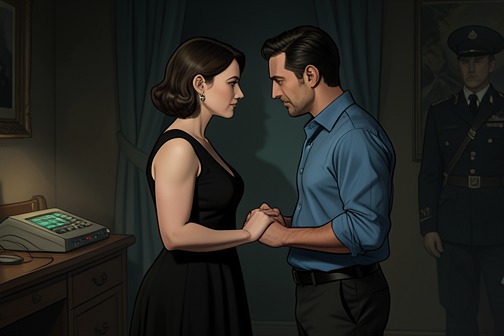
[Erica and Tate’s Relationship](entity:event-recall-event-erica-and-tate-s-relati-3f1b4fddc0ce) is the story’s decisive movement from shared mourning into renewed intimacy. Erica is Jake’s widow, while Tate is Jake’s close friend and former best man, making their romance feel at once emotionally inevitable and morally dangerous. Their bond gains force because neither has to explain the particular burden of having loved Jake, yet that same understanding makes every step toward love seem like a possible betrayal. The relationship ultimately gives Erica a way to stop defining herself only as a widow and gives Tate a chance to rebuild his own life after military service and loss.
## Identity and Background
Erica’s connection with Tate begins in the aftermath of Jake’s death. She describes grief as the raw pain of losing the person loved for years, preserving Jake’s presence through the scent left on his clothes, notes discovered in drawers, and the repeated shock of waking and expecting him to be beside her. Jake had served in the Middle East with the [Navy SEALs](entity:organization-recall-organization-navy-seals-448396a16812) as a Special Forces soldier, and Erica had always understood that his work carried the possibility of death, even while she pushed that fear aside and counted down the days until his return.
Tate shares the wound from another position. After what happened to the rest of his regiment, he received an honourable discharge and struggled to adjust to city life. Jake had described him as a reformed bad boy who had entered the Navy only after pressure from his parents, initially resisting before finding a family in his regiment. Military service did not erase his swagger, but it was joined by vulnerability, maturity, intelligence, and a desire to make his life useful. After leaving a series of low-paid jobs, Tate concentrated on doing good for the veteran community and continued training for counselling, an effort Erica admired.
## From Grief to Attraction
At first, Erica found it too painful to spend time with Tate because of his closeness to Jake. They nevertheless kept in touch, sharing the emotions of grieving the same man. Their conversations could include intimate memories of Jake’s speech tics and the way his voice cracked when he became excited—details that outsiders could not understand in the same way. Tate’s own readjustment after military service made him an unusually credible companion for Erica: both were trying to live in a city after a life structured by absence, danger, and bereavement.
Their friendship also carried a gradually acknowledged curiosity. Tate occasionally texted Erica for what he called “women advice,” revealing his inexperience with dating despite his imposing six-foot frame. She saw past that physical presence to a sweet man with a warm, unexpected sense of humour, and began wondering what he might be like on a date. The possibility remained unspoken until a visit ended with Tate leaving her apartment and Erica realizing how desperately she wanted him. When he returned and tapped at the door, she understood that he had come back for the same reason. He pulled her into a kiss that felt unlike her recent dates and released feelings that had been waiting beneath the friendship.
The kiss is charged by memory as much as desire. Erica recognizes that Tate had once watched her and Jake kiss in their wedding ceremony, so his intimacy with her cannot be separated from his witness to the marriage that preceded it. The relationship therefore begins in a space where pleasure and guilt arrive together. The physical immediacy of the encounter does not erase the past; it makes the past newly present, forcing both characters to decide whether loyalty to Jake requires emotional stasis.
## The Decision to Try
Tate names the obstacle directly. He tells Erica that he likes her but understands their complex positions: she is the widow of the man he knew, and he was the best man at her wedding. He does not want to betray Jake or overstep with Erica, yet he also wants to act on what he feels. His approach is neither a secret conquest nor an attempt to deny the moral complication. He presents the relationship as a choice that must be made openly.
His reasoning rests on shared experience. Tate believes they may work better together than with people who have no understanding of their circumstances, because both are beginning again from the same place. Erica accepts that logic. Dating other men had required her to explain the overwhelming fact of having a dead husband on the first dates, whereas Tate already understood the emotional terrain without demanding a full account. The mutual knowledge turns attraction into compatibility: the chemistry is immediate, but the trust beneath it has been built through mourning.
Erica responds by choosing action over further self-denial. She kisses Tate on the couch, and the physical ease of the encounter contrasts with the anxieties usually associated with a first kiss. She feels both the strangeness of beginning intimacy again and the comfort of being desired and desiring someone in return. Tate initially takes things slowly, allowing them to reacquaint themselves with intimacy, even as the intensity between them presses toward a deeper relationship.
## Relationship and Social Conflict
The next few weeks transform Erica’s private identity. Dating Tate allows her to release, at least partly, the role of the widow who has been left behind. She experiences the relationship as a missing piece finally falling into place, not because Jake’s death becomes less painful, but because her life acquires a future that is not organized entirely around that death.
Their decision provokes disapproval from people connected to Erica’s earlier life. Friends who had drifted away return with questions and react with horror when she confirms that she and Tate are together and happy. Their outrage treats widowhood as a permanent obligation and moving on as an act of audacity. Erica rejects that judgment. She refuses to continue living according to expectations imposed by people who neither share her grief nor bear responsibility for her future, turning the relationship into an assertion of personal agency as well as a romance.
The couple’s domestic routine gives the new bond ordinary substance. Tate visits while Erica finishes work, cooks dinner, and shares wine and the most interesting parts of the day with her. He continues his counselling training, while Erica takes pride in his effort and remains impressed by him. These repeated acts matter because they replace the heightened drama of grief and forbidden attraction with a pattern of care: the relationship becomes a life practiced through meals, conversation, work, and mutual encouragement.
## Narrative Significance
The relationship’s central value shift runs from immobilizing loss toward chosen renewal. Jake’s death remains the emotional foundation of the story, and the narrative does not pretend that grief can be fully explained or simply overcome. Instead, Erica’s recovery occurs through a belated reorganization of memory. She continues to miss Jake and think of him daily, but she also remembers that he would not have wanted her to spend the rest of her life grieving for someone who could give nothing back. Tate becomes the person who can witness that grief without requiring Erica to remain trapped inside it.
The romance also makes intimacy a form of testimony. Tate and Erica know Jake through different but overlapping memories, and their relationship preserves rather than cancels his significance. Their shared jokes, their knowledge of his mannerisms, and the unease surrounding Tate’s presence at the wedding keep the dead man within the emotional architecture of the new relationship. What changes is not whether Jake mattered, but whether his importance must prevent the living from forming another attachment.
As an event, Erica and Tate’s Relationship is presented through impersonal third-person framing around scenes narrated from Erica’s intimate perspective, with the decisive moments carried by remembered grief, bodily attraction, and direct conversation. Its emotional power comes from the collision of two truths: Erica and Tate are connected because of Jake, and they can become partners only by accepting that their lives cannot remain permanently defined by him. Their romance is therefore both a continuation of shared loyalty and a refusal to let bereavement become the final shape of either person’s life.
Event 33
Erica and Tate’s Pregnancy

[Erica and Tate’s Pregnancy](entity:event-recall-event-erica-and-tate-s-pregna-5707f820c95c) is the culminating event of a romance built from grief, hesitation, and renewed trust. The pregnancy confirms that their relationship has moved beyond a temporary refuge from loss and gives their carefully limited new life an irreversible future-oriented consequence.
## Causes and Background
Erica enters the relationship carrying the aftermath of Jake’s death. Jake had been an elite Navy SEAL stationed in the Middle East, and Erica had long understood that his work placed him in constant danger, even while she pushed that fear aside and counted the days until his return. His death leaves her with an intense widowhood defined by absence, memory, and the physical traces of the life they shared, including his clothes, notes, and the empty space beside her in bed.
Tate becomes important because he offers Erica a way to live again without demanding that she deny what came before. During the first weeks of their relationship, she is finally able to release the identity of being only a widow and to give herself emotionally to someone new. Their romance is initially sustained by caution: Tate visits while she finishes work, cooks dinner, shares wine with her, and continues training for counselling. The routine is intimate but deliberately modest, allowing Erica to experience security without immediately committing to another life-changing arrangement.
## The Relationship Before the Pregnancy
The pregnancy follows a period in which Erica and Tate discover a stable domestic rhythm. Erica values the simplicity of their arrangement and the fact that they have not yet made a major commitment. That limited scale makes the relationship feel safe, but it also reveals how thoroughly Tate has altered Erica’s understanding of what is possible. She had believed that a tragedy as devastating as Jake’s death had made rebuilding her life impossible; being with Tate proves to her that a second chance at a good beginning remains available.
Their happiness is not universally accepted. Friends from Erica’s earlier life question whether she has moved on too soon and react with horror when she confirms that she and Tate are together. Erica refuses to let their disapproval determine her choices. Her decision to continue the relationship therefore carries a second meaning: the pregnancy grows out of her rejection of the expectations that had kept her tied to a prescribed identity as a grieving widow.
## What Happens
Approximately two months after Erica and Tate settle into their routine, the safety of their uncomplicated arrangement changes. Tate comes to Erica’s home and immediately recognizes from her expression that something is wrong. She has been clutching a positive pregnancy test at her side, and when she raises it for him to see, no explanation is necessary. Her anxiety gives way to elation as Tate embraces her and nuzzles her neck.
The scene turns on a rapid movement from apprehension to shared joy. Erica’s fear reflects the scale of the discovery: pregnancy is not merely another pleasant development in a relationship that has been intentionally kept small. It makes their future tangible and places their emotional recovery within the demands and possibilities of family life. Tate’s physical response communicates acceptance before either character needs to explain what the result means, and the event closes with their renewed intimacy rather than with uncertainty or separation.
## Consequences and Ending
The pregnancy changes the value of Erica and Tate’s relationship from provisional comfort to durable family potential. Their connection had allowed both of them to begin again, but the positive test establishes that the beginning is no longer metaphorical. The relationship now carries a child and the responsibilities associated with parenthood, making the second chance they found in each other materially consequential.
The event also completes the narrative movement from bereavement toward chosen attachment. Erica does not erase Jake or pretend that grief was insignificant; instead, she reaches a point at which love for Tate and hope for a child can coexist with the memory of the man she lost. The pregnancy therefore functions as both a romantic confirmation and a structural ending. The story concludes at the moment when their private happiness opens into an uncertain but shared future, leaving the couple in a state of elation and renewed commitment rather than returning them to the isolation that followed Jake’s death.
Event 34
Radiant’s Rejection of Forced Breeding
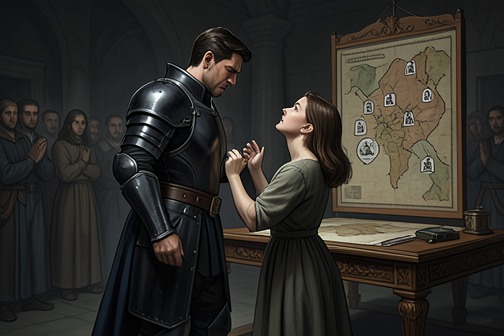
[Radiant’s Rejection of Forced Breeding](entity:event-recall-event-radiant-s-rejection-of-907647c0717c) marks the moment when [Prince Radiant](entity:character-recall-character-prince-radiant-6d4f17dd80ca)’s assigned duty collides with [Amy](entity:character-recall-character-amy-b0c9984bdc2f)’s insistence on bodily autonomy. Sent to impregnate a human for the Chubalahans’ breeding and experimentation program, Radiant initially treats the task as a protocol that must be completed. Amy’s refusal, however, forces him to confront the violence hidden inside that supposedly rational system. His response does not immediately become open rebellion, but his decision to delay, consult Admiral Hutt, and reconsider the use of force establishes the first meaningful break between his personal ethics and the authority he serves.
## Causes and Background
Radiant’s mission belongs to a larger Chubalahan program that selects humans for experimentation and reproduction. The species considers humans comparatively primitive and views them as a population from which useful genetic material may be taken. Its officials do not regard human subjects as equals, and Admiral Hutt openly classifies them as slaves. The program therefore converts reproduction into an administrative quota: the human body is a resource to be evaluated, impregnated, and returned to the system’s schedule.
Amy enters this system already carrying a complicated desire for motherhood. In another context, she has discussed marriage and pregnancy as practical requirements, including a family inheritance stipulation that demands marriage and pregnancy within six months. Yet her willingness to contemplate having children does not mean that she consents to an imposed procedure. When Radiant explains that the Chubalahans prefer automatic impregnation because it is considered safer and less prone to infection or birth defects, Amy rejects the medical logic as an answer to her human need for intimacy. She says that she will consider children with them only if they romance her and physically connect with her, making clear that reproductive desire and reproductive consent cannot be separated.
## The Confrontation with Amy
Radiant’s rejection begins as a refusal to accept the terms of the experiment. Amy tells him that she will not submit to medical evaluation and will not allow herself to be impregnated mechanically. When he approaches with a stunning device after deciding that enough time has been wasted, her protest changes the encounter from a procedural disagreement into an explicit plea for freedom. She says that she does not want the process carried out that way and asks him to respect her wishes.
Amy then explains why the demand matters to her. She has always wanted a baby, but she does not want motherhood to become another lonely experience. Men who might have fathered a child with her had seemed cold and heartless, and she had rejected relationships that offered biological possibility without affection. Her appeal therefore does more than oppose a single alien technology; it defines the conditions under which she considers reproduction meaningful. She wants a child connected to mutual care, desire, and emotional responsibility rather than to an impersonal breeding schedule.
Radiant is unsettled by the directness of her fear and loneliness. Although he tries to remain mission-focused, he begins to feel pity and a desire to comfort her. He allows Amy to remain in her prison quarters while he consults Admiral Hutt instead of immediately stunning her and carrying out the procedure. The choice is limited and precarious, but it is the first action in the episode that places Amy’s expressed wishes above operational efficiency.
## The System’s Answer
Radiant’s appeal to authority produces no ethical exception. Admiral Hutt orders him to impregnate Amy and stay ahead of schedule. When Radiant asks whether the scientists understand that forcing a human to become pregnant is an offense against her species, Hutt confirms that they do understand. The answer exposes the central fact of the Chubalahan regime: the problem is not ignorance but the deliberate refusal to recognize human consent as binding.
Hutt explains that humans are slaves and therefore not equals. Radiant understands that the Chubalahan system has no meaningful category for the rights Amy is invoking. Its superior technology, its claims of practicality, and its provision of comfort to prisoners do not make the captivity humane. The episode places comfort beside coercion to show how domination can operate through advanced care while preserving the captive’s lack of choice.
Radiant returns to the duty imposed on him. He considers using gas to put Amy to sleep before impregnating her, recognizing that unconsciousness would spare him the difficulty of dealing with her resistance. Yet her honesty prevents the decision from becoming routine. She has asked him not to proceed and has said that she would rather die than be forced, because forced reproduction would hurt too much. Radiant does not simply dismiss those words as irrational human behavior; he remains with the moral discomfort they create, and that discomfort is the event’s essential reversal.
## Consent, Love, and Cross-Species Ethics
The dispute expands when Amy calls the Chubalahan practice cruel and identifies it as the creation of sex slaves from innocent people. Radiant admits that his race may not understand consent, treating it as a specifically human characteristic. Amy challenges him to consider whether he can understand it now that he has read her thoughts and feelings. The question shifts responsibility from an abstract species to an individual who has witnessed a particular person’s fear.
Amy describes love as irrational, difficult, and unpredictable, but also as a practice of kindness: resisting selfish actions and giving pleasure to someone else. Radiant initially struggles to understand how pleasure could avoid being selfish. Amy answers that pleasure shared by people who care about each other’s safety is an expression of love. Her explanation gives the scene its ethical vocabulary. Reproduction is not reduced to genetic compatibility or successful conception; it becomes inseparable from safety, mutuality, and the recognition of another person’s will.
Radiant’s position remains constrained by his rank and his society’s rules. He tells Amy that he cannot simply send her home because exceptions are forbidden, and the protocol still demands that he impregnate her with alien DNA. Nevertheless, his resistance has altered the meaning of obedience. He now knows that compliance will not be a neutral scientific act but a violation that Amy has clearly identified and rejected.
## Consequences and Significance
The event crystallizes the book’s recurring conflict between institutions that assign reproductive roles and individuals who try to reclaim authority over their bodies. Marriage requirements can make pregnancy a condition of inheritance; surrogate arrangements can turn gestation into an obligation followed by the loss of the child; and alien breeding programs can treat human subjects as genetic material. Across these situations, the crucial distinction is between wanting a child and being compelled to produce one. Radiant’s hesitation makes that distinction visible from the perspective of an enforcer who begins to recognize the person inside the assigned specimen.
The episode also connects Amy’s crisis to other systems of unequal power. The [Watchers](entity:character-recall-character-watchers-156c2f4cc152) select one human from each community and use some of those chosen people for breeding in an effort to create a superior hybrid. Slaves are excluded from the political protections of the societies that control them while remaining fully exposed to those societies’ demands. Even a condition such as pregnancy can become a contested form of custody and ownership when a powerful species claims authority over the mother and child.
Radiant’s rejection is therefore neither a completed liberation nor a simple heroic victory. He does not yet free Amy, openly defy the Chubalahan command, or abolish the breeding protocol. Its importance lies in the interruption: a prince trained to regard coercive reproduction as normal is made to pause by Amy’s refusal, loneliness, and insistence that safety must precede intimacy. The system continues to demand obedience, but Radiant can no longer encounter that demand as if it were morally empty. In the wider narrative, his hesitation opens the possibility that empathy, consent, and chosen connection may cross the boundary that the Chubalahans have built between superior rulers and disposable humans.
Event 35
Jenna’s Open Marriage Agreement
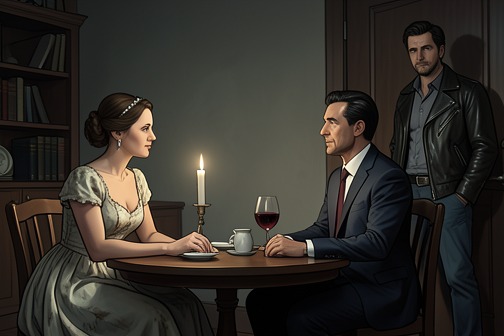
[Jenna’s Open Marriage Agreement](entity:event-recall-event-jenna-s-open-marriage-a-35e0a1662437) marks the decisive transformation of [Jenna](entity:character-recall-character-jenna-65f88e27192a) and [Kyle](entity:character-recall-character-kyle-7dd591f8eb9a)’s marriage from an exclusive partnership under strain into a deliberately negotiated three-person relational structure. Kyle’s repeated absences have made Jenna consider divorce, but his proposal converts the threatened separation into an experiment in openness, preserving their emotional bond while permitting Jenna to seek companionship elsewhere.
## Causes and Background
Kyle and Jenna have been married for three years, but his work keeps him away for long periods. Jenna admits that the resulting loneliness has made the urge to cheat overwhelming and has left her constantly fantasizing about men and sex. Her contemplated solution is to end the marriage and pack her belongings, not because affection has disappeared, but because the existing arrangement no longer supplies the human connection she needs. The crisis therefore arises from a conflict between continuing love and an unsustainable pattern of absence.
Kyle responds by acknowledging that he cannot reliably meet the ordinary expectations of marriage. He recognizes that he promised to be present but is unable to keep that promise because of his job, sometimes being away for much of their shared life. His willingness to discuss the problem prevents Jenna’s dissatisfaction from being treated simply as betrayal. Instead, the marriage becomes a subject of explicit negotiation, with both partners forced to state what they need and what they are still unwilling to lose.
## The Agreement and Its Rules
Kyle proposes an open marriage as an alternative to divorce. He tells Jenna that she may have outside male partners, but establishes one precise boundary: no male partners may enter the bedroom that he and Jenna share. She may visit other men at their homes, while their marital bed remains reserved for the couple. The rule gives the arrangement a physical center, distinguishing the marriage’s shared domestic space from the relationships permitted beyond it.
The agreement is not presented as a one-sided license. When Jenna asks whether Kyle intends to have affairs as well, he admits that he has sometimes been tempted but has not acted on those impulses. He accepts that permission should operate in both directions, making reciprocity part of the arrangement. He also insists that Jenna and Kyle’s relationship must remain first even if other partners become involved. Jenna agrees, although she is visibly shocked because she had expected to leave and had not imagined that Kyle would offer such a compromise.
Kyle’s central argument is emotional rather than merely sexual. He tells Jenna that he loves her and does not want their marriage destroyed simply because his work keeps him away. He is prepared to share her if she can remain open to that possibility, provided that their union continues to come first. Jenna answers that she loves him, and this mutual declaration keeps the agreement from being reduced to an impersonal sexual contract. Its operating principle is that outside intimacy may be added without displacing the marriage’s primary attachment.
## Jenna’s First Step Outside the Marriage
After Kyle gives her permission, Jenna goes to a bar to determine whether she can actually act on the agreement. She is not certain that she can flirt with a stranger, and she describes the choice as a way either to open the marriage or to avoid divorce. Her wedding ring remains visible, and [Rack](entity:character-recall-character-rack-16e67658bf84) notices the mark it has left on her finger. The detail makes her marital status part of the encounter rather than something concealed: she enters the new space as a married woman with her husband’s consent, not as someone secretly abandoning her marriage.
Jenna’s uncertainty shows that permission does not immediately resolve the emotional difficulty. Kyle’s proposal removes the immediate need to leave, but it does not make unfamiliar intimacy simple. She must test the boundaries of a new identity while continuing to understand herself as Kyle’s wife. The agreement thus creates freedom and anxiety at the same time: it gives Jenna an authorized path toward companionship while confronting her with the practical and emotional consequences of using it.
## Consequences and Expansion
The arrangement later develops beyond a private conversation between spouses. When Kyle prepares to leave again for roughly a month, he tells Rack to take care of Jenna. He embraces Jenna, says that he loves her, and acknowledges that Rack can provide the presence he cannot. Kyle also says that he has not been with anyone but Jenna and cannot bring himself to be with another woman, establishing an asymmetry within the theoretically reciprocal agreement: both partners have permission, but Kyle does not necessarily exercise it.
Kyle refuses to make Jenna feel guilty because he believes the arrangement is preferable to divorce. He accepts Rack as someone who may become part of their life, provided Rack respects the marriage and keeps Jenna safe and healthy. Kyle even treats the sexual experimentation as less threatening than the loss of the relationship. His departure keeps the original problem—absence—alive, but his words convert that absence from an unspoken injury into a condition the three adults must consciously manage.
The story eventually identifies the arrangement as a triadic family structure involving Jenna, Kyle, and Rack. What begins as a desperate compromise therefore becomes a new relational form rather than a temporary permission slip. Its unresolved tension lies in the contrast between explicit rules and unpredictable attachment: the bedroom boundary, the priority of the marriage, and the promise of mutual respect attempt to contain desires that may not remain neatly separable. Jenna’s Open Marriage Agreement is consequently both an act of preservation and a challenge to the meaning of marital exclusivity.
Event 36
Jenna’s Pregnancy by Rack

[Jenna’s Pregnancy by Rack](entity:event-recall-event-jenna-s-pregnancy-by-ra-c5a5e64b410d) marks the point at which an experimental marital arrangement becomes an irreversible family crisis. [Jenna](entity:character-recall-character-jenna-65f88e27192a) has entered a bar not as a divorced woman but as a married woman whose husband has given her permission to have a boyfriend. The permission was intended to preserve the marriage while her husband was frequently away for work; instead, Jenna’s first sexual encounter with [Rack](entity:character-recall-character-rack-16e67658bf84) creates a pregnancy whose paternity is clear and whose consequences reach beyond the private thrill of a single night.
## Causes and Background
Jenna explains to Rack that her husband offered an open marriage as an alternative to divorce. His work kept him away for long periods, and the couple had decided that allowing her another relationship might be preferable to ending their marriage. Jenna is uncertain whether she can actually flirt with a stranger, however, and comes to the bar partly to test her own capacity for the arrangement. The wedding ring remains visible on her hand, making the contradiction plain: she is still married, but has entered a space where she may be expected to pursue someone else.
Rack recognizes the situation from the ring mark on Jenna’s fingers. His observation gives the encounter a practical clarity that Jenna herself lacks. She is not beginning from a clean separation or a settled new identity; she is carrying the obligations and symbols of one marriage while trying to discover whether another form of intimacy can fit inside it. The arrangement therefore begins with permission, but not with emotional certainty or a clearly defined future.
## The Unprotected Encounter
Jenna and Rack have sex during their first night together, and Jenna briefly notices that they have not used protection. Rack then resumes kissing her and removes the rest of her dress, distracting her from the immediate risk. She decides to worry about it later, embracing the night as an act of rebellion against the conduct expected of a “good girl.” Rack carries her to the hot tub, and the encounter continues through the yard, the house, and finally the bed as dawn approaches.
The sequence matters because the pregnancy does not result from a long-planned attempt to conceive. Jenna and Rack use protection after that first night, but the initial unprotected sex occurs at exactly the moment when Jenna misjudges her fertility. She assumes that her period is due within a week and that she is too late in her cycle to become pregnant. Her confidence rests on an assumption rather than on reliable protection, while the excitement of the night postpones any serious consideration of what pregnancy would mean.
## Discovery and Paternity
Jenna stares at a pregnancy test in shock after her period fails to arrive. She is almost three weeks late, and the two bright pink lines leave no reasonable alternative to the conclusion that she is pregnant. The timing transforms a private lapse into a fact that can no longer be deferred, explained away, or contained within the night she had hoped to treat as an isolated act of freedom.
Jenna knows that Rack is the father. Her husband has been out of the country, and she and her husband have not been intimate for months. Because of that absence of sexual contact, she cannot present the child as her husband’s without deliberately concealing the truth. The pregnancy therefore exposes the limits of the open-marriage experiment: permission to take a boyfriend has not settled questions of parentage, domestic responsibility, jealousy, or the future of the marriage.
## Disclosure to Rack
Jenna initially has no clear plan. She does not know whether to tell her husband or Rack first, whether to tell anyone at all, or whether the pregnancy will end her marriage. She also questions whether her bond with Rack is strong enough to support raising a child. Their relationship is developing and they enjoy each other’s company, but affection and sexual compatibility have not yet become an established two-parent family.
When Jenna finally tells Rack, she asks him not to hate her and hands him the pregnancy test without speaking. Rack studies it before asking whether the child is his. Jenna confirms that there is no one else and repeats that her husband has been away and that they have not had sex in months. Her tears reveal the emotional cost of the disclosure, while Rack’s response is immediate reassurance: he gathers her into his arms, rocks her, and tells her that he is there for her. His comfort does not resolve the marriage or custody questions, but it prevents the revelation from becoming an immediate rejection.
## Consequences and Significance
The pregnancy places Jenna between three competing claims: her existing marriage, her growing attachment to Rack, and the child whose existence makes the arrangement permanent in a way that permission alone never was. Her husband may forgive her, or the pregnancy may bring the marriage to an end; Jenna cannot know which outcome will follow. Rack’s willingness to support her offers a possible future, but the evidence does not yet establish whether that future will replace the marriage, coexist with it, or fail under the pressure of responsibility.
Within the broader pattern of the narrative, Jenna’s pregnancy belongs to a recurring examination of reproduction as a source of power, obligation, and risk. Other relationships are shaped by inheritance requirements, forced breeding systems, or arrangements in which one person bears the physical consequences of a bargain. Jenna’s case is different because the relationship begins with apparent consent: her husband permits an outside partner, and Jenna chooses to pursue Rack. Yet the pregnancy shows that consent to a relationship is not the same as consent to every consequence of sexual intimacy, and that reproductive autonomy depends on information, protection, and the ability to negotiate what happens afterward.
The event also turns the open marriage from an abstract compromise into a material household problem. A boyfriend can be treated as an experiment; a pregnancy requires decisions about truth, partnership, care, and belonging. Rack’s embrace supplies the first sign of solidarity after the test is revealed, but Jenna remains frightened and without answers. The pregnancy’s decisive significance lies precisely in that unresolved threshold: it creates a family possibility while simultaneously threatening the marriage that made the possibility imaginable.
Event 37
The Three-Person Marriage Arrangement

[The Three-Person Marriage Arrangement](entity:event-recall-event-the-three-person-marria-14ef40c1a87e) transforms [Jenna](entity:character-recall-character-jenna-65f88e27192a)’s open marriage from a theoretical promise into a lived family structure. Jenna is pregnant by [Rack](entity:character-recall-character-rack-16e67658bf84) while still married to [Kyle](entity:character-recall-character-kyle-7dd591f8eb9a), and the revelation compels the two men to confront not only their feelings for her but also the practical question of whether they can jointly accept the child. The arrangement survives because Jenna refuses to choose between the two men, Rack refuses to displace Kyle, and Kyle ultimately agrees to learn how to share both his wife and the responsibilities of fatherhood.
## Causes and Background
Jenna’s pregnancy is the immediate catalyst. She tells Kyle that she is pregnant and makes clear that the pregnancy is not far enough along to be his, establishing Rack as the biological father. The disclosure turns a previously negotiated relationship experiment into an unavoidable emotional and domestic crisis. Jenna still loves Kyle and does not want a divorce, but she also loves Rack and does not want to abandon the relationship that has led to the pregnancy.
Jenna’s earlier agreement with Kyle had permitted her to seek companionship outside the marriage, but the possible consequences had not been fully understood when Kyle accepted it. Kyle later acknowledges that he knew Jenna needed companionship and wanted children, while he had not been the husband or father she needed him to be. The pregnancy therefore exposes the gap between consenting to an arrangement in principle and confronting its consequences in daily life, marriage, and parenthood.
## The Confrontation
Jenna presents the truth with Rack beside her, hoping that the disclosure can occur through conversation rather than secrecy. Kyle reacts with shock and anger, asks whether Jenna wants a divorce, and then punches Rack in the jaw. The blow gives the conflict a physical form: Kyle’s fear of losing his wife and his sense of marital claim briefly override the open arrangement he had previously accepted.
Rack does not retaliate or retreat. After recovering from the punch, he tells Kyle that he loves Jenna, that he had promised to tell him with her, and that he had not intended to demand a divorce. He explains that he is willing to share Jenna with Kyle because he knew she was married when their relationship began. His position distinguishes possession from commitment: Rack wants to remain part of Jenna’s life and the child’s life, but he does not frame his love as a demand that Kyle disappear.
Jenna’s distress becomes the emotional center of the confrontation. She cries and insists that she loves both men, that the pregnancy was not deliberately planned, and that she does not want to choose between them. At the same time, she recognizes that neither man can be forced into the arrangement. She tells Kyle that she will understand if he can no longer remain with her or cannot accept a relationship involving both men, but she also sets a firm condition: if Kyle remains her husband, he must accept the child and become an active part of its life.
## Negotiating the Family
Kyle’s response changes the direction of the event. Although he is confused and wounded, he embraces Jenna and says that he is willing to do whatever is necessary to make the relationship work, including sharing her with another man. He admits that he had not understood the possible repercussions when he agreed to the arrangement, but he does not treat that failure of foresight as a reason to abandon Jenna or reject the baby.
Kyle then addresses Rack directly. He does not pretend that the two men already trust one another; instead, he says he is willing to get to know Rack if Jenna believes she can love them both and manage the relationship. His willingness is conditional and uncertain, but it marks a movement away from rivalry toward responsibility. Kyle also makes clear that acceptance must include fatherhood. Jenna will not remain married to him if he refuses to accept the child or participate actively in the child’s life.
Rack answers with an equally defined commitment. He acknowledges that Kyle was Jenna’s husband first and says he has no desire to take her away or threaten the bond between the married couple. Yet he insists that he loves Jenna, that the baby is his child, and that he wants to be present in the child’s life. The arrangement thus becomes a negotiated three-person family rather than a simple contest between a husband and a lover. Jenna’s marriage remains intact, Rack’s paternity is recognized, and both men are asked to accept obligations rather than merely claim emotional rights.
## Acceptance and Aftermath
The first sign of provisional acceptance comes when Kyle agrees that the three of them should test whether the arrangement can work. He kisses Jenna, and Rack remains part of the shared domestic space rather than being expelled. Later, Kyle and Rack comfort Jenna together, physically surrounding her instead of fighting over access to her. Kyle’s possessive gesture remains visible—he tightens his hold on Jenna and reminds Rack that she was his wife first—but the gesture no longer leads to another attack.
Jenna understands that the future remains uncertain. She has never imagined herself with more than one boyfriend or husband at a time, yet she concludes that she can love both men. Her hope is not that the conflict has vanished, but that honesty and a willingness to remain on the same page will allow the relationship to survive its difficulties. The ending therefore offers a qualified promise rather than an effortless resolution: the household will face further complications, especially with a baby involved, but the three adults have chosen cooperation over separation.
Rack also accepts the risks of the arrangement without presenting himself as its victim. He says he knew from the moment they met that Jenna was married and still loved her husband, but he fell in love with her anyway. His commitment is therefore portrayed as deliberate, while Kyle’s acceptance is portrayed as an ongoing process. Jenna falls asleep content after Rack massages her shoulders and kisses her forehead, believing that the relationship can work if all three remain honest and committed. The event ends with a stable emotional direction, even though its practical future is still unresolved.
## Narrative Significance
The arrangement is a concentrated conflict between marital exclusivity, reproductive responsibility, and the possibility of a plural family. Pregnancy makes every abstract boundary consequential: love must be translated into custody, presence, recognition, and daily care. Jenna’s demand that Kyle accept the child prevents the relationship from being reduced to sexual permission, while Rack’s refusal to displace Kyle prevents fatherhood from becoming a claim of romantic conquest.
The event also follows a romance pattern of crisis followed by reaffirmation, but its central tension is not resolved through the removal of a rival. Instead, the supposed rivals are required to construct a shared arrangement. Kyle’s punch represents the old logic of possession; Rack’s restraint and Kyle’s eventual willingness to learn represent a more difficult ethic of negotiated belonging. Jenna remains the emotional and relational center, yet the conclusion gives both men independent responsibilities toward her and the baby.
Its significance lies in the fact that the relationship survives not because jealousy is denied, but because jealousy, uncertainty, and unequal emotional histories are spoken aloud. Jenna admits that she does not know how the future will turn out. Kyle admits that he did not understand what he had agreed to. Rack acknowledges the danger of loving a married woman. Their tentative family is therefore founded less on certainty than on explicit consent, continuing negotiation, and the shared decision to remain present.
Event 38
The Watchers’ Choosing

[The Watchers’ Choosing](entity:event-recall-event-the-watchers-choosing-07477c285288) is the yearly ceremony by which the [Watchers](entity:character-recall-character-watchers-156c2f4cc152) select a human from each community for service on their planet. For [Maggie](entity:character-recall-character-maggie-39724c72a859), the institution changes spring’s first day from a childhood festival into a moment of dread: at eighteen, she enters the lottery for the first time, draws the marked number 5842, and is carried from a cheering public stage into an alien metallic facility. The event establishes the Watchers’ rule as both paternalistic and coercive, revealing a society that has exchanged human self-government for security while treating human bodies as an annual resource.
## Causes and Political Background
[The Choosing](entity:state-recall-state-the-choosing-429f5583e367) exists within a civilization ruled by the Watchers, who arrived on Earth before Maggie was born and now determine the conditions of human life. They provide the population with everything it needs, including advanced technology, healing knowledge, and assigned work. Their authority is so complete that they can reportedly stop the rain when humans misbehave. The arrangement is presented as protection against an earlier era of disorder known as the Time of Trouble, but its price is that every community must surrender one person each year.
The Watchers’ benevolent image therefore rests on an unequal exchange. They have taught humans remarkable skills and created a materially supplied society, yet they reserve the right to remove selected people from Earth and impose whatever use they consider appropriate. The Choosing is not a voluntary honor in any meaningful sense. It is a recurring state ritual that makes subjection appear orderly, fair, and even celebratory.
The consequences for those selected are widely feared. Some are said to become slaves, working in fields, serving as carpenters, or attending to the Watchers’ needs on a planet resembling Earth. Their lives are reportedly short, partly because the Watchers have violent tempers and can dispose of human servants when dissatisfied. Others are used for breeding as part of the Watchers’ attempt to combine their genes with humanity and create a superior hybrid being. The lottery thus links political domination with reproductive control: the chosen person may lose not only freedom and homeland but also authority over labor, sexuality, and biological identity.
## The Ceremony and Maggie’s Selection
[Spring](entity:time-recall-time-spring-5076a6d014bd)’s first day is the appointed date for the annual drawing. All adults over eighteen must participate, while those over forty-five may remove their names if they choose. Each participant receives a numbered stone, keeps it from year to year, and remains identified by that number until either withdrawing or being chosen. The system’s fixed numbering gives the lottery an appearance of impartial administration, even though the result is irreversible for the person selected.
Maggie’s first Choosing begins against the memory of childhood festivities. She prepares desserts and leaves home, but for the first time she cannot enjoy the gathering. The food and games continue around her while the adults wait in fear; she is especially conscious of parents who already have children and feels a brief relief that she has none. The contrast makes the ceremony’s social power plain: a communal celebration continues because the community has learned to place ritual pleasure beside the possibility of losing one of its members.
When bells call the adults to the center of the park, Maggie joins the line with her stone in hand. Its surface is smooth, and its number is coated in pure gold. The gold recalls an earlier economy in which the metal was used as money, but under the Watchers it has become abundant and worthless because material needs are supplied and occupations are assigned. The stone consequently carries two meanings at once: it is an obsolete token of exchange and the current instrument by which a human life is classified and claimed.
The announcer welcomes the crowd and describes the selected person as a servant to the Watchers. The audience cheers, but Maggie looks down and hopes to return home safely. The winning number is announced as 5842. When Maggie recognizes it on her own stone, she freezes. She cannot take a step, the world spins, and she loses consciousness. Her first direct encounter with the Choosing is therefore not a triumphant acceptance but a bodily collapse under the force of an institutional decision.
## Removal from Earth
Maggie next becomes aware that she is on the stage, supported by several men while the community cheers. Her vision is blurred, and the announcer congratulates her as though the public response could transform coercion into good fortune. She is taken behind the stage, seated, and given water while the crowd is told to continue enjoying the day. The ceremony absorbs her terror without interrupting its festive schedule.
The apparent backstage interval is abruptly revealed as something else. As Maggie drinks, she realizes that she is no longer behind the stage but inside a metallic room, seated on a hard metal chair among other selected people. Some look as confused as she feels; others appear happier than they have ever been, suggesting that the Choosing has produced both fear and internalized hope. Maggie struggles to accept that Earth is already behind her and that the transfer has happened without a meaningful opportunity to resist.
A Watcher enters, identifiable by completely white eyes without an iris or pupil. He surveys the women and orders several to stand; when he reaches Maggie, she obeys. None of the women argues or asks questions. They follow him because the institution has already made obedience the only intelligible response. The passage from numbered stone to metallic room shows how quickly a public classification becomes physical custody.
## Consequences and Reproductive Stakes
The Choosing changes Maggie’s status from an adult member of her community into a controlled subject of the Watchers’ breeding system. The rumors surrounding the lottery distinguish between service and breeding, but neither path preserves ordinary human autonomy. Those assigned as laborers are treated as replaceable servants, while those used for reproduction become instruments in an effort to redesign the human population.
The event’s reproductive consequences become explicit when Urieal tells his father that he has bred one of the human women, Maggie, because he wants the first hybrid to come from royal blood. He argues that humans should not be treated as animals, explaining that Maggie had been covered in cuts from spikes, frightened, and bleeding when he first saw her. His father rejects the idea that humans are equals, insisting that the Watchers rescued them from themselves. Maggie’s selection therefore initiates a conflict within the ruling order itself: Urieal sees the chosen human as a person whose dignity must be protected, while the [King](entity:character-recall-character-king-817ed90ecad5) sees her as a subordinate being available for political and biological use.
The lottery also reveals how domination is sustained by collective memory. Maggie’s grandfather, who lived before the Watchers’ rule, wished that someone in the family would have the privilege of serving them. Maggie cannot understand why he would desire such a fate for someone he loved, because she did not experience the earlier crisis that made Watcher rule seem necessary. Her fear is not simply personal; it is a generational rejection of the gratitude that legitimizes the system.
## Narrative Significance
The Choosing is a ritual of apparent fairness that produces an extreme inequality of power. Numbered stones, annual rules, age limits, bells, an announcer, and a public crowd make the process look procedural rather than violent. Yet the procedure conceals the fact that the selected person cannot meaningfully consent and may be transported, enslaved, or subjected to breeding. The event’s value shift is stark: spring, previously associated with pleasure and community, becomes a season of apprehension, and Maggie’s hope of going home becomes enforced removal.
Maggie’s selection also provides a central image for the book’s recurring struggle over bloodlines and reproduction. Elsewhere, marriage and inheritance conditions demand children to preserve family property, while supernatural and alien societies define status through purity, mating, and hybrid offspring. The Choosing radicalizes that pattern by removing private negotiation altogether. A community’s stone determines who will be available to another civilization, and the selected body becomes the site where the Watchers’ political future is tested.
Most importantly, the event establishes the Watchers’ dominion as a system that combines care with coercion. Their gifts of healing, technology, food, and economic stability do not cancel the annual seizure of human lives. Instead, those benefits help make the seizure appear acceptable to the wider population. Maggie’s collapse, her confused arrival in the metal room, and her silent obedience expose the human cost beneath the ceremony’s cheers: the community’s security depends on its willingness to celebrate the loss of one of its own.
Event 39
Urieal’s Protection of Maggie

[Urieal’s Protection of Maggie](entity:event-recall-event-urieal-s-protection-of-f5c8d1077570) is the decisive confrontation between the [Watchers](entity:character-recall-character-watchers-156c2f4cc152)’ benevolent self-image and the coercive breeding system through which they rule humanity. [Maggie](entity:character-recall-character-maggie-39724c72a859) has been taken from Earth under an annual lottery that supplies the Watchers with human servants and breeders, and the encounter leaves her weak, bleeding, and unable to stand without help. Urieal’s response begins as personal shock but develops into an explicit order: humans are not to be harmed, Maggie is to be left untouched by everyone except him, and any future human experimentation must be reconsidered as a matter of policy rather than treated as the ordinary cost of Watcher power.
## Background: A Civilization Built on Choosing Humans
The event grows out of the Watchers’ domination of Earth. They arrived before Maggie was born, replaced human self-government with their own authority, supplied technology and healing, and demanded one person from each community every year in return. Adults remained in the lottery until age forty-five unless they withdrew or were chosen; each participant carried a numbered stone that had to be preserved and brought to the annual drawing. Maggie’s community presented the Choosing as a public institution, but its outcome was forced service to the Watchers, with selected humans transported to the Watchers’ planet to labor as field workers, carpenters, domestic servants, or breeders.
The system’s language of provision concealed a sharp hierarchy. Watcher society portrayed humanity as a recently evolved, technically crude species that needed supervision, while the Watchers pursued a genetic program intended to combine their genes with human ones and create a superior being. Those sent to the Watchers’ world could be treated as slaves, and the breeding population was exposed to violence by Watcher males who regarded human bodies as sources of sexual access and experimental offspring. Maggie therefore enters the event not as a protected guest but as a politically excluded person: the Watchers control her movement, labor, reproductive capacity, and continued survival while insisting that their rule constitutes salvation.
## The Encounter That Changes Urieal’s Understanding
Maggie’s immediate experience destroys the distance between official policy and physical consequence. After a terrifying creature has used her for breeding, a Watcher in human form orders her to stand even though she is too weak and sore to support her own weight. Her injuries, the blood on her thighs, and the fluids left on her body make visible what the Watchers’ abstract vocabulary of quotas, trials, and genetic improvement attempts to conceal. A second Watcher enters with compassion, helps her stand, and takes her to a bathroom so that she can clean her wounds.
That compassionate Watcher is Urieal. He introduces himself while preparing a bath and initially misunderstands Maggie’s tears, asking whether the encounter had failed to give her pleasure. Maggie’s reply exposes the moral absurdity of that assumption: she asks why the Watchers bring humans to their planet, why they torture them for pleasure, and why they cannot leave humans on Earth to live their own lives. Urieal answers that the Watchers saved humanity from collapse, but Maggie identifies the price of that rescue as forced labor, experimentation, and death. His difference from the colder Watchers is important, yet the scene does not make him innocent; he belongs to the ruling species and must first be confronted with what its institutions do to the people it claims to have saved.
## From Private Horror to a Protective Order
After Maggie eats and falls asleep, Urieal goes to speak with his men. The event’s direction turns sharply here. He has not previously understood what happened to the breeders, because he trusted his subordinates to care for them as he would have done. Now he is angry that Maggie was injured and decides that she must be protected. His initial motive remains entangled with the breeding program: he believes that royal blood should flow through one of the first hybrids and intends to father offspring himself. Nevertheless, the discovery of institutional abuse forces him to distinguish reproduction from degradation and authority from unchecked permission.
Urieal confronts [Defoli](entity:character-recall-character-defoli-fc0817ac6b06), the Watcher who looked at Maggie with disgust. Defoli explains the existing doctrine with brutal clarity: humans either comply without being injured or resist and die. He invokes Urieal’s father’s prohibition against unauthorized human interaction and warns the prince not to become involved in the lives of beings considered beneath Watcher status. Defoli also treats the breeders’ suffering as entertainment for Watcher males, revealing that the violence is not an accidental breach of procedure but a tolerated feature of the system.
Urieal answers by using the authority that the system gives him against those who administer it. He orders Defoli to announce that no harm may come to any human brought to the Watchers’ planet. He further commands that Maggie is not to be touched and that he alone may have contact with her unless he gives permission otherwise. Defoli bows and obeys outwardly, although he does not agree and intends to discuss the matter with the [King](entity:character-recall-character-king-817ed90ecad5). The order therefore creates an immediate protection around Maggie while also exposing the limits of reform under a hierarchy in which safety depends on the will of a prince.
## The Dispute with the King
Urieal then carries the conflict upward. He tells his father that he has bred one of the humans because he believes the first hybrid should come from royal blood. The King agrees with the reproductive objective, but Urieal refuses to leave the matter there. He describes Maggie as covered in cuts from spikes, frightened, and bleeding when he first saw her, and argues that humans cannot be treated like animals if the Watchers intend to combine their genes with theirs.
The King rejects the language of equality. In his view, the Watchers rescued humans precisely because humans were incapable of governing themselves, and rescue therefore confirms Watcher superiority rather than creating reciprocal obligations. Urieal understands his father’s position but insists that care must mean more than possession. He argues that a human carrying royal offspring deserves better treatment and asks whether the King would accept the same abuse for his own descendant. The question transforms Maggie from an anonymous breeder into the future mother of a royal child, but it also reveals the incompleteness of Urieal’s moral advance: her protection is first argued through her relationship to his offspring, even as his broader command promises protection for every human brought to the planet.
Urieal’s defiance has practical consequences. He arranges for food to be prepared and left outside Maggie’s door, instructs the medical staff not to move her into containment, and orders that she remain in the room he provided while receiving care. He even considers returning to Earth with Maggie and the child if his father refuses to change the treatment of humans. The possibility of exile or withdrawal from the Watchers’ world gives his protest a concrete direction: protection may require not merely supervising the institution but abandoning its central geography of captivity.
## Consequences and Narrative Significance
The event produces an immediate but precarious shift in Maggie’s circumstances. She receives food, water, a bed, a bath, and medical attention rather than being transferred into ordinary containment. Urieal brings her water himself, and her relief when he enters shows how quickly a single protective figure becomes significant inside a system where every other authority has been associated with pain. Yet the scene also makes clear that Maggie remains under Watcher control. Urieal’s order protects her because he claims her, and his stated intention to father an offspring means that the reproductive system has not disappeared; it has been placed under a more sympathetic ruler.
Its larger significance lies in the contradiction it makes impossible to ignore. The Watchers justify domination by calling themselves humanity’s rescuers, but their institutions demand human bodies, labor, obedience, and reproductive capacity. Maggie’s injuries turn that contradiction into a scene of recognition, while Urieal’s response turns recognition into conflict between a reforming heir and the established order. The event belongs to the story’s recurring pattern in which marriage, inheritance, mating, or breeding is presented as a rule and then challenged by the person whose body bears its cost. Here, protection is both an act of compassion and a political breach: Urieal can restrain the violence only by questioning the hierarchy that authorizes it.
Event 40
Nina and Daniel Become Roommates

[Nina and Daniel Become Roommates](entity:event-recall-event-nina-and-daniel-become-3f6756425153) is the turning point at which [Nina](entity:character-recall-character-nina-507986764de1)’s vulnerability after an attempted carjacking becomes the basis for an intimate, unstable household arrangement. Daniel Baxter first appears as the stranger who protects her, but the rescue quickly develops into a bargain: he needs somewhere to stay while managing a business investment, and Nina is looking for a roommate. What begins as gratitude and convenience therefore becomes the opening movement of a relationship shaped by danger, attraction, trust, and unequal knowledge.
## Causes and Circumstances
Nina encounters Daniel immediately after a man has threatened her with a gun and attempted to harm her. Daniel intervenes, knocks the attacker unconscious, returns Nina’s keys, and remains to give a statement when the police arrive. The attacker is taken to jail, while Nina is spared the prospect of testifying. The scene leaves her frightened and unsettled, but Daniel’s intervention also makes him appear trustworthy at the precise moment when her ordinary sense of safety has been damaged.
Daniel uses that moment to explain why he is in town. He is well known in motorcycle-racing circuits and has come to examine a new investment whose completion will require roughly a month or two of personal supervision. He does not want merely to sign the papers and leave; he wants to remain close enough to watch the investment develop. His request for lodging is thus presented as temporary and practical, tied to the duration of the contract rather than to an initial declaration of romantic interest.
## The Roommate Agreement
Nina is reluctant to let a stranger live in her house. Her hesitation is rational: Daniel has only just entered her life, and the fact that he rescued her does not erase the risks of inviting an unknown man into her home. Daniel answers by introducing himself, identifying his professional reputation, and describing the investment that will keep him in town. His appeal combines reassurance with confidence, asking Nina to treat an extraordinary encounter as a fortunate opportunity rather than as a reason to withdraw.
Nina’s circumstances make the proposal difficult to refuse. She has been looking for a roommate, and Daniel’s request offers an immediate solution to that practical problem. She eventually tells him that perhaps she no longer needs to search for one and writes her address on the palm of his hand. The gesture is materially simple but dramatically charged: Nina gives Daniel the means to cross from the public scene of the rescue into her private space before either has established a conventional relationship.
Daniel arrives before Nina returns, with the landlord’s permission to let him into the apartment. A neighbor tells Nina that her “friend” has already shown up and encourages her to take advantage of what she views as a fortunate opportunity. The neighbor’s blunt sexual interpretation exposes how quickly the arrangement is being read as more than housing. Nina herself remains uneasy about a strange man being inside her home, but the practical agreement has already begun to acquire the atmosphere of an erotic wager.
## From Shelter to Attraction
Nina enters the apartment to loud music and finds Daniel in the shower. The bathroom door is ajar, steam escapes into the hallway, and the frosted glass does little to conceal his naked silhouette. The scene makes the new domestic arrangement physically immediate: Daniel is not an abstract roommate waiting to be introduced but an intrusive, highly visible presence occupying Nina’s home and commanding her attention.
The event also completes the value shift begun on the roadside. Nina first sees Daniel as a rescuer whose kindness creates an obligation; she then has to confront him as a sexually compelling man whose presence destabilizes the boundaries she had tried to preserve. His appearance, confidence, and willingness to enter the apartment before her return intensify both attraction and distrust. The household begins not with ordinary domestic familiarity but with a collision between emergency, debt, and desire.
## Consequences and Narrative Significance
The immediate consequence is that Nina and Daniel become co-residents under improvised conditions. Daniel receives a place to stay for the period required to complete his investment, while Nina gains the roommate she had been seeking. Yet the arrangement carries a deeper consequence: the private home becomes the setting in which Nina must test whether gratitude can coexist with attraction and whether a stranger who has protected her can safely be allowed continued access to her life.
Nina later takes a weekend at a beach house in the Hamptons, using the distance to let the stress of the attempted carjacking recede. Even while acknowledging that she is still affected by the attack, she feels able to move beyond it. The contrast clarifies the role of the roommate event: Daniel’s arrival does not simply follow the danger as an unrelated romance; it helps redirect Nina from immediate fear toward a new and more complicated form of intimacy.
The event belongs to the book’s recurring pattern of relationships formed through practical contracts and sudden need. Elsewhere, marriage is proposed as a route to inheritance, citizenship, or economic security, while surrogacy is negotiated through payment and employment. Nina and Daniel’s arrangement is less formal, but it follows the same logic: shelter, protection, and companionship circulate between people whose emotional connection has not yet caught up with the terms of their exchange. Its significance lies in the way a temporary roommate agreement becomes the threshold of a romance, with the home serving simultaneously as refuge, risk, and invitation.
Event 41
Mercy and Vincent’s Arranged Marriage

[Mercy and Vincent’s Arranged Marriage](entity:event-recall-event-mercy-and-vincent-s-arr-d326279f4b93) is an inheritance-driven union founded not on courtship but on negotiation. Mercy needs a husband because her grandfather’s will makes marriage a condition of receiving the estate, while [Vincent](entity:character-recall-character-vincent-083c1ffa77d9) needs money to help rescue his mother’s indebted farm. Their wedding therefore turns marriage into a practical instrument for preserving property, securing family finances, and protecting two stubbornly independent lives.
## Causes and Background
[Mercy Hamilton](entity:character-recall-character-mercy-hamilton-e5c6e996b1ef) learns from her lawyer, [Tom Pinken](entity:character-recall-character-tom-pinken-8041a6ca6145), that her grandfather’s will requires her to marry before she can collect her inheritance. The revelation shocks her because she has spent her life working beside the man who raised her after her parents died in a carriage accident. She has helped run the family horse business, trained and ridden its thoroughbreds, and regards the enterprise as part of her own identity rather than as property awaiting male management. Her resistance is intensified by the possibility that a husband might try to control the business or prevent her from riding.
Mercy’s independence is expressed through an aggressive temper and an uncompromising tongue. She insists that a woman can run a business as well as a man and refuses the assumption that marriage should make her subordinate. Yet the will gives her little room to reject marriage altogether. Tom explains that she need not love the husband or even spend much time with him; she can choose a man who will not interfere with her life. The arrangement thus begins with a contradiction: Mercy rejects the social authority of husbands while accepting marriage as the price of retaining authority over her inheritance.
Tom searches for a candidate who will treat the marriage as an exchange rather than a romance. He asks his assistant, Louis, whether Louis’s cousin is single and needs money. Vincent has recently retired from the military, has never married, and is living at his mother’s small farm repairing things after his father’s death. The farm has fallen into debt, and his military pension is insufficient to save it. Tom presents the proposed arrangement as a solution to both households: Vincent will receive a wife, access to a horse farm, and financial support for his family, while Mercy will obtain a husband who can satisfy the will without disrupting her work.
## Negotiation and Terms
Vincent is selected because he appears old enough to have outgrown youthful recklessness, young enough to work with the horses, and free from the vices and previous marriage Mercy fears. Mercy is wealthy enough to pay the farm’s debts and provide Vincent’s mother with living expenses. In return, Vincent is expected to perform the social and legal role required by the inheritance. The transaction is therefore not merely a private promise; it is a carefully balanced contract in which money, labor, property, and marital status are exchanged.
Mercy sets her own conditions. She demands a husband who is not ugly or feeble-minded, has no horrible vices, and will not humiliate her by openly displaying mistresses. Vincent, for his part, asks whether the monthly stipend to his mother will remain part of the agreement. Mercy confirms that it will, explaining that he is providing her with a service and that she intends to honor her side of the deal. His request makes the economic foundation of the marriage explicit: his family’s survival is not incidental to the union but one of its central terms.
The pair also negotiate discretion. Vincent expects privacy concerning the money and any love affairs either spouse may have while married. Mercy responds with a direct threat that she will kill him if he cheats. Rather than retreat, Vincent laughs, tells Tom to draw up the contract and marriage license, and agrees to proceed immediately. His decision converts an improbable proposal into an actionable plan. The scene’s tension comes from the fact that both characters treat the marriage as business while revealing, through confrontation and humor, that neither is emotionally passive or easily controlled.
## The Wedding and Its Immediate Meaning
The wedding takes place in a church, where the ceremony’s traditional form contrasts with the unconventional bargain behind it. Mercy arrives with Tom, holding her head high but gripping his arm so tightly that she leaves fingernail marks in his skin. Her physical resistance shows how little the ceremony resembles a surrendered romantic dream. When Tom pries her hand away and places it into Vincent’s, the staging makes the transfer of legal and social responsibility visible: the lawyer who arranged the deal gives the bride to the man who has agreed to fulfill it.
Vincent asks whether she is ready and tells her that she looks beautiful. Mercy cannot trust herself to speak, and the remainder of the wedding passes in a blur as she faces the priest. The ceremony publicly presents them as husband and wife, but its private logic remains contractual. Mercy is not abandoning the horse farm or her ambitions; she is attempting to preserve them through a role she initially regards as necessary paperwork. Vincent is not marrying for inherited wealth; he is accepting a position that may stabilize his mother’s farm and give him a place in a working horse operation.
## Consequences and Broader Pattern
The marriage belongs to a wider pattern in which intimate relationships are organized around inheritance, debt, citizenship, employment, or family survival. [Abigail](entity:character-recall-character-abigail-d72687631c24) describes a plan to marry a rich American, divorce him, and use the money to begin a business after escaping [London](entity:location-recall-location-1bfd335cdd1b). William and his lawyer consider a mail-order bride as a business solution to an inheritance clause, with transportation, citizenship, continued marriage, and childbirth treated as contractual benefits and obligations. [Jenna](entity:character-recall-character-jenna-65f88e27192a)’s open marriage is likewise presented as an alternative to divorce when her husband’s work keeps him away. Kember is offered one hundred thousand dollars, medical expenses, and possible employment in exchange for becoming a surrogate, while [Emma](entity:character-recall-character-emma-0b5c09f9ac66) accepts a mail-order marriage to Lucas as a way to leave painful reminders and rebuild after catastrophe.
These parallels clarify what makes Mercy’s arrangement distinctive. She is not simply rescued from poverty, nor is she merely traded into a household without agency. She possesses wealth, professional competence, and a clear understanding of the bargain, yet the inheritance condition still makes her freedom conditional on marriage. Vincent has less financial power, but he is not without leverage: his labor, his military background, and his willingness to accept or reject the terms are necessary to the agreement. Their apparent equality is therefore negotiated rather than given.
The event also anticipates a recurring contrast between contractual beginnings and emotional possibility. In other relationships, practical arrangements may become intimate: Kember and Dennis move from a proposed surrogacy agreement toward personal attachment, and the simple domestic routine between Tate and Erica becomes a second chance after grief before pregnancy changes its scale. Mercy and Vincent’s wedding similarly leaves open the possibility that a union entered for inheritance and debt may acquire meanings not contained in its original paperwork. The decisive change at the wedding is thus legal and economic first, but narratively it creates the conditions under which trust, conflict, or affection can later be tested.
## Narrative Significance
Mercy and Vincent’s Arranged Marriage dramatizes the pressure exerted by property law on personal choice. Mercy’s grandfather’s final condition reaches beyond death, governing the life of the granddaughter who built the business with him. Vincent’s mother’s debt exerts a parallel pressure from the opposite direction, turning his need to protect his family into a reason to accept a marriage he would not otherwise seek. Neither character enters the church without a practical motive, and neither motive can be dismissed as purely selfish.
The event’s central value shift is from threatened independence to provisional security. Before the arrangement, Mercy risks losing control of the inheritance and the horse business; Vincent faces the continuing decline of his mother’s farm. The contract offers each a form of protection, but it also places both inside obligations that may restrict them. The church ceremony makes that exchange official without resolving its emotional uncertainty. Its significance lies precisely in that unresolved tension: marriage is shown as both a mechanism of control and a tool that characters can use to defend the lives they have worked to build.
Event 42
Emma’s House Fire
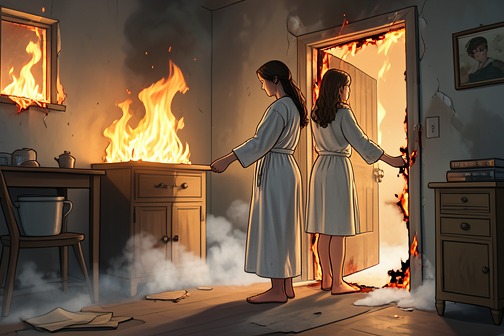
[Emma’s House Fire](entity:event-recall-event-emma-s-house-fire-ec7e4225f425) is the decisive catastrophe in [Emma](entity:character-recall-character-emma-0b5c09f9ac66)’s story: a sudden blaze kills her husband, [Jasper](entity:character-recall-character-jasper-a1e1f2fe4259), and their daughter, Laura, while Emma survives only because rescuers pull her from the burning house. The fire transforms grief into self-accusation, strips Emma of her home and financial security, and ultimately drives her to leave [England](entity:location-recall-location-england-b153c1f368ea) for a mail-order marriage with Lucas in the [American West](entity:location-recall-location-f5d62f6854cd).
## Causes and Immediate Circumstances
The fire arrives without warning, turning Emma’s home from a place of family life into an inescapable death trap. She wakes to Jasper coughing on the floor while flames billow around him and acrid smoke makes it difficult to see or breathe. Faced with an impossible choice, Emma leaves the bedroom to reach Laura first. Her decision is presented not as indifference toward Jasper but as a mother’s instinctive prioritization of her child; even after the disaster, she insists that she would make the same choice again.
Emma’s attempt to save Laura is physical and desperate. The door is scorching beneath her fingers, and opening it sends a rush of flame that throws her backward roughly five feet. Wearing only a nightshirt, stumbling over its hem, and losing consciousness, she moves with her head lowered and covers her mouth with a shirt taken near the door. These details make survival a matter of exhausted movement rather than heroic control. The fire overwhelms both the house and Emma’s ability to act within it, while every second spent reaching one family member reduces the possibility of saving another.
## The Deaths of Jasper and Laura
Emma reaches Laura’s room and understands immediately, from seeing her daughter on the bed, that Laura is already dead. She tries to reach her, but the flames are too high; before she can do more, the ceiling collapses. The collapse closes off Emma’s last hope and forces her to retreat from the scene, leaving her alive but unable to recover her child.
Emma then makes it back to the bedroom, only to discover that Jasper has also been lost. He is not overcome by smoke inhalation alone: the fire has consumed him. Emma cannot understand why she did not hear him scream, though she later suggests that not hearing it may have spared her an even more unbearable memory. The image nevertheless remains fixed in her mind, an apparition she expects to haunt the rest of her life. The event therefore carries two forms of loss: the immediate deaths themselves and the recurring visual memory through which those deaths continue after the flames are gone.
Rescuers find Emma and drag her away from the house while she struggles against them. In the moment of rescue, survival feels to her like an unwanted condition. Jasper and Laura are dead, everything she possesses has been destroyed, and Emma believes that she has nothing left to live for. The fire’s value reversal is absolute: a home associated with family, comfort, and material stability becomes the source of death, while rescue, ordinarily a return to safety, becomes an interruption of her wish to die.
## Guilt, Faith, and Trauma
The fire leaves Emma searching for a moral explanation for an event that seems senseless. She wonders whether God is punishing her for having moved away from the Catholic life and for allowing herself to become absorbed in material things. This interpretation turns grief inward, making survival appear like evidence of personal failure rather than an accident of circumstance. Her mother repeatedly tells her that she did everything she could and that she must learn to forgive herself, but reassurance cannot immediately dislodge the guilt produced by the fire.
The Bible found clutched in Emma’s hands, with its leather binding burned into the fabric, embodies this conflict between faith and catastrophe. Emma does not remember retrieving it from the dresser, so the object becomes an unexplained trace of the moments she cannot fully recall. It is both a religious relic and evidence of fragmented memory: the book survives in her grasp even as the people and home around her do not. Her mother interprets the deaths through divine mystery, saying that Jasper and Laura were taken by God and that the rescuers were a godsend, but Emma’s experience remains bodily, immediate, and resistant to such consolation.
The narration presents the fire retrospectively, after Emma has already decided to leave. That distance does not make the event settled. Instead, the recollection returns in broken sensory impressions—coughing, smoke, scorching metal, falling flame, a body consumed, and hands pulling her away—showing how the past continues to govern the present. Emma’s survival is therefore not a clean recovery but a prolonged aftermath in which memory, guilt, and the desire for escape remain entangled.
## Consequences and Aftermath
The disaster does not end when the fire is extinguished. Almost a month later, Emma is still mourning, and her parents are struggling to support her. Jasper had been the family’s breadwinner, so his death creates practical as well as emotional devastation: bills accumulate, her parents’ assistance becomes increasingly futile, and the household can no longer restore the life that existed before the blaze. Emma’s parents love her, yet they are also becoming exhausted by her continued despair, making the family home another reminder of both affection and unbearable loss.
Emma consequently chooses departure as a form of survival. She tells her mother that she has nothing left in England and that the painful reminders surrounding her have become impossible to endure. Becoming a mail-order bride is not initially a confident romantic decision; Emma admits uncertainty about it, but regards Lucas as a good man who needs help caring for his niece. The proposed marriage offers practical purpose and geographic distance at once. By boarding a boat toward the American West in 1860, Emma seeks neither to erase Jasper and Laura nor to undo the fire, but to place enough distance between herself and the scene of their deaths to begin living again.
Her mother warns that the American West is not a welcoming place for strangers from a strange land, and reminds Emma that family will remain behind in England. Emma accepts the danger because remaining has become its own form of confinement. The fire thus produces a second rupture: first it separates Emma from her husband and child through death, and then it separates her from her parents, country, social position, and familiar style of living through voluntary exile.
## Narrative Significance
Emma’s House Fire functions as both an external disaster and the origin point of Emma’s next identity. Before it, she is situated within marriage, motherhood, a comfortable household, and a material life whose security she later questions. After it, she is a bereaved survivor carrying guilt, financial pressure, damaged faith, and a need to escape. The catastrophe supplies the emotional and economic conditions for her mail-order-bride plot with Lucas; without it, the journey west would not be an act of necessity and attempted healing.
The event also establishes the tension between self-punishment and self-preservation that shapes Emma’s transition. She believes she may deserve blame, wants to die when rescuers reach her, and cannot imagine a future beyond the fire’s losses. Yet her actions inside the house reveal an opposing force: she repeatedly enters danger to reach Laura and Jasper, keeps moving despite burns, smoke, falling fabric, and failing consciousness, and survives long enough to be carried out. The fire therefore exposes Emma’s defining contradiction. She experiences survival as guilt, while the narrative records it as an arduous act of endurance.
Its lasting significance lies in the fact that escape is not presented as a simple cure. Emma leaves because memory has made home uninhabitable, but the images of the fire will accompany her regardless of whether she eventually finds happiness. Her departure changes the direction of her life without cancelling the wound that caused it. The event is consequently the story’s central threshold: a household disappears in flames, and from its ruins Emma enters an uncertain new life built around loss, responsibility, and the possibility of finding a future beyond the scene that destroyed her past.
Event 43
Emma’s Mail-Order Marriage to Lucas
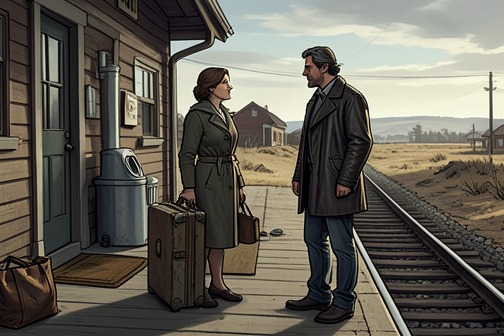
[Emma’s Mail-Order Marriage to Lucas](entity:event-recall-event-emma-s-mail-order-marri-e75035f168f8) is the turning point through which a grieving English widow leaves behind fire, debt, and painful memories for an uncertain life with Lucas in Texas. The marriage promises practical rescue and a new home, yet its first face-to-face encounter replaces romantic expectation with coercive haste, making the event both an escape into possibility and a warning about the power imbalance built into mail-order marriage.
## Causes and Background
[Emma](entity:character-recall-character-emma-0b5c09f9ac66)’s decision follows a chain of losses that has stripped her previous life of security. Her husband, [Jasper](entity:character-recall-character-jasper-a1e1f2fe4259), and her child die in a devastating house fire, leaving her emotionally shattered and without the income that had supported the household. The family land is sold to repay debts, but the sale leaves Emma with very little money; even her suitcase comes from a used store. Her parents try to help, yet their assistance cannot solve the financial consequences of Jasper’s death. Emma therefore faces grief and material insecurity at the same time, with the home around her filled with reminders of what has been destroyed.
Her departure is not presented as a carefree romantic adventure. Emma tells her mother that she has considered the mail-order arrangement uncertain, but that Lucas appears to be a good man and needs help caring for his niece, [Nancy](entity:character-recall-character-nancy-371993dde326). She also believes that Lucas’s responsibilities make a woman with maternal experience particularly useful in his household. The proposed marriage thus joins several practical needs: Emma requires a new beginning and a way out of debt and mourning, while Lucas needs someone to care for Nancy because he manages several properties and cannot keep the child constantly under his supervision.
Emma’s farewell gives the decision the weight of a personal threshold. She reflects on her failed attempt to save her family from the fire and on her loss of faith before deciding that the disaster must have some eventual meaning. As the boat’s horn announces departure, she chooses Texas and the [American West](entity:location-recall-location-f5d62f6854cd) as the site of her next life. She hesitates at the gangplank, looking back at her tearful mother, but finally promises herself that she will not turn back. The mail-order marriage is therefore framed as an act of survival: not proof that grief has ended, but a decision to move while grief remains.
## Crossing the Atlantic and Meeting Lucas
During the voyage, Emma isolates herself in her room and emerges mainly to find food. The withdrawal gives her a temporary refuge from the world, but it also emphasizes how little emotional certainty accompanies her physical journey. A letter from Lucas offers some hope because he sounds kind and reliable on paper, yet Emma recognizes that letters permit anonymity until the moment of meeting. The arrival in Texas therefore carries a second, more immediate danger: the man described through correspondence must now be measured against his conduct.
At the port, Emma expects to find Lucas accompanied by Nancy, but Lucas arrives alone. Instead of giving her time to adjust or speak with him, he seizes her wrist, takes her luggage, and insists that they must leave immediately because he has cattle to prepare for market and his mother cannot continue babysitting Nancy. His calloused hands and impatience identify him as a working rancher under pressure, but his urgency also turns Emma from a prospective partner into an item to be collected. She feels that he treats her as property, and the event’s value shift is unmistakable: the possibility of a gentle new life becomes, at first sight, a struggle to retain dignity and choice.
Lucas’s appearance and manner complicate Emma’s reaction. He is crass, smells unpleasant, and wears a black duster, black hat, and cowhide gloves that make him resemble a villain from an old bank-robbery story. His eyes are cold because he is in a hurry, yet she also finds him physically attractive in a rough, forceful way unlike Jasper. The attraction does not erase the coercion; instead, it creates the unstable mixture of fear, curiosity, and desire that governs their first encounter. Emma notices the contradiction in herself as Lucas pulls her through the crowd, but she remains conscious that his physical command has prevented any calm introduction.
## The Marriage Transaction
The central act of the event occurs when Emma finally wrenches her wrist free and tells Lucas that she can walk on her own. She objects that marriage is a major step, particularly when she has come to care for Nancy, but Lucas interrupts her, produces the promised ring, and slips it onto her finger without kneeling or creating the romance she expected. He treats the ring as an item already owed under the agreement rather than as a personal declaration. His impatient request to end the questioning reinforces the sense that the marriage is being completed administratively before intimacy or trust has had a chance to develop.
Emma had been influenced by Lucas’s earlier descriptions of serene rivers, hand-holding, and learning to know a woman beyond the physical. Shared bereavement also seemed to offer them common ground: Lucas had lost his brother, while Emma had lost her family. The meeting reveals that these romantic-sounding promises were not necessarily sincere. Lucas admits that he said such things because he was desperate to find someone, not because he believed in love. His actual objective is narrower and more functional: he wants a woman’s presence in the household so that Nancy can be managed and cared for. He openly describes the marriage as a commitment to look after the child rather than as a relationship founded on affection.
The surrounding stories in the book place Emma’s arrangement within a wider economy of intimate contracts. [Abigail](entity:character-recall-character-abigail-d72687631c24) describes a plan to marry a wealthy American, help him inherit his family fortune, and later return to [London](entity:location-recall-location-1bfd335cdd1b) with money to start a business. William approaches marriage as a business deal, proposing a mail-order bride whose contract would provide transportation and citizenship in exchange for remaining married for ten years and bearing a child while being excluded from the estate. Elsewhere, a work visa crisis drives Avril toward becoming an e-mail-order bride; [Jenna](entity:character-recall-character-jenna-65f88e27192a) enters an open-marriage arrangement to avoid divorce; and Dennis offers Kember one hundred thousand dollars, medical expenses, and possible continuing contact in exchange for surrogacy. These parallel arrangements make Emma’s marriage part of a recurring pattern in which love, residency, labor, inheritance, and reproduction are negotiated as exchangeable benefits.
## Consequences and Narrative Significance
For Emma, the immediate consequence is a physical relocation that does not provide immediate emotional safety. She has left [England](entity:location-recall-location-england-b153c1f368ea) because remaining there means living among the reminders of Jasper, her child, the fire, and unpaid obligations. In Texas she may find a home on Lucas’s property and a role in Nancy’s life, but she must begin that future with a man who has already ignored her boundaries and admitted that his courtship language was partly strategic. The marriage consequently offers escape without guaranteeing tenderness.
The event also establishes the relationship’s governing conflict: Emma seeks a new life while still needing recognition as a person with choices, whereas Lucas seeks efficiency, domestic help, and relief from responsibility. His ranch, his cattle, his absent schedule, and his dependence on others to supervise Nancy all explain his practical urgency, but they do not justify the force with which he handles Emma. The ring becomes the clearest symbol of this conflict. It marks a legal or social commitment, yet its hurried delivery exposes how little mutual understanding exists beneath the formal bond.
Narratively, the marriage crosses Emma from mourning into an uncertain second chapter. Her reflection that fate has dealt the cards does not mean that the arrangement is freely chosen in an uncomplicated sense; it shows how desperation can make a constrained option appear like destiny. The event’s significance lies precisely in that ambiguity. Emma has the courage to leave, but the new life begins with unequal bargaining power, untested promises, and a husband who says he does not believe in love. The marriage therefore functions as both rescue plot and critique of the conditions that make rescue necessary.
Event 44
Hope’s Mail-Order Marriage to Avery
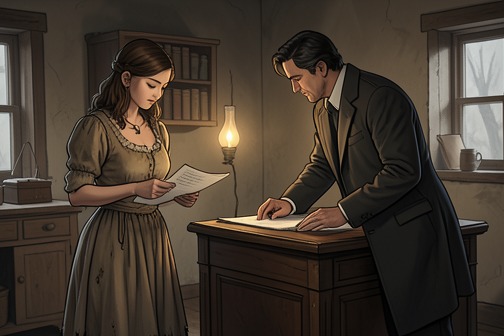
[Hope’s Mail-Order Marriage to Avery](entity:event-recall-event-hope-s-mail-order-marri-cd299840b8af) is a turning point in which a widow’s desperate economic decision becomes an unexpectedly mutual love story. After her husband’s death, Hope faces foreclosure and the burden of preserving the home and land associated with her previous marriage. A periodical offers her a possible solution: become a mail-order bride, find a man willing to help her keep what she has, and accept that romance may never be part of the bargain. Instead, her correspondence with [Avery](entity:character-recall-character-avery-3f30ea9cdcd5) leads from negotiated security to a marriage she chooses because she believes her heart has room for a new love without erasing the old one.
## Causes and Background
Hope’s decision is shaped first by bereavement and material danger. Living in the [American West](entity:location-recall-location-f5d62f6854cd) in 1855, she remembers the protection and companionship she once found with [Hank](entity:character-recall-character-hank-79d5809e13b8), but his death leaves her to continue without him while the bank prepares to foreclose. She persuades the bank to grant a one-day extension, using emotional appeals to delay the immediate loss, yet the reprieve does not solve the underlying debt. The mail-order bride advertisement therefore appears not as a romantic fantasy but as a possible financial rescue: Hope hopes to find a man who will help her retain what she has, even though she has no expectation that love will follow.
Hope’s position also exposes the social stigma attached to the practice. As she travels by stagecoach in a white dress, she anticipates that the town will judge her once people learn she is a mail-order bride. The arrangement is widely associated with desperation, and she expects neither the townspeople nor the religious community to understand her motives. Her journey thus carries two forms of risk at once: the economic risk of losing her property and the reputational risk of entering a marriage publicly treated as evidence of need.
Avery’s advertisement initially frames the proposed relationship in restrained, practical terms. He presents himself as a Christian man who will treat a woman with respect and kindness, asks only for help with daily chores, and emphasizes that he owns a ranch of 200 acres. He describes marriage as a serious commitment whose timing should be decided together, and this combination of means, religious conviction, and apparent restraint catches Hope’s attention. Their correspondence reveals further points of identification: both are only children, and both lost their fathers young, leaving their mothers to raise them. Before they meet, Hope sees in Avery not simply a wealthy prospect but a possible kindred spirit.
## The Marriage as an Economic Arrangement
The first meeting immediately tests whether Avery’s promises of care will remain merely words. He meets Hope with daisies, her favorite flowers, and offers her the courtesy of opening the stagecoach door and helping her down. Yet the welcome is accompanied by a concrete intervention in her finances. Avery has spoken to the bank and paid the debts owed by Hope’s deceased husband, despite her having told him not to do so. Hope experiences the act as a betrayal because he has assumed control over a debt that she and her husband had been responsible for handling themselves.
The conflict reveals the unequal power built into the arrangement. Avery interprets Hope’s disclosure as an indirect request for rescue, while Hope insists that women may say one thing and mean another and that a partner should read between the lines. His protective impulse therefore carries both genuine concern and a paternalistic assumption that he knows what she needs. The event’s central value shift occurs here: the promised security that should make the marriage possible temporarily threatens Hope’s dignity and autonomy. His payment of the debt also changes the economic relationship, since Hope recognizes that he now has a claim not only on his own 200 acres but, in practical terms, on the land tied to her former marriage.
The broader narrative repeatedly places marriage beside contracts, inheritance, debt, citizenship, labor, and property. Elsewhere, [Abigail](entity:character-recall-character-abigail-d72687631c24) explains a plan to marry a rich American, divorce him, and use the money to start a business; William and his lawyer discuss a mail-order bride as a legally protected means of satisfying an inheritance stipulation; Dennis offers Kember substantial payment, medical expenses, and employment in exchange for surrogacy; and [Jenna](entity:character-recall-character-jenna-65f88e27192a)’s marriage is opened as an alternative to divorce when [Kyle](entity:character-recall-character-kyle-7dd591f8eb9a) is frequently absent. Against these arrangements, Hope and Avery’s story is distinctive because the initial economic logic does not remain the relationship’s final meaning. Material security starts the connection, but mutual recognition eventually transforms it.
## Domestic Life and Mutual Recognition
At Avery’s ranch, practical domestic labor becomes the first sustained test of compatibility. Hope notices that Avery’s bedroom still looks like that of a bachelor, with clothes scattered about and an unmade bed, confirming that he has lived without a wife and is seeking a complete partnership rather than a temporary convenience. She prepares a stew using vegetables and water drawn from a gravity-fed mountain well. The fresh spring taste recalls her childhood and gives her a renewed sense of possibility, while cooking allows her to bring a part of her former life into an unfamiliar home.
Avery responds to the meal with unusually personal praise. He says that he has not eaten a genuinely home-cooked meal since living with his parents and imagines that his mother would be proud that he had found a woman worthy of his love. The exchange makes domestic work more than an assigned marital duty: it becomes a language through which both characters disclose family memories and judge whether the other can belong in the household. Even the comic moment when Avery burns his mouth on the stew softens the formal distance between them; he laughs, blows on the next bite, and resembles the expression Hope remembers from her late husband.
Hope also refuses the passive role that Avery’s wealth and social position might impose. She tells him that he can ask for help with the fence, using his own language of shared household responsibility against any assumption that she should merely be displayed or managed. He is amused and impressed by her independence, especially after seeing her wield an axe rather than behave as someone trained to serve a husband like a king. Their attraction grows through this friction between traditional expectations and Hope’s insistence on being heard.
Religious objects reinforce the compatibility they discover. Hope carries a leather-bound Bible given to her by her mother and treats it as a personal lifeline. Avery recognizes its emotional importance and reveals that he shares her religious beliefs while fingering the gold chain and cross around his neck. Their common faith does not erase the practical nature of the marriage, but it gives the relationship a moral vocabulary broader than money, debt, or household labor.
## From Convenience to Love
Hope initially sees Avery as a solution to a crisis, and Avery worries that she may see him as a wealthy man capable of providing an escape. He admits that he expected her to smell of desperation and feared that she was using him for his money, since some women regard him as a golden ticket. Their mutual suspicion forms the emotional obstacle of the event: each wonders whether the other is entering the marriage for a calculation rather than a person.
That suspicion gradually dissolves through repeated evidence of character. Hope finds no tobacco-stained hands or teeth and no sign that Avery is trying to force sexual intimacy. She is surprised by his good heart, background, and lack of apparent bad habits. He, in turn, is pleased that she is not simply seeking wealth and is struck by her willingness to work, speak directly, and share the responsibilities of the ranch. The relationship moves from assessment to admiration because each character’s conduct contradicts the other’s worst expectation.
The decisive emotional turn comes when Hope tells Avery that she loves him. She has already admitted the feeling to herself, but speaking it aloud makes the tentative bond real and leaves both of them exposed. Avery answers that he has felt similarly from the moment he first saw her and describes the experience as love at first sight. He gives her his mother’s ring, presenting the family heirloom as a sign that she has entered the emotional history of his household rather than merely filled a practical vacancy.
Hope accepts Avery’s proposal and explicitly separates new love from replacement. She acknowledges that her late husband will always retain a place in her heart, yet she also believes that loving Avery does not betray that earlier marriage. The resolution is therefore not amnesia or substitution. It is a reorganization of grief: the woman who believed she was choosing convenience discovers that she can build another future without surrendering the memory of the life she lost. Avery seals the confession with a spontaneous kiss, then worries that he may have made Hope uncomfortable and apologizes, preserving the text’s emphasis on tenderness as something that must be received rather than presumed.
## Consequences and Narrative Significance
The marriage’s immediate consequence is the preservation of Hope’s material future, but its deeper consequence is the recovery of emotional agency. She begins with a plan to secure land and survive public judgment; she ends by choosing Avery openly, after discovering that the man who could have been merely a financier is also a companion, labor partner, religious equal, and lover. The event converts the mail-order bride arrangement from a symbol of desperation into the setting for a second beginning.
The story’s significance is sharpened by comparison with other relationships in the surrounding narrative. Some characters treat marriage as an inheritance mechanism, a visa solution, a debt exchange, or a reproductive contract. Others negotiate open marriage, surrogacy, or family obligations with explicit economic terms. Hope and Avery share those pressures, especially the link between property and marriage, but their arc suggests that a relationship formed under constraint can still become authentic when both people revise their assumptions and recognize one another’s boundaries. The event therefore joins the book’s recurring interest in contractual intimacy while offering one of its clearest movements from calculation to commitment.
Hope’s marriage also embodies the book’s recurring pattern of rescue through love, though the rescue is not entirely one-sided. Avery pays the debt and offers security, but Hope transforms his bachelor household through work, memory, faith, and emotional candor. She is not simply saved from foreclosure; she becomes an active participant in the ranch and in the emotional life Avery has been unable to establish alone. The ending’s promise is consequently a shared home rather than a transaction completed: grief remains part of Hope’s identity, but it no longer prevents her from accepting happiness.
Event 45
Hope’s Pregnancy Reveal
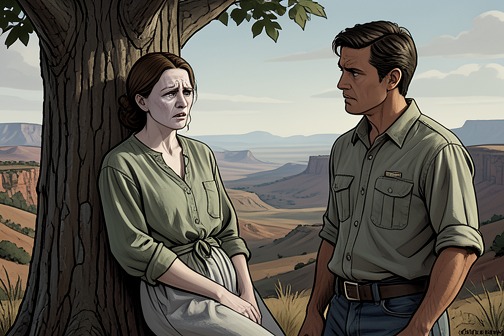
[Hope’s Pregnancy Reveal](entity:event-recall-event-hope-s-pregnancy-reveal-c10943cad25a) is the decisive reversal in Hope and [Avery](entity:character-recall-character-avery-3f30ea9cdcd5)’s relationship: the secret she fears will destroy their future instead becomes the condition through which they define a new family. Hope is carrying her deceased husband [Hank](entity:character-recall-character-hank-79d5809e13b8)’s child, and the revelation forces Avery to choose whether his love extends beyond a conventional romantic bond to include a child who is not biologically his. His answer turns exposure into acceptance and courtship into a lasting domestic commitment.
## Causes and Hidden Stakes
Hope conceals the pregnancy because she expects Avery to regard Hank’s child as an unbearable complication. While working outside with Avery, she becomes dizzy after overexerting herself. Avery recognizes the physical danger, calls her stubborn but admires her strength, and urges her to go inside, drink water, and rest while he completes the remaining work. Hope knows that the dizzy spells are caused by the pregnancy, yet she has not told him that she is carrying her husband’s baby.
Hope also understands that the concealment cannot last. She is already using loose clothing to hide the changes in her body, describing the pregnancy as an additional burden brought into Avery’s life alongside her own emotional history. The secrecy is therefore not casual deception but a conflict between the need to speak honestly and the fear that honesty will end the relationship. The eventual disclosure carries both romantic and reproductive stakes: Avery must accept Hope, the unborn child, and Hank’s continuing place in the family’s story.
## Public Discovery and Flight
The secret emerges during a church visit connected with Hope and Avery’s impending marriage. After the service, a woman congratulates Hope and touches her belly, assuming that the pregnancy is already known. Hope is stunned; Avery first looks confused and then begins to understand. The scene removes Hope’s control over the timing and manner of her confession. What she had intended to tell Avery privately is exposed in front of the community.
Hope immediately apologizes and runs from the church. She continues until she reaches a tree beside a pond on the outskirts of town, where exhaustion leaves her unable to go farther. Her flight expresses the shame and panic of a person who believes that disclosure has made her unworthy of the future she wanted. The movement from church to open ground also strips away the social setting in which the revelation occurred, leaving Hope and Avery to confront its meaning without the town as an audience.
## Avery’s Acceptance
Avery follows her on horseback and finds her by the pond. Instead of treating the pregnancy as a betrayal or withdrawing from the relationship, he tells her that she could have spoken to him and that the pregnancy does not change his love. He acknowledges that it changes the circumstances, but not his decision to remain with her, and says he will be honored to become part of her family.
Avery’s acceptance becomes the event’s central value shift. Hope expects rejection; Avery offers deliberate inclusion. He explains that her flight made him realize he did not want to live without her, regardless of the child’s biological father. When Hope worries that he may be saying this merely to comfort her, Avery places his hand on her belly and treats the unborn child as a life requiring protection rather than as evidence of a rival relationship. He promises to help raise the baby with the values he inherited and to ensure that the child knows Hank loved them, even though Hank did not live to meet them.
## Marriage, Birth, and Family Continuity
Hope believes the baby will be a girl, and Avery helps her back onto the horse so they can return home together. She describes the unborn child as fortunate to have a devoted mother and two fathers: Avery as the living parent who will raise her, and Hank as the deceased father whose love and memory remain part of her identity. The disclosure therefore does not erase Hank. Instead, it establishes a form of family continuity in which Avery’s care and Hank’s legacy coexist.
Hope and Avery soon marry, and a few months later Hope gives birth to a daughter. Hope sees Hank’s eyes in the baby and understands that a part of him will continue through her. Avery proves that his promise was genuine by becoming, in Hope’s view, the best father she could have asked for; the love visible when he holds the child is presented as the bond of a father and daughter rather than as reluctant obligation.
Hope names the girl Henrietta to give Hank his rightful place in her life. Avery understands the meaning of the name, accepts it, and holds Hope’s hand as the family becomes complete. The ending resolves the immediate fear of rejection while preserving the child’s connection to Hank, making acceptance not a replacement of one father by another but an enlargement of the family’s emotional inheritance.
## Narrative Significance
The event follows a romance pattern in which apparent exposure produces the relationship’s deepest commitment. Hope’s pregnancy is initially a hidden liability within a mail-order marriage plot, and the church discovery creates a brief dark moment: the community knows before Avery has heard the truth from Hope, and Hope assumes the revelation has made the desired future impossible. Avery’s pursuit supplies the restorative turn, replacing secrecy with speech and fear with a concrete promise of shared parenthood.
The scene also gives reproductive responsibility an interpersonal dimension. Hope bears the physical risk and emotional burden of pregnancy, while Avery’s response determines whether that burden becomes a source of exclusion or a basis for belonging. His acceptance is expressed through future actions—marriage, protection, child-rearing, and recognition of Hank’s memory—rather than through a temporary reassurance alone. By ending with Henrietta’s birth and naming, the narrative frames the reveal as the moment when an uncertain romance becomes an intergenerational family arrangement.
Event 46
Darren’s Mail-Order Bride Scam

[Darren’s Mail-Order Bride Scam](entity:event-recall-event-darren-s-mail-order-bri-8343edc9857d) is a turning-point event in which [Darren Crowley](entity:character-recall-character-darren-crowley-3b24bfb6dcb2)’s casual appetite for spectacle collides with the material consequences of treating marriage as a purchasable public-relations device. What he imagines as a joke for the press becomes an obligation involving an already-arrived woman, a non-refundable payment, possible immigration violations, and the life of [Kacie](entity:character-recall-character-kacie-d8c0a3627145), an innocent person he never expected to meet.
## Causes and Background
Darren’s crisis grows out of a longer pattern of careless public speech and celebrity damage control. After an interview about his criticism of the Black Lives Matter movement, he fails to understand how his statement that “white lives matter too” is perceived by the community. His father, [Doc Crowley](entity:character-recall-character-doc-crowley-e43a84e48565), tells him to stop speaking to reporters and warns that another scandal could destroy the public support surrounding Darren Crowley. The proposed remedy is itself performative: Darren is encouraged to announce an engagement to an actress, use the relationship to reverse the rumors, and end it a few months later. Darren briefly thinks that dating a black woman might achieve the same effect, revealing how readily he treats intimate relationships as instruments for managing public opinion.
The decisive mistake occurs during a party. Fifteen hours before he confronts the consequences, Darren is tipsy and playing on social media when someone suggests that he look for a mail-order bride. The proposal is presented as easier and funnier, a way to embarrass the press and generate headlines. Darren is intoxicated by the attention and does not realize that the hypothetical has become an actual transaction. When he later searches his web history, he finds that he has visited numerous pages for South African mail-order brides on the Lily Brides website and that an order email has arrived. The event therefore begins in the gap between speech and action: Darren believes he has been entertaining an outrageous idea, while the online intermediary has treated his words and payment as instructions.
## What Happens
The first sign that the joke has become real is an email asking Darren whether he has met her yet. He remembers that he did not merely discuss the idea with a friend; he spoke with [Josiah](entity:character-recall-character-josiah-8a088d2c9b59), a travel agent and mail-order connection whose operation is probably not legal but whose ability to arrange matters makes withdrawal difficult. Darren apologizes and claims that he thought they were discussing hypotheticals. Josiah replies that Darren has already forwarded the payment and that it is non-refundable. When Darren asks him to cancel the travel plans, Josiah explains that his delegate is already in the [United States](entity:location-recall-location-united-states-2f533bc8d0b9), staying in a hotel and awaiting orders. Darren paid for her, Josiah insists, so Darren now has the responsibility to dispose of her in whatever manner his conscience allows.
The exchange turns a foolish purchase into a coercive chain of responsibility. Josiah does not present a lawful contractual remedy; he explicitly warns Darren that no one ever said the arrangement was legal and advises him not to discuss legalities because Josiah knows who he is and understands that Darren cannot afford to drag the Crowley family name through public disgrace. Darren’s wealth and reputation, which ordinarily function as protections, become pressure points. The intermediary can exploit both the transaction and Darren’s fear of exposure, while the woman at the center of the arrangement has been reduced to an object that someone else ordered, transported, and expects Darren to manage.
Darren spends roughly half an hour arguing with his lawyer, but the conversation confirms rather than solves the problem. He already understands that he was foolish to trust someone on the deep web and doubly foolish to order a mail-order bride. He also recognizes that his supply of “get out of jail free cards” is nearly exhausted. If the public learns that he has been involved with mail-order brides, particularly African mail-order brides, the existing national scandal could become worldwide. His fear is not limited to criminal or immigration consequences; he is also calculating the reputational cost of the woman’s racial identity being attached to the story.
The private panic becomes immediate when a light knock sounds at the front door. Darren realizes that the woman has arrived and considers paying her off, but even that possible escape is entangled with the risk of scandal and the question of whether he would be breaking immigration laws. He opens the door slowly and meets the face of his supposed wife. The arrival reverses his expectation: instead of the short, frightened foreign girl he has imagined, he finds Kacie, a cocoa-skinned beauty with dark silky hair, a toothy smile, a smooth blue sweater, and a large designer bag. Her composed appearance does not lessen the seriousness of the situation; it exposes how thoroughly Darren has invented a stereotype to make his own misconduct easier to bear.
## Consequences and Aftermath
The event changes the value of the mail-order-bride idea from comic publicity to unwanted human responsibility. Darren had initially treated the arrangement as a headline-generating performance, but the arrival of Kacie forces him to confront the fact that a real woman has been displaced and placed in a vulnerable position through his drunken decision. The transaction cannot simply be erased because the payment has been made, the travel has occurred, and the intermediary has withdrawn while leaving Darren with the practical and moral burden.
The scam also exposes the unequal power built into the arrangement. Josiah controls access, information, and the logistics of travel; Darren controls money, housing, and the possibility of public recognition; Kacie arrives as the person most affected while having the least visible control over the conditions that brought her there. Even Darren’s thought of paying her off retains the language of disposal rather than partnership. The event’s central conflict is therefore not only Darren against an unscrupulous intermediary or Darren against the press. It is the collision between a man’s fantasy of purchasing a convenient solution and another person’s irreducible life.
The broader narrative repeatedly places marriage beside money, inheritance, employment, citizenship, and reproduction. [Abigail](entity:character-recall-character-abigail-d72687631c24) describes a plan to marry a rich American, divorce him, and use the money to start a business. William considers a mail-order bride as a business deal tied to transportation, citizenship, ten years of marriage, and bearing a child, while attempting to prevent her from claiming the estate. [Amy](entity:character-recall-character-amy-b0c9984bdc2f) encounters a prospective husband who openly frames marriage around his parents’ will, financial stability, children, friendship, and monogamy. Kember is offered one hundred thousand dollars for surrogacy, medical expenses, and a possible personal-assistant position, with an open-adoption arrangement proposed to preserve her contact with the child. [Emma](entity:character-recall-character-emma-0b5c09f9ac66) chooses a mail-order marriage to Lucas partly to escape the painful reminders of a house fire and the loss of her family. Against these negotiated or desperate arrangements, Darren’s case is distinguished by its accidental origin, its fraudulent intermediary, and his initial intention to use a woman as a publicity prop.
## Narrative Significance
Darren’s Mail-Order Bride Scam gives the book’s recurring contract logic its most unstable and openly comic form. In other relationships, economic exchange is at least discussed as a deliberate bargain: a bride may seek citizenship or stability, a husband may seek an heir, a surrogate may seek money, and a lonely man may seek domestic companionship. Darren begins without even the seriousness of a bargain. He mistakes the digital trace of an order for the harmless residue of a joke, and the story punishes that mistake by making the consequence arrive at his own door.
The event also connects several modern systems of mediation. Darren’s social-media activity turns attention into a market; the Lily Brides website converts desire into searchable profiles and completed links; Josiah’s emails transform online intention into travel logistics; and the press converts private conduct into public reputation. Each medium promises distance from consequences, yet each helps make the consequence more concrete. The website makes the woman selectable, the intermediary makes her transportable, and Darren’s celebrity makes the transaction dangerous enough to enforce.
As a story event, the scam belongs to the main chronological narration and is structured around a sharp reversal. Darren expects an amusing strategy that will help him control a scandal. Instead, he discovers that the strategy has created a new scandal before he has even decided what he wants. The knock at the door is the material punctuation of that reversal: the joke has acquired a face, a body, luggage, and a claim on his conscience. Kacie’s arrival does not resolve the conflict; it establishes the obligation from which the rest of Darren’s story must proceed.
Event 47
Darren and Kacie’s Relationship

[Darren and Kacie’s Relationship](entity:event-recall-event-darren-and-kacie-s-rela-3b62ef5f7a9a) is a turning point in which a cynical arrangement built from reputation management, racialized publicity, and the power of a mail-order scam becomes an emotionally serious connection. Darren initially approaches [Kacie](entity:character-recall-character-kacie-d8c0a3627145) as part of a strategy devised to repair the damage caused by his public scandals, yet her intelligence and independence expose the limits of that performance. The relationship gains its decisive meaning when Darren admits that he could have exploited her but instead releases her, transforming a coercive transaction into a choice Kacie can freely accept or reject.
## Publicity Scheme and Unequal Beginning
Darren enters the relationship under pressure from his father, who wants to reverse the rumors surrounding him by arranging a public engagement to a woman. Darren first misunderstands the proposal as an opportunity to date a Black woman, but his father clarifies that the intended performance is a short-lived engagement to a B-grade actress: they would date, announce the engagement, and separate a few months later. Darren recognizes the plan as a useful way to vindicate himself and also as a familiar opportunity to charm women.
The arrangement becomes more compromised when Kacie is brought into Darren’s life through a mail-order scam. The truth is not initially available to her, and Darren understands that he possesses power over a woman who does not know the circumstances surrounding her arrival. His attraction therefore develops inside an obvious moral imbalance: he can treat Kacie as an instrument of his public rehabilitation, or he can acknowledge her as a person whose consent matters. The relationship’s tension comes from that gap between the story Darren intends to stage and the unscripted person he encounters.
## Attraction Through Difference
Kacie quickly resists the role of an impressed or submissive bride. She tells Darren that she is not the sort of woman dazzled by possessions, and she reads his behavior with an accuracy that unsettles his usual confidence. She sees that he does not make much money despite trying to impress women, while Darren is drawn to her intelligence, wit, maturity, and worldly inner strength. Her composure prevents him from reducing her to the decorative partner his publicity scheme requires.
Darren’s attraction also forces him to confront his own learned preferences. He had previously limited himself to fit white women and treated the conventional trophy girlfriend as a social expectation. Kacie’s sophisticated voice, teasing manner, boldness, and distance from American assumptions about feminine submissiveness challenge that pattern. What first appears to him as an exotic difference becomes a more demanding form of recognition: he wants her attention because she is not easily won, not because she can simply make him look acceptable in public.
The physical and emotional intensity of the encounter develops together. Darren does not merely want to confess an attraction; he wants Kacie’s full and uninhibited consent, and he becomes fascinated by the fact that she has not yet been reduced to a victim who needs rescuing. The reversal is important. Although Darren still holds institutional and financial power, he begins to feel that he is the one seeking something from Kacie. The possibility that he may genuinely need her replaces the confidence with which he entered the arrangement.
## Disclosure and the Choice of Freedom
The relationship reaches its moral crisis when Darren tells Kacie that there is something she ought to know about the man who acted as her agent. He describes that intermediary as an unpleasant and untrustworthy figure, beginning the disclosure that exposes the deception surrounding her situation. Kacie reacts with anger and immediately insists that she is leaving; she rejects the idea that anyone can keep her against her will. Darren does not physically prevent her and offers to buy her a ride home, an action that marks the first concrete limit he places on the power available to him.
Darren then explains the origin of the scheme. He presents himself as a foolish man who became famous after an ill-considered joke, was branded racist by the press, and was encouraged by his father to date an African-American woman as a political maneuver. He says that he eventually abandoned the publicity logic in favor of seeking an unusual and intellectually challenging woman from [South Africa](entity:location-recall-location-south-africa-49123e8bd978). His explanation does not erase the exploitation built into the arrangement, but it distinguishes the public motive from the private attachment that has grown after meeting Kacie.
The decisive change comes when Darren admits that he likes Kacie, sees that she has suffered, and believes she has much to offer a man who feels spiritually diminished. He describes her presence as making him feel complete and capable of becoming better, while also claiming that he could make her happy if she allowed him to do so. Kacie understands the danger in his confession: he had the power to take her, abuse her, and discard her, yet he has chosen to give her freedom. Darren answers that releasing her is simply the right thing to do. The value at stake shifts from possession to consent, and the relationship can continue only after the original coercive structure has been acknowledged.
## Consequences and Narrative Significance
Kacie’s freedom changes the meaning of every subsequent choice. If she stays, the decision cannot be treated as the fulfillment of a contract or the successful completion of Darren’s publicity plan. It must be understood as a decision made after the fraud has been exposed and the exit has been offered. Darren’s behavior remains morally compromised by his initial participation, but his willingness to surrender control creates the possibility of an earned relationship rather than a transaction disguised as romance.
The episode also places Darren’s development beside other relationships in the book that treat marriage, migration, inheritance, or reproduction as economic bargains. [Abigail](entity:character-recall-character-abigail-d72687631c24)’s prospective marriage is discussed as a way to obtain money after a family catastrophe; William and his lawyer design a marriage around citizenship, inheritance protection, and a required child; [Jenna](entity:character-recall-character-jenna-65f88e27192a)’s marriage is opened as an alternative to divorce; and Dennis proposes a paid surrogacy arrangement while offering Kember employment and continued contact with the child. Against these models, Darren and Kacie’s relationship begins in the same language of leverage but turns on the recognition that a person must be able to withdraw.
Kacie’s South African background is likewise significant within the book’s recurring pattern of cross-border relationships. [Nairobi](entity:character-recall-character-nairobi-12f7eaa1ec31)’s mother prepares her for an American mail-order marriage as protection against poverty and political danger, while [Opal](entity:character-recall-character-opal-b515ca0df54f)’s escape from enslavement makes freedom the condition of any future life. Kacie’s story does not remove the colonial and racial power structures surrounding migration, but her refusal to be impressed and her insistence on leaving deny Darren the easy role of benevolent purchaser. She is not valuable because she can repair his reputation; she becomes indispensable because she remains capable of judging him.
## The Relationship’s Final Shape
The relationship therefore moves through a sequence of meeting, strategic performance, attraction, disclosure, and voluntary reconsideration. Darren begins by treating romance as something he can deploy: first as a publicity cure, then as a pursuit in which his money and influence would guarantee access. Kacie interrupts that logic by questioning him, refusing to flatter him, and recognizing the difference between mental admiration and physical desire. Darren’s eventual confession makes the relationship reciprocal only in possibility, not by erasing the past.
Its lasting significance lies in that incomplete but meaningful reversal. Darren does not become trustworthy merely because he declares affection, and Kacie is not required to reward his honesty. What changes is the condition under which they can continue: the mail-order deception is named, the danger is recognized, and Kacie is permitted to leave. The relationship’s emotional promise comes not from the original bargain but from Darren’s relinquishment of ownership and Kacie’s retained power to decide whether love can exist after exploitation.
Event 48
Kember and Dennis’s Surrogacy Agreement

[Kember and Dennis’s Surrogacy Agreement](entity:event-recall-event-kember-and-dennis-s-sur-6fb5d78e0fff) is a negotiation in which reproductive labor is initially presented as an extension of employment but gradually becomes a question of parenthood, bodily autonomy, and emotional attachment. Dennis seeks a child carrying his DNA; Kember needs secure work and money, yet fears that pregnancy would create a bond she could not simply surrender. Their proposed agreement therefore exposes the unequal power behind an apparently voluntary exchange and becomes the foundation for a relationship that may be more intimate than either participant first intended.
## Causes and Background
[Dennis Williams](entity:character-recall-character-dennis-williams-e0c36c86b94d) enters the arrangement as a wealthy chief executive of a major banking company who wants a child but has no wife. His demanding management style has already driven away assistants: he expects high-quality work, rejects employees who spend time on the telephone instead of completing their duties, and has seen previous interview candidates leave in tears. At the same time, he is attending classes on donor eggs, surrogacy, and the practical details of creating a family. His desire is not merely to provide for a child; he specifically wants the child to have his DNA, and his wealth gives him confidence that he can meet the financial demands of parenthood.
Kember arrives for an interview as a prospective personal assistant. She has recently visited a fertility clinic because her cousin, who works there, suggested that she consider becoming an egg donor. Kember says she would rather obtain a normal job, but the visit places reproductive work inside the immediate circumstances of her search for employment. Dennis notices the connection and asks her about it directly. When she explains why she was at the clinic, he reveals that he was there because he wants a baby and is considering using a surrogate. The interview thus shifts from a conventional assessment of office labor toward an inquiry into whether Kember might supply a different, far more intimate form of labor.
The arrangement belongs to a wider pattern in which marriage, childbirth, migration, inheritance, and financial security are treated as negotiable contracts. [Abigail](entity:character-recall-character-abigail-d72687631c24) describes a plan to marry a rich American, help him inherit his family fortune, divorce him, and use the resulting money to begin a business. William learns that control of his family estate requires marriage and an heir, then proposes treating the marriage as a business deal with a mail-order bride who would receive transportation and citizenship in exchange for remaining married and bearing a child. [Jenna](entity:character-recall-character-jenna-65f88e27192a) explains that her husband has permitted her to take a boyfriend because the alternative was divorce. Against this background, Dennis and Kember’s discussion is not an isolated oddity: it is one instance of a recurring world in which private relationships are organized through economic need and formal obligation.
## The Proposal and Its Terms
Dennis first makes the proposal while still conducting Kember’s job interview. He asks what she would think of becoming his surrogate as part of her personal-assistance position, startling her into asking whether he is asking her to have his baby. His proposed compensation combines several forms of payment and protection: a working salary, medical care, legal fees, and the costs of insemination. He then offers a total of one hundred thousand dollars for the surrogacy, while continuing to consider her for the assistant’s position, which pays fifty thousand dollars a year plus medical benefits.
The financial language makes the exchange concrete. Kember’s body would not simply be helping Dennis privately; it would be incorporated into a package of employment, medical provision, legal administration, and cash payment. Dennis also offers an open-adoption-type arrangement under which Kember could know the child while it grew up. He acknowledges that she would be the child’s mother and says that he wants to raise the child in the circumstances he believes a child carrying his name and DNA deserves. His offer therefore contains both an attempt to control parenthood and an effort to soften the finality of surrender by preserving Kember’s possible connection with the child.
Kember does not accept immediately. She points out that a two-parent family matters for a child’s stability and asks what would happen if Dennis’s child needed a mother while no woman was present in the household. Dennis answers that he could hire nannies, might eventually find the right woman, or could allow Kember to remain involved through an agreed parenting or adoption plan that included photographs and visits. He then asks her to go out with him that night before making a decision. The proposed contract consequently expands into a personal encounter before its terms have been settled.
## Consent, Attachment, and the Change in Terms
The decisive obstacle for Kember is not the money. When Dennis asks whether payment is the issue, she explains that donating eggs would be fundamentally different from carrying a baby and handing it over after birth. Pregnancy would involve bodily change, attachment, physical closeness, and the experience of holding the child. She fears that she would become emotionally bonded and would not be able to give the baby away. Her objection distinguishes genetic contribution from gestational and maternal experience, making clear that the agreement cannot reduce pregnancy to a service whose emotional cost is fully covered by a fee.
Kember’s response forces Dennis to alter the proposal. Rather than asking her to act only as a surrogate, he suggests that she become the mother of his child within a two-parent relationship and that they share the child as it grew older. He says he selected her deliberately, stressing both her identity and his attraction to her, and not merely because she happened to be available through the clinic. The original arrangement was built around a separation between the biological father and the paid carrier; the revised version makes Kember a continuing parent and turns the transaction toward an uncertain partnership.
That change does not erase the original imbalance. Dennis is the employer, the person with substantial financial resources, and the person who first frames pregnancy as something Kember might earn through him. Kember is seeking a job and acknowledges that she needs one. Even when he offers continuing contact with the child, he remains the party who defines the payment, medical coverage, legal expenses, insemination, and prospective parenting structure. Her hesitation shows that reproductive consent is not secured merely because compensation is generous or because an agreement offers formal options. The question is whether a person under economic pressure can negotiate freely when employment and pregnancy are placed in the same conversation.
## From Contract to Intimacy
The proposal’s emotional direction changes during the evening they spend together. Kember is still uncertain and says she came to the interview for the assistant’s job, not to decide immediately to carry a child. After wine makes the discussion easier to endure, she repeats that the central difficulty is attachment rather than stress or money. Dennis listens thoughtfully, then proposes the two-parent relationship. When Kember asks whether he finds her sexually attractive, he takes the wineglass from her hand, sets it on the table, pulls her from her chair, and draws her into his arms.
This physical turn does not resolve the agreement; it reveals how quickly contractual language can become entangled with desire. Dennis’s initial logic is managerial and reproductive: he needs a child, Kember needs income, and a carefully designed arrangement might satisfy both. His later response treats attraction as a reason to revise the contract into a relationship. The movement is significant because it changes the value at stake from financial security alone to the possibility of mutual desire, while leaving unresolved whether intimacy strengthens Kember’s freedom to choose or makes refusal more difficult.
The agreement also echoes other proposals in the novel. William’s mail-order-marriage plan makes transportation, citizenship, a minimum marriage term, and childbearing contractual benefits and duties. In the surrogacy negotiation, Dennis similarly tries to convert a vulnerable need into a regulated exchange, but Kember’s fear of attachment exposes what the contract cannot contain. A document may specify payment, medical care, legal fees, access, or custody; it cannot guarantee that the person who carries a child will remain emotionally separate from it.
## Consequences and Significance
The agreement is consequential because it joins four systems that are often treated as separate: labor, reproduction, romance, and family law. Kember is approached simultaneously as an employee, a potential surrogate, a possible mother, and a prospective partner. Dennis’s wealth makes the arrangement seem administratively manageable, yet Kember’s questions about maternal absence and the child’s need for two parents show that financial provision does not answer every ethical or emotional demand of family life.
Its broader significance lies in the contrast between apparent choice and the conditions shaping that choice. Across the surrounding narratives, people enter marriages to obtain inheritance, citizenship, escape, money, protection, or a route away from painful reminders. [Emma](entity:character-recall-character-emma-0b5c09f9ac66) leaves [England](entity:location-recall-location-england-b153c1f368ea) for Texas as a mail-order bride, hoping to escape the constant reminders of a devastating fire while helping Lucas with his niece. [Valerie](entity:character-recall-character-valerie-879cd9992233) accepts a lifelong mate bond after her partner saves her from a brain tumor and impending death, describing the arrangement through gratitude and indebtedness rather than love. [Maggie](entity:character-recall-character-maggie-39724c72a859) faces a system in which communities must surrender one person each year to the [Watchers](entity:character-recall-character-watchers-156c2f4cc152), who use some humans as slaves and others for forced breeding. Kember’s situation is less overtly coercive, but it belongs to the same continuum of reproductive choices made under unequal conditions.
The proposed arrangement therefore does not end with a simple exchange of money for a baby. Kember’s insistence that pregnancy creates attachment changes the terms, and Dennis’s response changes the meaning of the proposal itself. What begins as an employment-linked surrogacy plan becomes a possible two-parent family, but its foundation remains marked by bargaining power, bodily risk, and the unresolved question of whether affection can transform a transaction into freely shared parenthood. In that tension, the event concentrates the book’s recurring concern with relationships that promise security while demanding intimate forms of surrender.
Event 49
Kember’s Pregnancy and Relationship with Dennis

[Kember’s Pregnancy and Relationship with Dennis](entity:event-recall-event-kember-s-pregnancy-and-b28d1fd247ed) is a turning-point event in which a planned birth becomes the means through which Kember and Dennis acknowledge desires that had been present before either of them openly named them. What begins as artificial insemination, paperwork, and an agreement that Dennis will receive the child develops into a reciprocal romantic commitment, leaving Kember pregnant and the couple willing to discover what their relationship can become.
## The Surrogacy Agreement
Kember does not enter the arrangement without reservations. She understands the difference between donating eggs and carrying a child through pregnancy before surrendering it at birth: carrying the baby would involve bodily change, emotional attachment, childbirth, and the pain of not keeping the child. Her fear is not primarily financial. She worries that bonding with the baby will make the contract impossible to honor, especially because the signed agreement gives Dennis the baby and denies her parental rights.
Even so, Kember agrees to proceed with artificial insemination at a clinic. Her decision is influenced by the money, by her growing affection for Dennis, and by an intuition that the arrangement may not remain purely commercial. She continues working as Dennis’s assistant while the agreement moves from negotiation to medical procedure. At the clinic, she lies on the examination table while a catheter is inserted and sperm is injected; afterward, she texts her cousin to say that the procedure is complete. The clinical routine makes reproduction appear manageable and administrative, but Kember’s private uncertainty shows the emotional cost that the paperwork cannot contain.
## Pregnancy and Confirmation
After the procedure, Kember drives home slowly, questioning why she has accepted an agreement that formally removes her rights to the child. She senses that signing the contract may not settle the future as decisively as it seems. Dennis gives her explicit instructions to text him as soon as the follow-up test confirms the result, making the pregnancy both a medical outcome and the central condition of their arrangement.
The confirmation arrives after several weeks. [Kesha](entity:character-recall-character-kesha-3dc4860e2c15) tells Kember, “You are definitely pregnant,” and celebrates by hugging her and performing a small happy dance. Kember receives the news with uncertainty rather than uncomplicated joy; she knows the pregnancy has succeeded, but the reality of carrying Dennis’s child has not yet fully settled in her body. When she visits Dennis and he anxiously asks for the result, she tells him, “It worked.” His immediate response is relief and happiness, and he embraces her, treating the pregnancy as wonderful news rather than merely the fulfillment of a contract.
## Dennis Reveals His Motive
The pregnancy becomes the occasion for Dennis to confess that he had concealed a personal motive from the beginning. He explains that when Kember came into his office after he had seen her at the fertility clinic, his first impulse had been to ask her out. He genuinely wanted a baby, but he also wanted a reason to keep Kember close to him. He admits that she had initially lacked the qualifications for the job, yet had proved capable of handling the workload, and his admission forces Kember to reconsider both their professional arrangement and the supposed neutrality of the surrogacy proposal.
Dennis then makes the emotional meaning of the pregnancy explicit. He says that he wants more than a baby and wants Kember herself, asking her to give their relationship a real chance. His confession changes the arrangement from a one-sided reproductive transaction into a declaration of romantic intent, although it also reveals that he used the prospect of pregnancy to create a bond before openly asking for intimacy. Kember is shocked because the offer she accepted as a surrogate has been carrying an unspoken possibility of partnership for Dennis.
## From Contract to Relationship
Kember responds physically before she can fully resolve the ethical and emotional complications of Dennis’s confession. She embraces him, kisses him, and allows desire to replace her immediate anxiety about the baby and the future. Their intimacy confirms that her own attachment was not limited to the role of surrogate; she had already imagined that Dennis might eventually want her as well. The pregnancy therefore acts as a midpoint transformation: it does not merely produce the child promised by the agreement, but brings the hidden relationship into the open.
Dennis continues to define his intention beyond the pregnancy, promising that he will want Kember long after the baby is born if she gives him the opportunity to prove it. The promise matters because Kember’s greatest fear has been disposability: becoming necessary only as a body that carries Dennis’s child and then being excluded from the child’s life. His words do not erase the contract or guarantee that the future will be simple, but they answer her fear with an expressed commitment to remain connected to her beyond childbirth.
## Ending and Significance
After their first full sexual encounter, Dennis tells Kember that they have much to discuss but that, for the night, he intends to make love to her repeatedly. Kember accepts the prospect of a genuine relationship and acknowledges that she might not have agreed to become his surrogate if she had not sensed the possibility of something more between them. Her response recasts the earlier uncertainty: the arrangement was financially motivated, but it was also shaped by attraction, trust, and hope.
The event ends without resolving every practical question about the pregnancy, the contract, or parental rights. Instead, it offers a provisional emotional resolution. Kember is pregnant, Dennis has declared that he wants both her and the baby, and she is willing to take a real risk on him. Her final acceptance recognizes that the future remains unknown, yet treats the present relationship as sufficient for the moment. The narrative thus converts a potentially exploitative reproductive bargain into a romance while retaining the tension between bodily autonomy, contractual obligation, emotional attachment, and the desire to build a two-parent family.
Event 50
Merriam逃离Colin的追杀
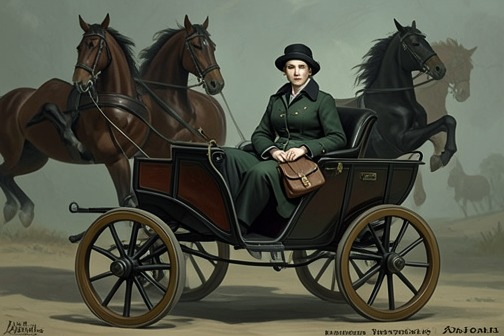
Merriam’s escape from Colin’s pursuit is the decisive reversal that transforms a difficult journey into a flight for life. Sent out on an errand with important documents concealed in her stagecoach, Merriam is isolated on unfamiliar roads and forced to rely on endurance, caution, and Vance’s timely protection when the people hunting her close in. The episode changes her understanding of her marriage: what she had treated as a strained relationship begins to look like a deliberate plan to have her killed.
## Causes and Background
Merriam begins the journey aware that the road is dangerous but determined to make the trip without appearing vulnerable. She keeps the satchel containing the documents in a hidden compartment beneath the seat, away from prying eyes, and understands that traveling alone as a woman places both her body and her life at risk. After more than three hours in the saddle, the horses remain capable of continuing, although Merriam knows they will eventually need water and nourishment.
The journey’s apparent difficulties are then revealed as sabotage rather than bad luck. Merriam hears a crack and feels the stagecoach lose control; when she stops, she finds that its axle has split and is leaning to one side. The damage leaves her unable to continue by carriage. A distant gunshot spooks the horses, which rear, break free from their harness, and race away, leaving Merriam with neither transportation nor immediate protection. She retrieves the document satchel and straps it over her shoulder, an action that preserves the mission’s purpose while making her feel conspicuously marked as a target.
## What Happens
Forced to walk along a dusty trail, Merriam follows the sound of water while trying to remain alert to unwanted visitors. She has to lift her dress through mud, and another bullet nearly strikes her before the impact of a shot against glass exposes the shooter’s position. The firing is not yet an open attack aimed at killing her; it is target practice, but its proximity makes the threat unmistakable. The broken axle, the vanished horses, and the gunfire form a tightening chain in which every means of escape is removed.
Merriam reaches a clearing and encounters Vance, a clean-shaven cowboy dressed in a black hat and black leather vest, carrying a six-shooter at his waist. He has been shooting bottles and invites the hidden observer to reveal herself, offering food and company rather than immediately treating her as an enemy. His presence first appears to be another danger on an already hostile road, but the encounter becomes the event’s central turn: the stranger who could have exploited Merriam instead becomes the person capable of keeping her alive.
After Merriam sleeps beside him, Vance is gone when she wakes, and the temporary safety of the camp collapses. She hears voices and realizes that a search party is moving through the area. The men have been instructed to find her before morning, and their orders make clear that the package she carries must not be damaged. They also reveal that the harness straps were cut lightly, ensuring that the horses would escape after the gunshot and that Merriam would be left on foot. The hunters therefore know the precise conditions of her predicament and are pursuing her as a controlled target rather than searching at random.
Vance returns before the pursuers discover Merriam. When she screams, he covers her mouth to keep the sound from carrying and tells her that they must leave quietly. At first light, he counts at least five men and warns that others may be nearby. He leads Merriam and the horse down toward the water’s edge, away from the main roads, using the terrain to avoid the searchers. The escape is consequently not a triumphant flight into open country but a quiet withdrawal through a narrowing margin of safety.
## Recognition and Consequences
The hunters’ reference to a boss awakens Merriam’s most frightening suspicion: the person ordering her removal may be her own husband, Colin. Vance recognizes the implication before she fully speaks it, and Merriam’s face confirms the truth. Her danger is no longer merely criminal or accidental. It is intimate, organized, and connected to the marriage on which she believed her future depended.
Merriam explains that the marriage had always been marked by tension and by her sense that she failed to satisfy Colin’s expectations. He wanted a sophisticated trophy bride, someone who could serve as visible social ornament, while Merriam’s upbringing had left her with more practical roots. Her attempt to become the woman he wanted did not secure her place beside him; instead, the escape reveals that her inadequacy in his eyes may have become a reason for eliminating her. The documents make her valuable to the pursuers, but the marital betrayal makes the pursuit personally devastating.
Vance’s protection produces the scene’s immediate value shift. Merriam begins stranded, exposed, and apparently abandoned; by the end of the sequence she is still hunted, but she has an ally who can read the threat, count the attackers, extinguish the fire, and guide her away from the roads. His intervention does not end Colin’s pursuit or guarantee Merriam’s safety. It does, however, replace helpless isolation with a provisional partnership and gives her the possibility of surviving long enough to confront the truth about her husband.
## Narrative Significance
The event operates as a pursuit-and-escape plot built from escalating gaps between expectation and result. Merriam expects a hazardous errand and discovers a planned assassination; she expects the broken carriage to be misfortune and learns that the horses and harness were manipulated; she initially fears the armed cowboy and finds protection instead. Each reversal converts an ordinary object—the axle, the harness, the bottles, the document satchel, and the main road—into evidence of either danger or survival.
The sequence also makes Merriam’s movement through the landscape a measure of her changing position. The carriage promises social protection but leaves her stranded, while walking through mud exposes the bodily cost of escape. The concealed documents preserve the larger stakes, yet they also make her a package-bearing target in the eyes of the men sent after her. By carrying them herself and following the water away from the roads, Merriam becomes more than the passive object of Colin’s scheme: she acts to preserve evidence, evade capture, and remain alive despite the conditions designed to make her vulnerable.
Its ending remains provisional rather than final. Merriam and Vance have escaped the immediate search by moving along the water’s edge, but the armed party is still nearby and Colin’s alleged order remains unresolved in the wider plot. The event’s lasting importance lies in the recognition it forces: Merriam can no longer interpret her marriage as merely disappointing or emotionally cold. The sabotaged journey and the search for the undamaged package expose a life-threatening conspiracy, while Vance’s assistance opens the first credible path away from Colin’s control.
Event 51
William劫走Elizabeth

William’s abduction of Elizabeth is the decisive turning point in the estate raid: what begins as an organized search for wealth, horses, food, and vulnerable women becomes the violent removal of a specific woman from her home. The episode shifts Elizabeth from protected household member to captive carried away on horseback, while establishing the coercive power imbalance that later surrounds her connection with William.
## Causes and Background
The raid is planned as a practical assault on an apparently wealthy estate. The landowner is expected to be away on business, and his usual protective guard will therefore be absent, leaving only servants and field workers to defend the property. The raiders regard the timing as ideal because confronting the wife and handmaidens seems easier than facing the homeowner and his private soldiers. Their motives are openly mixed: some seek gold and jewels, some horses, some food and other provisions, and others intend to assault women. The plan is not presented as a single disciplined military objective but as opportunistic plunder in which every member of the group expects to find a personal reward.
William participates in this scheme while eating buttered bread and a borrowed apple, the first meal he has had in more than a day, and accepting ale from another member of the group. His hunger places the raid within a wider atmosphere of deprivation, yet the narrative does not turn that deprivation into an excuse for what follows. The same group that searches the kitchen and larder also treats women as spoils, and William’s later choice of Elizabeth grows directly out of that predatory environment.
## The Raid Reaches Elizabeth’s Room
Elizabeth first senses that something is wrong through fragmentary signs rather than a clear announcement. The dogs outside become noisy, and from upstairs she hears an unfamiliar disturbance behind the house. At the window, she sees a young boy running through the vegetable garden while grabbing produce from the vines. A scream from downstairs confirms that the danger is inside the household. Elizabeth rushes to her bedroom, struggles with the door, and finally bolts it despite the metallic screech that may reveal her location.
The locked room briefly becomes a refuge. Elizabeth crouches between her needlepoint easel and the rough stone wall while movement, rustling, and male voices spread through the house. She worries about [Olivia](entity:character-recall-character-olivia-b40a5119f315), whom she has left alone in the kitchen, and holds her breath when footsteps stop outside. The attempted opening of the door transforms concealment into exposure: the locked room itself signals to William that something worth finding may be hidden within it.
William’s suspicion is confirmed when he breaks through the lock with a heavy black boot. He enters as though he already owns the room, only to find an orderly bedroom rather than the treasure store he expected. The contrast is important: Elizabeth’s tidy, domestic interior offers no protection once the logic of plunder has entered it. Her bedroom, bed, curtains, and stored dresses are absorbed into the raiders’ world of unauthorized possession.
## The Abduction
Elizabeth tries to make herself smaller against the stone wall, but William discovers her behind the easel. He greets her with apparent amusement and demands to know what she is doing on the floor. When she stammers in fear, his rough, calloused hand closes around her bare shoulder and hauls her upright. The gesture is not an act of rescue or courtship; it is the physical assertion of ownership over a person who has already made her refusal clear.
William announces that he has found the missus and describes her as a prize. Elizabeth protests and tells him to release her, but he answers the protest by treating her resistance as another reason not to let her go. His size intensifies the imbalance: he is strongly muscled, more than six feet tall, and able to manhandle her onto his shoulder. When Olivia attempts to block his path, William pushes her aside and carries Elizabeth out of the house.
The removal is completed through the image of the horse. William throws Elizabeth stomach-down across [King](entity:character-recall-character-king-817ed90ecad5)’s back, mounts smoothly, and rides away while keeping one firm hand on her lower back to hold her in place and steering with the other. Elizabeth can raise her head only enough to see Olivia screaming from the open kitchen door as the raiding party disappears over the hill. The scene therefore ends not with negotiation but with separation: Elizabeth is taken from the estate, Olivia is left behind, and the household’s last visible witness can do nothing to stop the retreat.
## Consequences and Narrative Meaning
The immediate consequence is Elizabeth’s transformation into a captive and William’s acquisition of a woman he has selected from the household during a raid. Her locked door, attempted concealment, spoken refusal, and physical struggle all establish that she does not consent to being taken. The episode consequently gives concrete form to the book’s recurring pattern in which intimate arrangements are framed through property, marriage, money, or survival, but here the transaction begins as outright violence rather than a stated contract.
That pattern appears elsewhere in sharply different forms. [Abigail](entity:character-recall-character-abigail-d72687631c24)’s proposed marriage is described as an exchange in which she will marry a rich American, help him inherit his family fortune, and later return to [London](entity:location-recall-location-1bfd335cdd1b) with money to start a business. William himself later approaches marriage as a business deal, asking whether a mail-order bride can be contracted to remain married for a minimum period and bear a child while being prevented from claiming the estate. [Jenna](entity:character-recall-character-jenna-65f88e27192a)’s open marriage is likewise presented as a negotiated alternative to divorce, while Dennis offers Kember money, medical expenses, employment, and continued contact with a child in exchange for surrogacy. Against those arrangements, Elizabeth’s abduction shows the most extreme form of the same possessive logic: before marriage can be discussed, her freedom has already been removed.
The event also establishes a grim contrast between William’s stated desire for control over property and the human reality of the person he takes. In the later contractual logic surrounding marriage and inheritance, legal language attempts to regulate spouses, children, estates, citizenship, and duration. During the raid, however, William bypasses law entirely. His declaration that Elizabeth is a prize compresses woman, household, and wealth into the same field of possession. The narrative’s decisive value shift is therefore from domestic security to captivity, with Elizabeth’s home becoming the first site from which her autonomy is stripped away.
As a plot movement, the episode combines raid, pursuit, and abduction. It begins with a calculated vulnerability in the estate’s defenses, narrows through Elizabeth’s sensory discovery of the intrusion, and culminates in a forced journey across the landscape on King’s back. The structure makes the change in power visible beat by beat: the household is first merely uneasy, then endangered, then breached; the bedroom is first a hiding place, then a trap; and Elizabeth moves from standing within her own home to being carried away under William’s physical control. The disappearance over the hill closes the scene while opening the longer conflict surrounding her captivity, William’s claim over her, and the possibility of whether any later relationship can emerge from such a beginning.
Event 52
Elizabeth选择留在William身边
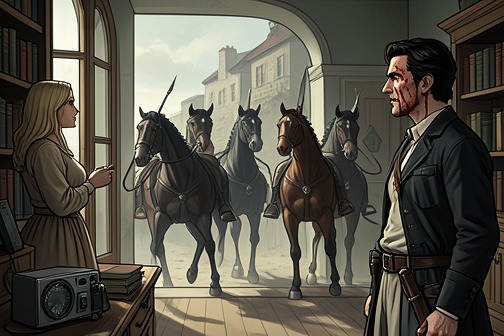
Elizabeth’s choice to remain with William is the decisive turn in their flight from the estate: with four horsemen approaching the cabin, she is asked to choose between returning to her former life and escaping with the wounded man who has become her protector and lover. Her whispered decision, followed by a kiss, an intimate request, and a hurried flight through the trees, changes the meaning of their relationship from sheltering dependence to mutual commitment.
## Causes and Immediate Pressure
The decision occurs in a cabin that has briefly served as a refuge, but the refuge is collapsing almost as soon as it becomes habitable. William bursts through the heavy wooden door breathless, disheveled, and bleeding, warning Elizabeth that the pursuers are close behind him. The danger becomes visible when she reaches the window and recognizes four horsemen pounding toward them. The approaching riders turn the cabin from a possible home into a trap and force an answer that cannot be postponed.
William does not simply order Elizabeth to follow him. Standing beside her at the window, he turns her toward him and asks whether she wants to stay with him or return home. The question gives the scene its central moral and emotional structure: Elizabeth must identify where she belongs while armed men are closing in, and William must accept that her decision cannot be taken for granted. The choice is therefore made under extreme pressure, but it is still presented as hers.
## The Choice at the Window
Elizabeth initially reacts with surprise, asking what William means. When he clarifies that he wants to know whether she will stay with him or return home, she answers with a single whispered word: “Stay.” The brevity of the response emphasizes its immediacy. Her heart speaks before calculation can intervene, so the decision is not framed as a practical assessment of danger but as the recognition of an attachment already formed.
The value shift is sharp. Elizabeth’s earlier home represents the place to which she could theoretically return, while the cabin represents danger, flight, and an uncertain future with William. Yet when the choice becomes explicit, the supposed safety of returning loses its authority. By choosing William, Elizabeth exchanges the protection of a known order for the risks of an escape whose emotional meaning is clearer to her than its material prospects.
William answers her decision physically rather than through a long explanation. He pulls her close and kisses her deeply and ferociously. The kiss confirms that her choice has altered the relationship for both of them: Elizabeth is no longer merely someone being carried away from danger, and William is no longer acting only as a rescuer. Their bodies register the decision before the escape resumes, making desire part of the event’s consequence rather than a separate development.
## Escape and Consummation
The approaching horses interrupt any possibility of delay. William retrieves the small metal key from its hiding place in the wall, takes Elizabeth’s hand, places her on [King](entity:character-recall-character-king-817ed90ecad5)’s back, and races with her into the surrounding trees. The key connects the romantic decision to the practical conditions of survival: Elizabeth had discovered it while investigating the three locked boxes, and William now recovers it before they leave. The couple’s departure thus carries both their emotional commitment and an unresolved secret from the cabin.
Their escape does not end the intimacy created at the window. When William later asks Elizabeth to explain why she wants to stay, she answers without words by placing her palm against his chest and sliding it to the back of his neck. The gesture becomes a second affirmation, one that translates her earlier whispered choice into deliberate physical consent. When William reminds her that he will not take anything she does not willingly give, Elizabeth explicitly asks whether he will share the bed with her that night.
That request establishes a further boundary within the relationship. Elizabeth is not portrayed as merely yielding to William’s strength or circumstances; she is required to ask, and she does so. He carries her to the bed, and their encounter becomes the consummation of the choice made under pursuit. Afterward, they hold one another as sleep claims them, and the next morning finds them still entangled. The scene therefore moves from threat, to decision, to flight, to chosen intimacy, with each stage reinforcing the preceding one.
## Consequences and Narrative Significance
Elizabeth’s decision makes William’s protection reciprocal. He has been the person who moves her through danger, but her answer gives him a reason to continue the escape as a shared future rather than a unilateral rescue. Their immediate consequence is flight from the horsemen, while the deeper consequence is the formation of a relationship founded, at least in this pivotal scene, on explicit choice and repeated confirmation.
The event also develops the story’s recurring contrast between imposed circumstances and personal agency. Other narratives in the surrounding material place women inside marriages, captivity, domestic violence, grief, or forced movement. Elizabeth likewise faces pursuit and uncertainty, but the crucial exchange at the window pauses the action long enough for her preference to be spoken. Her “Stay” does not erase the danger surrounding her; it gives that danger a new emotional direction.
As a romance beat, the scene functions as a midpoint transformation from proximity to commitment. The threat of capture supplies the external pressure, William’s question creates the relational test, and Elizabeth’s answer produces the turn. The kiss, the recovered key, the ride into the trees, and the later request to share his bed all extend the same movement: Elizabeth does not merely escape with William; she chooses the life implied by escaping with him. The quiet image of the two sleeping together, still holding one another after the pursuit, provides the event’s temporary resolution while leaving their wider flight and the locked boxes as continuing sources of uncertainty.
Event 53
Victoria与Dylan建立家庭
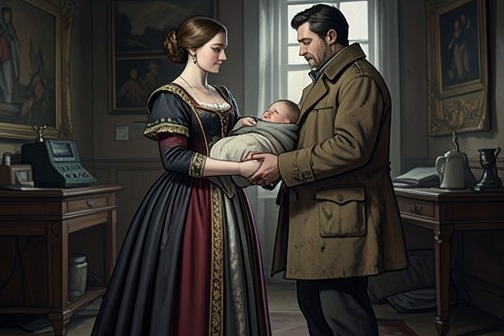
[Victoria](entity:character-recall-character-victoria-fef24d0cf051) and [Dylan](entity:character-recall-character-dylan-9404ac07efd4)’s establishment of a family is the decisive transformation of their relationship from a socially and culturally risky marriage into a mutually desired household. What begins amid class prejudice, family anxiety, and the threat of Highland violence becomes a domestic bond marked by sexual intimacy, clan acceptance, pregnancy, and the prospect of shared inheritance.
## Marriage Under Social and Political Pressure
The marriage takes place in an atmosphere already strained by hierarchy and danger. Victoria comes from the wealthy Kensington family, whose name is associated with business, humanitarian respectability, and the privileges of an English aristocratic background. Her brother Richard objects to her relationship with Dylan because he considers him uncouth, unshaven, and descended from farmers. The objection is not merely personal: Richard believes that Victoria’s marriage should protect the family’s status and continue its line. At the same time, Highland warriors are approaching English settlements, towns have been destroyed, and soldiers guard the edges of the community. Victoria’s union with Dylan therefore crosses both class and cultural boundaries while unfolding against the possibility of armed conflict.
The ceremony itself is presented as a threshold rather than a triumphant public spectacle. Dylan is captivated when he sees Victoria descending the staircase in lace, and the two experience an immediate physical response when he takes her hand from her father’s arm. Yet the celebration remains disorienting for Victoria. After the ceremony and a small glass of ale, she can barely understand the Scotsmen’s toasts, while her thoughts turn anxiously toward the night ahead. Her parents withdraw, [Abigail](entity:character-recall-character-abigail-d72687631c24) goes to the servants’ quarters, and only Victoria and Dylan remain in the dining hall. Dylan’s nervous question about whether his new wife is ready to see her room exposes the uncertainty beneath the formal event: the marriage has been completed publicly, but the household still has to be made emotionally real.
## From Ceremony to Chosen Intimacy
The decisive shift occurs after the wedding night, when the new marriage becomes something Victoria actively wants rather than merely something she has entered. The following morning, Dylan asks Mrs. Walker what she would like to do, kneels before her, and promises to make it happen. Victoria initially responds with visible shyness, twisting her hands and avoiding his penetrating blue eyes. When he lifts her chin and asks what is troubling her, she quietly asks to repeat what they did the previous night. Her repetition matters: it converts the marriage’s physical consummation into an expressed desire and establishes that intimacy is not confined to an obligation created by the ceremony.
The couple then withdraws from ordinary clan life for several weeks as winter approaches. The clansmen notice that they see very little of Dylan or Victoria and make raunchy jokes about the newlyweds, but they do not begrudge Dylan his happiness or pleasure. The retreat gives the relationship a private space in which attraction can become routine and attachment can deepen. When Victoria does return to meals and evening conversations, the clan discovers that she is lively rather than merely ornamental, and her presence begins to belong within the household’s social world.
## Clan Acceptance and Domestic Belonging
Victoria’s integration into Dylan’s family is one of the event’s most important consequences. Her marriage initially places her between worlds: she is an English woman from a privileged family, while Dylan belongs to a Highland community whose language, customs, and social identity are unfamiliar to her. The household’s acceptance does not erase that difference, but it makes the marriage sustainable. The clansmen laugh about the couple’s seclusion without treating Victoria as an intruder, and they eventually accept her as a genuine addition to the family.
The morning after her parents leave, the emotional cost of the transition becomes visible. [Andrew](entity:character-recall-character-andrew-531aa0f64cfb) and [Lydia](entity:character-recall-character-lydia-3e7a560b729c) pack their belongings and depart with their staff. Victoria remains cold and distant toward her father but embraces her mother roughly, while Lydia brushes tears from her daughter’s eyes before climbing into the carriage. Victoria then returns to the castle so that she does not have to watch them drive away. The departure separates her from her birth family in practical and emotional terms, while Dylan follows her indoors and back to their room. His presence makes the castle a replacement home rather than merely the site of a politically advantageous marriage.
## Pregnancy and the Formation of a Household
The relationship becomes a family in the fullest sense when Victoria becomes pregnant. Several weeks after the wedding, she and Dylan appear before the gathered household, and later Victoria places his large hands on her swollen belly. Their joking intimacy continues even during pregnancy, suggesting that conception has not ended the erotic bond that brought them together. Instead, pregnancy is absorbed into the couple’s shared life and becomes a visible sign of their continuing closeness.
Victoria presents the pregnancy to her parents with open pride. She explains that she and Dylan kept trying until it finally worked, turning conception into the result of shared persistence rather than an accidental consequence hidden from the family. She then pats her stomach and announces that one day her estate will belong to the proud Scotsman beside her. The statement links reproduction, marriage, inheritance, and cultural change: the child will connect Victoria’s wealthy English lineage with Dylan’s Highland identity, while the anticipated inheritance gives the marriage a future extending beyond private affection.
The event also gains significance when compared with other marriage arrangements in the wider narrative. Some unions are explicitly negotiated as economic contracts: Abigail plans to marry a rich American so that he can inherit his family fortune and then return to [London](entity:location-recall-location-1bfd335cdd1b) with money for her own business; William and his lawyer consider a mail-order bride through a contract involving transportation, citizenship, a minimum marriage period, a child, and restrictions on estate claims; [Jenna](entity:character-recall-character-jenna-65f88e27192a) enters an open-marriage arrangement because her husband sees it as preferable to divorce; and Dennis offers Kember one hundred thousand dollars, medical expenses, and a possible continuing role in a child’s life in exchange for surrogacy. Against those arrangements, Victoria and Dylan’s household is still shaped by inheritance and lineage, but the narrative emphasizes mutual desire, domestic acceptance, and the emotional movement from uncertainty to attachment.
## Narrative Significance
Victoria and Dylan’s family-building arc uses marriage as both a crossing of boundaries and a reorganization of power. Victoria leaves an English household that measures love through class, reputation, and inheritance and enters a Highland home where her acceptance is demonstrated through everyday inclusion. Dylan, initially marked by Victoria’s family as socially inferior, becomes the partner with whom she chooses intimacy and the father of the child she proudly displays. The direction of value changes from apprehension to belonging, from separation from her parents to the creation of a new household, and from cultural difference to a future represented by their unborn child.
The event’s ending is therefore not simply the announcement of a pregnancy. It confirms a durable family structure: Victoria and Dylan remain together, the clan has accepted her, and the child promises to join two social worlds while extending both the marriage and its material consequences into the future. The final image of Victoria’s swollen belly and her confident prediction about Dylan’s eventual inheritance gives the household a public form. Their private relationship has become a family, a lineage, and a claim on the estate that once symbolized the authority of Victoria’s birth family.
Event 54
Patrick以停战协议带走Elizabeth
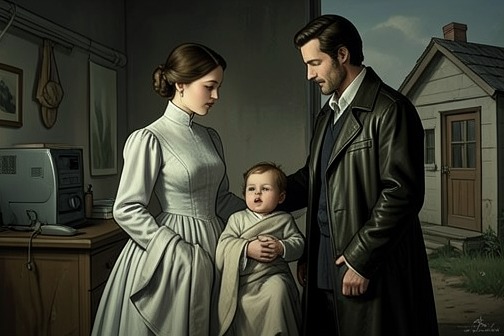
Patrick McDowell’s taking of Elizabeth is a coerced peace arrangement in which a Highland warrior demands her as the price of sparing an English town. The episode exposes a society that calls itself civilized while allowing magistrates, family authorities, and soldiers to exchange a woman’s freedom for a temporary truce. Its decisive significance lies in the collision between Elizabeth’s lack of consent and Patrick’s claim that honor can make such an agreement legitimate.
## Threats and Political Background
Patrick first makes his intentions known through a letter Elizabeth finds hidden in the back of her brother’s pants. He identifies himself as a Highland warrior charged with taking land and pillaging whatever he can find, then says that he has seen Elizabeth from a distance and wants her. The letter presents a stark alternative: if she does not consent to be his, he will destroy the town and take her by force. The formal language of a proposal cannot disguise the threat beneath it; Elizabeth’s supposed choice is bounded by the promised devastation of everyone around her.
The danger becomes harder to dismiss when the letters continue. Over the following weeks, Elizabeth receives five increasingly frightening messages, described as sweet but condescending and growing more menacing with each arrival. Her brother Richard is angry that she concealed them, while the town’s soldiers and magistrate are already alert because Highland warriors have destroyed other communities. The family has influence with the magistrate but not enough power to protect Elizabeth from the decision ultimately made in the town’s name.
## The Forced Negotiation
After Patrick agrees to talk, Richard tells Elizabeth that she must go because refusal may bring the Highland warriors down on their land. The magistrate has ordered him to negotiate on the town’s behalf, and Elizabeth understands that she has little genuine choice: if she will not go willingly, guards will take her to the meeting place. The arrangement is deliberately concealed from the public, reducing her abduction to a private transaction among those who possess authority.
Elizabeth travels on horseback with Richard and a single guard to a clearing outside town. Patrick arrives carrying a Scottish flag, wearing green-and-white tartan over one shoulder, with the other shoulder bare and a sword in his hand. The visual display combines diplomacy with military power. He does not approach as an ordinary suitor; he arrives as the representative of an armed force whose presence makes negotiation possible only because violence remains immediately available.
The lengthy discussion produces the terms of the truce. Elizabeth will remain Patrick’s for two full years, while the [Highlanders](entity:organization-recall-organization-a939b3bec2cb) agree to leave the town alone for ten years; after that period, negotiations will begin again. The agreement therefore treats Elizabeth as both a person to be possessed and a political guarantee. It temporarily changes the town’s value from threatened target to protected settlement, but the protection is conditional, private, and purchased through her surrender.
## Departure with Patrick
Richard apologizes while insisting that everyone must obey those who hold court over them. Elizabeth suspects that he has helped make the magistrate accept the arrangement, seeing something insidious in his expression and believing that he wants to be rid of her. His stated helplessness contrasts with his practical role in delivering her to the agreement. He claims to dislike handing her over like cattle, yet he escorts her to the clearing and leaves her with the warrior once the bargain is complete.
Patrick promises that nothing will happen to Elizabeth’s sister and invokes the word of a Scottish Highlander. He says that honor is the only thing he and his brethren possess that is worth anything. This assurance offers a code of conduct inside an arrangement that began with a threat, but it does not restore Elizabeth’s consent. His gentleness when taking her hand and helping her onto the horse complicates the immediate danger without removing the coercive structure that brought her there.
As Patrick helps Elizabeth mount, he touches her in a manner she recognizes as inappropriate, yet she also experiences the contact as pleasurable and feels herself drawn to his barbaric appearance and manner. She is then carried away with him while Richard appears to smile, reinforcing her suspicion that her brother has helped engineer the outcome. The departure is thus both a literal removal from town and a transfer of control: Elizabeth leaves the protection of her family and magistrate only to enter Patrick’s custody under the terms of the peace.
## Consequences and Narrative Significance
The agreement creates a temporary ten-year suspension of Highlander violence, but it does not resolve the conflict between the town and its attackers. It postpones the next negotiation while making Elizabeth the living condition of the peace. The arrangement’s duration also gives the event a grim administrative quality: her displacement is not presented as an uncontrolled raid but as a timetable, a bargain, and a future renegotiation.
Elizabeth’s departure exposes the instability beneath the period’s polished social order. The year is [1695](entity:time-recall-time-1695-36c332eaad78), yet she reflects that expensive clothing and formal authority have not made the society less barbaric. The magistrate’s court, Richard’s family authority, the guard’s presence, Patrick’s sword, and the Highlander code of honor all participate in a system where a woman can be surrendered to prevent collective harm. The scene’s value shift is therefore from public safety to private captivity: the town gains a reprieve, while Elizabeth loses the power to determine where she will go and to whom she will belong.
The episode also establishes the dangerous romantic ambiguity that follows. Patrick’s threat, military identity, and possession of a sword mark him as an agent of conquest, while his careful touch and promise of protection invite Elizabeth to perceive tenderness within domination. That contrast does not erase the violence of the bargain; it is precisely what makes the event consequential. The narrative binds attraction to danger and presents peace not as mutual agreement but as a transaction whose human cost is carried away on horseback.